Kimi K3 vs Claude: Benchmarks & 2026 Verdict
Kimi K3 vs Claude: K3 claims wins over Opus 4.8, but Fable 5 still leads overall. Benchmarks, per-task costs, and which model to pick in 2026.

Table of Contents
Kimi K3 vs Claude comes down to this: Moonshot's open-weight Kimi K3 now matches Claude Opus 4.8 and beats it on some coding benchmarks, but Claude Fable 5 still leads on the broadest independent intelligence test. The right pick depends on the job, not a single leaderboard.
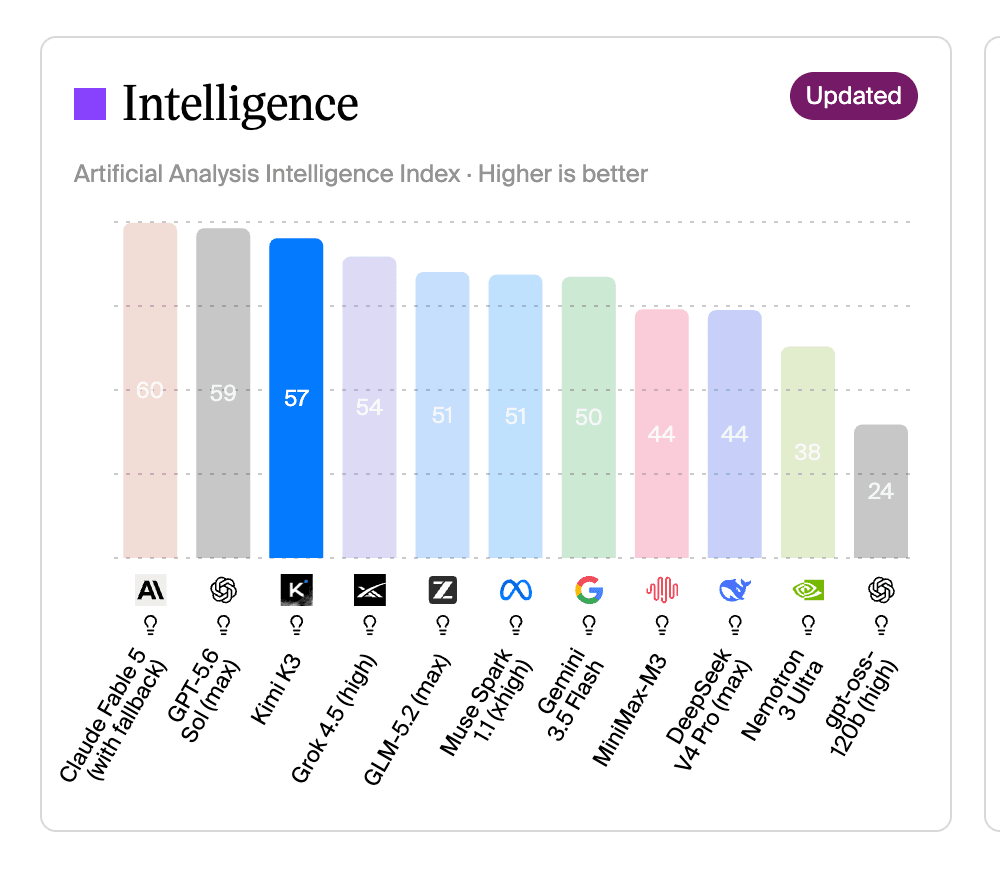
On the independent Artificial Analysis Intelligence Index v4.1, Kimi K3 scored 57.1, behind Claude Fable 5 (59.9, with an Opus 4.8 fallback) and GPT-5.6 Sol Max (58.9), while sitting roughly level with Opus 4.8 on its own (Artificial Analysis). Yet on the Frontend Code Arena, K3 took the #1 spot ahead of Fable 5. Both facts are true at once, which is the whole point of this comparison.
Key Takeaways:
- On the independent Artificial Analysis index, Claude Fable 5 (59.9) still leads Kimi K3 (57.1); K3 sits about level with Opus 4.8.
- K3 ranks #1 on the Frontend Code Arena, ahead of Claude, and self-reports wins over Opus 4.8 on several coding benchmarks.
- Per task, K3 runs about $0.94, roughly half of Claude Opus 4.8, so the old 10x Chinese-price gap is gone but K3 is still cheaper.
- K3 adds a 1M-token context window and open weights (due July 27, 2026); Claude stays closed with more mature tooling.
- No blanket winner: pick K3 for cost-sensitive coding and long context, Claude for production reliability and ecosystem depth.
Kimi K3 vs Claude at a Glance
For the Kimi K3 vs Claude decision, here is the head-to-head in one table. Every benchmark number carries its source, because self-reported and independent figures tell different stories.
| Factor | Kimi K3 | Claude Fable 5 | Claude Opus 4.8 |
|---|---|---|---|
| AA Intelligence Index v4.1 (independent) | 57.1 | 59.9 (Opus 4.8 fallback) | ~level with K3 |
| Frontend Code Arena (independent) | #1 (1679 pts) | below K3 | below K3 |
| Context window | 1,048,576 tokens | smaller standard window | 200K standard |
| Approx. cost per task | ~$0.94 | higher | ~2x K3 |
| Open weights | Yes (due July 27, 2026) | No | No |
| Tooling maturity | Newer, fast-moving | Mature (Claude Code) | Mature |
| Hallucination rate | Up vs predecessor | Baseline | Baseline |
The short read: Claude Fable 5 is still the most capable single model on the broadest test, but Kimi K3 wins specific coding arenas, costs less per task, and brings a 1M-token window and a coming open release Claude does not offer.
What this resolves: the top-line scorecard for Kimi K3 vs Claude. What it leaves unsolved: whether K3's benchmark wins hold up once you separate self-reported from independent numbers. That is the next section.
Kimi K3 Benchmarks: Self-Reported vs Independent
The Kimi K3 benchmarks story only makes sense if you keep two piles apart and label every number.
Start with the independent pile. Artificial Analysis scored K3 at 57.1 on its Intelligence Index v4.1, the #4 tested configuration and effectively the #3 model family, behind Fable 5 and GPT-5.6 Sol but comparable to Opus 4.8 (Artificial Analysis). On the independently run Frontend Code Arena, K3 placed #1 ahead of Claude. Those are the numbers to trust most because no vendor controlled the harness.
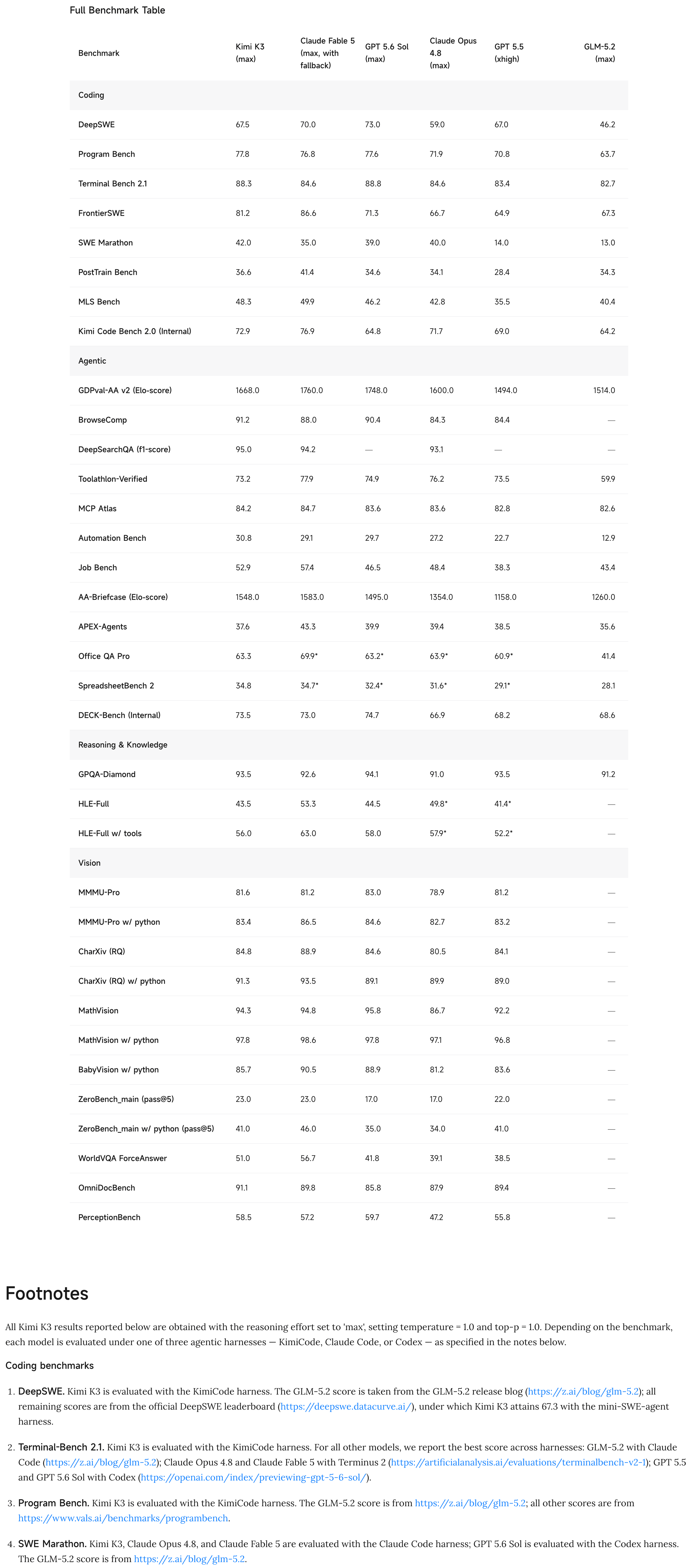
Now the self-reported pile. Moonshot's own table shows Terminal-Bench 2.1 at 88.3, Program Bench at 77.8, SWE Marathon at 42.0, and Kimi Code Bench 2.0 at 72.9, and claims wins over Opus 4.8 Max and GPT-5.5 high on mainstream benchmarks while conceding losses to Fable 5 and GPT-5.6 Sol. Mandatory caveat: Moonshot's comparison table mixes harnesses (KimiCode vs Claude Code vs Codex), so those cross-model rows are not controlled head-to-heads. A number produced under KimiCode is not directly comparable to one produced under Claude Code, and reading them as a clean win over Claude overstates the case.
One caveat runs the other way too. The Decoder reports K3's hallucination rate rose versus its predecessor, citing Artificial Analysis (the-decoder.com). For agent work that acts on its own output, a more confident but more error-prone model is a real risk that a headline benchmark score hides.
What this resolves: how to read K3's wins without conflating vendor and independent tests. What it leaves unsolved: which one actually writes better code, covered next.
Kimi K3 vs Claude Opus and Fable for Coding
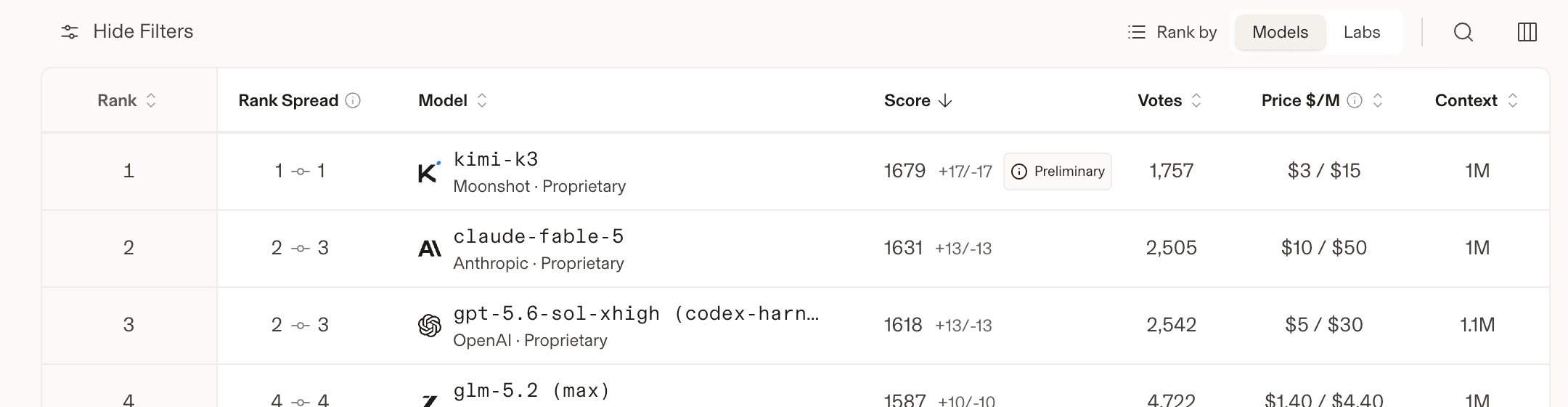
For Kimi K3 vs Claude Opus, coding is where K3 makes its strongest case. It took #1 on the Frontend Code Arena, a 17-place jump from K2.6, and Vercel's team reported K3 leading their web-engineering benchmark ahead of Fable, the first time an open model topped all proprietary ones there. The most striking demo was MiniTriton: K3 built a compact Triton-like compiler from scratch, tile-level IR over MLIR, optimization passes, PTX codegen, that matches or beats Triton and torch.compile on supported roofline benchmarks and sustains end-to-end nanoGPT training convergence.
Anecdotes point the same way but should be read as anecdotes. In one widely shared test on X, AI researcher Jun Song pitted K3 against Opus 4.8 on a Flappy Bird build and called K3 "significantly better," even "Opus 5 level" (single anecdotal test). Take Diego, a game developer who ran his own comparison: K3 generated a fuller scene with textures and lighting than Opus 4.8 on the same prompt, and he switched his prototyping to K3 while keeping Claude for his shipped codebase. That split, K3 for exploration, Claude for production, keeps recurring.
Where Claude still holds ground is depth and reliability over long sessions. Terminal-Bench 2.1 leadership belongs to Fable 5 and GPT-5.6 Sol, and Claude Code remains the more battle-tested agent harness. For how another challenger stacks up against Claude, see Grok 4.5 vs Claude. For Kimi K3 coding, the pattern is clear: K3 is genuinely competitive for greenfield and frontend work, while Claude's edge is trust on code that has to ship and stay up.
What this resolves: where each model wins on actual coding. What it leaves unsolved: whether K3's wins survive contact with the bill, which is a pricing question.
 Arena.ai ✓@arenaBig news: Kimi-K3 is now #1 in the Frontend Code Arena with 1679 pts, surpassing Claude Fable 5. This is a 17-place jump from Kimi-k2.6 (#18 to #1). Kimi-K3 ranked #1 in 6 of 7 domains.17.5K likes · on X, July 2026
 Artificial Analysis ✓@ArtificialAnlysKimi K3 scores 57 on the Artificial Analysis Intelligence Index. Its intelligence is comparable to Opus 4.8 and GPT-5.5 but remains behind Fable 5 and GPT-5.6 Sol. Moonshot AI plans to release the 2.8T parameter model's weights.4.7K likes · on X, July 2026
 wh ✓@nrehiew_Here are a few benchmark scores of K3 that have been officially confirmed. This is a Fable/Sol class model that is strictly better than Opus 4.8 across the board at Sonnet pricing. Insane2.9K likes · on X, July 2026
 Bhavy☄️ ✓@Bhavani_00007I tested Kimi K3 vs Claude Opus 4.8. Same prompt: an armory bay with lighting, props, and detail. It's not even close. Kimi K3 built a full scene with textures, proper lighting, ammo crates, and weapon racks.3.4K likes · on X, July 2026
 BridgeMind ✓@bridgemindaiKimi K3 just beat Fable 5 on the BridgeBench Horror House game test. I did not expect this at all. Kimi K3 is better than Fable 5 at game development and UI design, the two things Fable 5 was supposed to own.2.5K likes · on X, July 2026
 CG ✓@cgtwtsship Kimi K3 → top the Frontend Code Arena → outperform Opus 4.8 on every benchmark → Fable 5 level coding but Sonnet price → release the weights5.4K likes · on X, July 2026
 Theo - t3.gg ✓@theoNormally I don't comment on rumors, but if Kimi K3 actually beats out Opus 4.8 that's nuts. Also hearing Opus 5 might drop?4.3K likes · on X, July 2026
 gus ✓@igus_aiThe CEO of Anthropic, watching China launch a new AI model that beats Claude Opus 4.8 at EVERYTHING, matches Fable 5 while costing 8 TIMES LESS, and on top of that is 100% open source, and being able to do nothing about it.18.8K likes · on X, July 2026 · translated from Spanish
Pricing: Per-Task Cost, Not Per-Token Price
Per-token prices mislead; per-task cost is what you pay. Kimi K3 lists $3.00 per million input tokens and $15.00 per million output, with a $0.30 cache hit. That works out to roughly $0.94 per task, about the cost of GPT-5.6 Sol and roughly half of Claude Opus 4.8.
So K3 is cheaper than Claude, but not by the margin people expect. K3's predecessors held a rough 10x discount over Claude; this pricing ends that. You are no longer choosing K3 because it is dramatically cheaper. You are choosing it because it is competitive on capability and still meaningfully less expensive per task.
The wrinkle is output-heavy agent work. Because K3 charges $15 per million output tokens, a long autonomous run with thousands of tool calls scales with output volume fast. For a chatty, high-output agent, the per-task gap between K3 and Claude narrows. Model the actual token mix of your workload before assuming K3 is the budget option. For a fuller cost breakdown against K3's own predecessor, see our kimi k3 vs k2.6 comparison.
What this resolves: the true cost picture, not the sticker price. What it leaves unsolved: what K3 gives you that Claude simply cannot, covered next.
What Kimi K3 Offers That Claude Doesn't
Two things separate Kimi K3 from Claude regardless of benchmarks. The first is the 1M-token context window as standard, which lets K3 hold an entire mid-size codebase or a long research corpus in a single prompt. The second, and larger, is open weights: Moonshot has promised the full K3 checkpoint by July 27, 2026, which would make it the leading open-weight model and the first in the 3-trillion-parameter class (VentureBeat).
Open weights change the calculus for teams with data-residency, air-gap, or fine-tuning needs that a closed API from Anthropic cannot meet. Consider Lena, a platform engineer at a healthcare startup who cannot send patient-adjacent data to a third-party API: an eventual self-hosted K3 is a path Claude does not offer her at all. That is not a benchmark advantage, it is an availability advantage, and for some buyers it decides everything.
The honest counterweight: open weights you can self-host are only useful if you can run a 2.8T-parameter MoE, which needs serious hardware. For most teams, K3's openness is a future option, not a today convenience, and Claude's managed reliability is the safer default until the weights ship and the tooling matures.
What this resolves: the structural advantages K3 has over Claude that no benchmark captures. What it leaves unsolved: how to turn all of this into an actual pick, which is the verdict.
Is Kimi K3 Better Than Claude? Verdict by Use Case
Is Kimi K3 better than Claude? Not as a blanket statement, and anyone selling you one is skipping the part that matters. Here is the verdict split by what you are actually doing.
| If your priority is... | Better pick | Why |
|---|---|---|
| Frontend / greenfield coding | Kimi K3 | #1 Frontend Code Arena, strong prototyping |
| Production code that must stay up | Claude | Mature Claude Code harness, lower hallucination risk |
| Long-context work (1M tokens) | Kimi K3 | Native 1M window as standard |
| Lowest cost per task | Kimi K3 | ~half of Opus 4.8 per task |
| Highest single-model capability | Claude Fable 5 | Leads the independent AA index |
| Self-hosting / data residency | Kimi K3 | Open weights due July 27, 2026 |
| Output-heavy autonomous agents | Model the tokens | K3's $15 output can erase its price edge |
There is a third option the two-model framing hides. Model leadership now churns every few weeks: K3 today, an Opus 5 rumor already circulating, a new GPT tier next month. If your workflows are wired directly to one model's API, every leaderboard flip is a migration. An agent layer that treats the model as a swappable part absorbs that churn, the same lock-in trap we unpack in the end of model lock-in, so you can route work to whichever model wins this month without rebuilding. That is the shape MoClaw takes: a managed Kimi K3 agent you point at the job while the model underneath keeps changing. It does not make the Kimi K3 vs Claude question go away, it just stops that question from being one you re-answer with an engineering project each time.
What this resolves: a concrete pick for each real scenario. What it leaves unsolved: the edge cases below.
FAQ: Kimi K3 vs Claude
Is Kimi K3 better than Claude for coding?
For frontend and greenfield coding, K3 is genuinely competitive and tops the Frontend Code Arena ahead of Claude. For production code and long agent sessions, Claude's more mature tooling and lower hallucination risk still give it the edge. It is a split decision, not a clean win.
Is Kimi K3 cheaper than Claude?
Yes, but less than you would expect. K3 runs about $0.94 per task, roughly half of Claude Opus 4.8. The old 10x Chinese-model discount is gone, and output-heavy agent workloads can narrow the gap further because K3 charges $15 per million output tokens.
Does Kimi K3 beat Fable 5?
The Kimi K3 vs Fable 5 answer splits by test. On the independent Artificial Analysis Intelligence Index, no: Fable 5 leads at 59.9 to K3's 57.1. On the Frontend Code Arena, yes: K3 ranks #1 ahead of Fable 5. Which one matters depends on your workload.
Is Kimi K3 open source?
Not yet. Moonshot has promised full open weights by July 27, 2026, which Claude does not offer at all. Until the checkpoint ships, K3 is a hosted model like Claude. For the full spec rundown, see what is kimi k3.
What about Kimi K3's agent swarm versus Claude?
K3 ships a dedicated K3 Swarm Max variant for large-scale parallel agents, an architecture Claude does not match directly. We break it down in our kimi k3 agent swarm guide.
Kimi K3 vs Claude: Pick the Model, Keep the Workflow
Weigh Kimi K3 vs Claude and the honest conclusion is that there is no single winner, only a right tool per job. Claude Fable 5 is still the most capable single model on the broadest independent test and the safer default for production. Kimi K3 wins on frontend coding arenas, per-task cost, a 1M-token context window, and a coming open release, with a higher hallucination rate as the asterisk.
The deeper takeaway is that this scoreboard will look different in a month. The teams that stay sane treat the model as a component and invest in the workflow around it, so the next leaderboard flip is a config change, not a rebuild. From here, get the full picture with what is kimi k3, see how the kimi k3 agent swarm handles parallel work, or check the upgrade math in kimi k3 vs k2.6.
Continue Reading
More Comparison
Kimi K3 vs K2.6: What Changed & Upgrade?

ChatGPT Work vs Codex: Which Should Non-Developers Use?

Grok 4.5 vs Claude: Benchmarks & Pricing
OpenClaw Slack vs Claude Tag for Team Agents

Generative AI vs AI Agents vs Agentic AI

Claude Tag Alternative: Tag an AI for $20/mo
The MoClaw editorial team writes about workflow automation, AI agents, and the tools we build. Default byline for industry overviews, listicles, and collaborative pieces.
Use Kimi K3 on MoClaw, without the setup
Run Kimi K3 as an always-on managed agent with memory, your tools, and scheduling. No API wiring, no plan gating, no self-hosting.
References: Kimi K3 on Artificial Analysis (Intelligence Index v4.1) · Kimi's open model K3 nears GPT-5.6 Sol and Fable 5 (The Decoder) · China's Moonshot AI releases Kimi K3, the largest open-source model ever (VentureBeat) · Anthropic (Claude) · Kimi K3, and what we can still learn from the pelican benchmark (Simon Willison)