AI Chatbot vs AI Agent: Who Carries the Work?
AI chatbot vs AI agent: the split is not the chat box, it is the handoff. Learn which one your workflow needs by stakes, tools, memory, and review.
Table of Contents
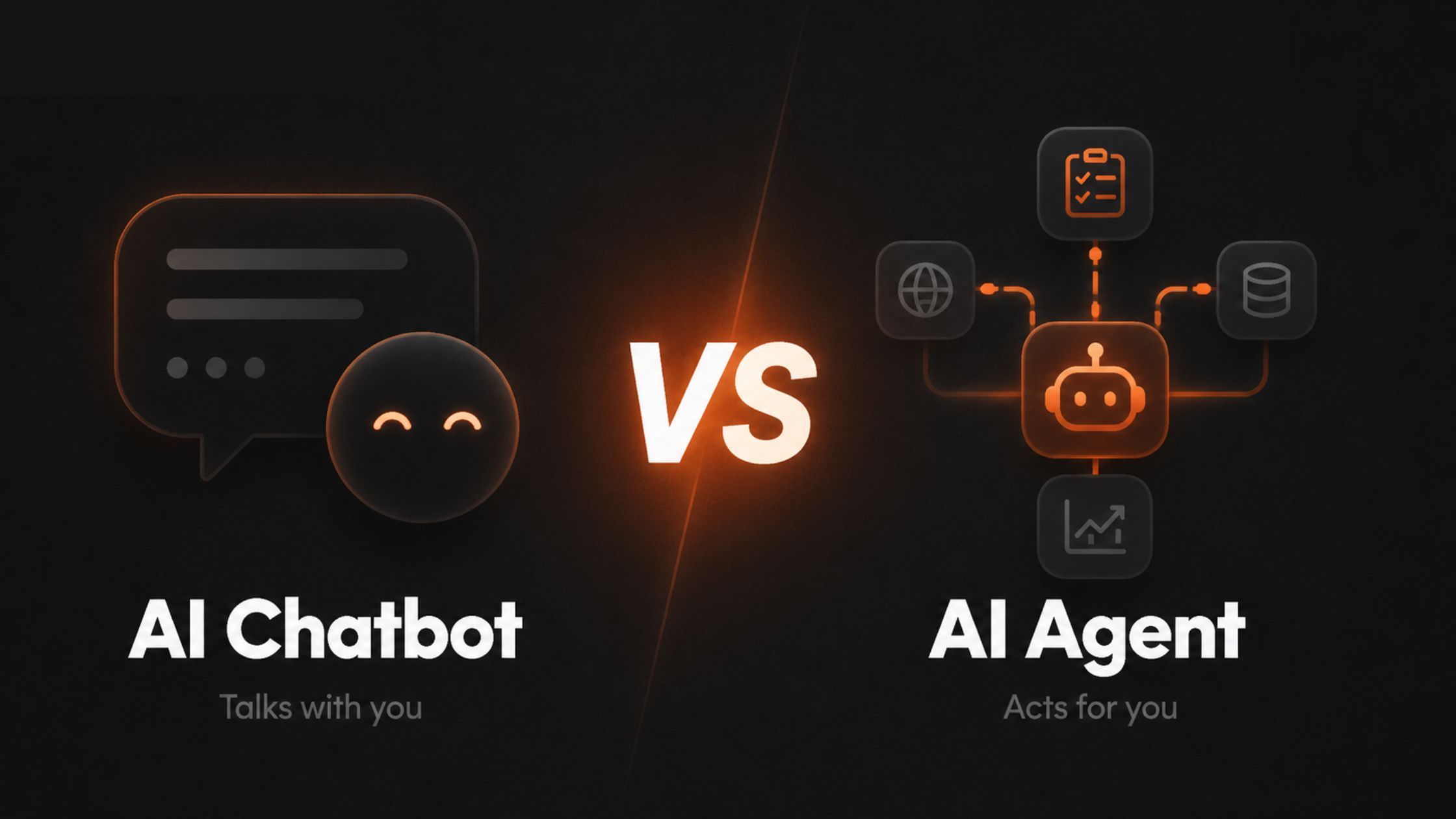
The AI chatbot vs AI agent question comes down to one line: an AI chatbot answers, an AI agent acts. A chatbot helps you draft, summarize, compare, or explain through conversation, and the task ends with its reply. An AI agent takes an outcome, keeps context, uses tools and rules, and carries part of the workflow until it reaches a defined stopping point. The category does not split at the prompt. It splits at the handoff.
Gartner predicts more than 40% of agentic AI projects will be canceled by the end of 2027, largely because teams buy autonomy before the workflow is ready for it. Most founders do not confuse chatbots and agents because they misunderstand AI. They confuse them because the products look identical at the moment of use: a chat box opens, you type, it replies. From that surface, "AI agent" can read like a new label for the same old chatbot.
Key Takeaways:
- A chatbot supports the person doing the work; an agent can carry part of the work itself.
- The dividing line is the handoff, not the chat interface. Judge what happens after the first response, not the response.
- Use a chatbot when the task ends with an answer. Use an agent when the answer starts more work that needs tools, sources, or repeatability.
- Most tools labeled "agents" are chatbots with tool access. Test for task state, boundary control, and recovery, not branding.
- Match control to capability: the more a system can do, the more clearly you define what it must not.
Quick Answer: AI Chatbot vs AI Agent
The AI chatbot vs AI agent distinction is easiest to see in one place: what each one leaves on your plate. An AI chatbot helps you answer, draft, summarize, explain, or compare through conversation. It works best when the task ends with a response. Definitional sources like IBM on chatbots and Salesforce on what an AI chatbot is frame it the same way: the value is the reply.
An AI agent helps when the response starts more work. It can use context, tools, rules, and review points to carry out defined parts of a workflow. A chatbot supports the person doing the work. An agent can carry part of the work itself.
Section summary: If the task ends with a useful reply, you want a chatbot. If the reply is only the start, you want an agent.
AI Chatbot vs AI Agent: The Core Difference Is the Handoff
The real differences show up in how each system takes instructions, uses context, handles tools, and returns results. It is best understood layer by layer, not by how the response sounds. Zendesk's breakdown of agents versus chatbots lands on the same seam.
Goal: request vs outcome. A chatbot is enough when the task ends with a summary, a draft, a comparison, or a rewrite. An agent makes sense when the task has a target beyond the response and the system has to move the work closer to a usable result.
Input: prompt vs operating brief. A chatbot depends on what you ask; vague request, vague answer. An agent needs an operating brief: which files to use, which tools to check, what rules apply, which sources to trust, and what a good result looks like. Without that context, it can sound helpful while producing work the team cannot trust.
Process: conversation vs task execution. Conversation works when you want control of each turn: ask, review, adjust, ask again. An agent breaks the goal into steps and keeps moving until it hits a defined stopping point.
Tools: suggestions vs system actions. A chatbot tells you what to update and where to look; you still leave the chat and do it. An agent, within approved boundaries, connects to tools, reads files, searches sources, and prepares outputs. Slack's framing of the business impact makes the same distinction.
Memory: chat recall vs work tracking. Chat history keeps a conversation coherent. Agentic workflows need to track what was checked, what failed, what is pending, and where the open questions are. When the system tracks that state, you stop managing it like a project and start reviewing it like a result.
Risk: wrong answer vs wrong action. A wrong answer usually waits for a person to carry it into the workflow. A wrong step can modify records, files, or messages before anyone notices. That does not make agents unsafe; it means control has to match capability, an approach Anthropic's guidance on building effective agents treats as a first principle.
Section summary: Six layers, one rule: the more a system can do, the more clearly you need to define what it should not.
The Work Ladder: When a Chatbot Stops Being Enough
Not every task needs an agent. The ladder shows where each tool fits based on the shape of the work, from answering a question (chatbot) up to running repeatable workflows with review points (agent). The jump happens when the task stops being answer-shaped and starts needing sources, structure, tools, or repeatability.
Consider Marcus, a solo brand consultant who drafts roughly 15 client proposals a month in ChatGPT. Each one ends when he copies the text into a doc and edits it. Bolting an agent onto that would add setup, monitoring, and cost with no payback, because the work already ends inside the conversation. For Marcus, the chatbot is not a compromise. It is the correct tool.
Section summary: Climb the ladder only when friction shows up after the answer. Below that line, a chatbot wins on cost and simplicity.
Why Most "AI Agents" Are Still Just Chatbots
Most tools labeled "agents" fail for a simple reason: the label is easier to add than the capability. First, the demos are too clean, completing a narrow task with perfect context and never showing what happens when details are missing or a step breaks. Second, tool access gets mistaken for agency: searching a site or reading a file is useful, but it does not prove the system knows when to use a tool or what to do when the result is weak. Third, the architecture is often incomplete, missing task state, permissions, workflow logic, stopping rules, and recovery.
The market stretched the word "agent" because it rewarded the label before the capability was clear. Salesforce's own agent-versus-chatbot comparison is part of a wider scramble to define the term. That is why buyers should test behavior, not branding.
The Fake-AI-Agent Test. Look for: task state (tracks done, pending, failed, needs review), tool judgment (uses tools for a reason, not because asked), context handling (asks for missing details instead of guessing), boundary control (pauses before sending, editing, or deleting anything important), output readiness (returns reviewable work, not instructions to finish), and recovery (adjusts when a source fails or the task changes).
Section summary: Agent washing is real. The first response is the wrong thing to judge; assess what happens after it.
AI Chatbot vs AI Agent on One Task: A Lead Research Example
Lead research is a useful stress test because the gap is easy to see. Take Priya, a two-person B2B SaaS founder who needed about 50 qualified prospects a week with fit signals, source links, and decision-maker roles. By hand it cost her hours every Monday across LinkedIn and Crunchbase: search, verify titles, copy into a sheet, drop weak matches, clean the format.
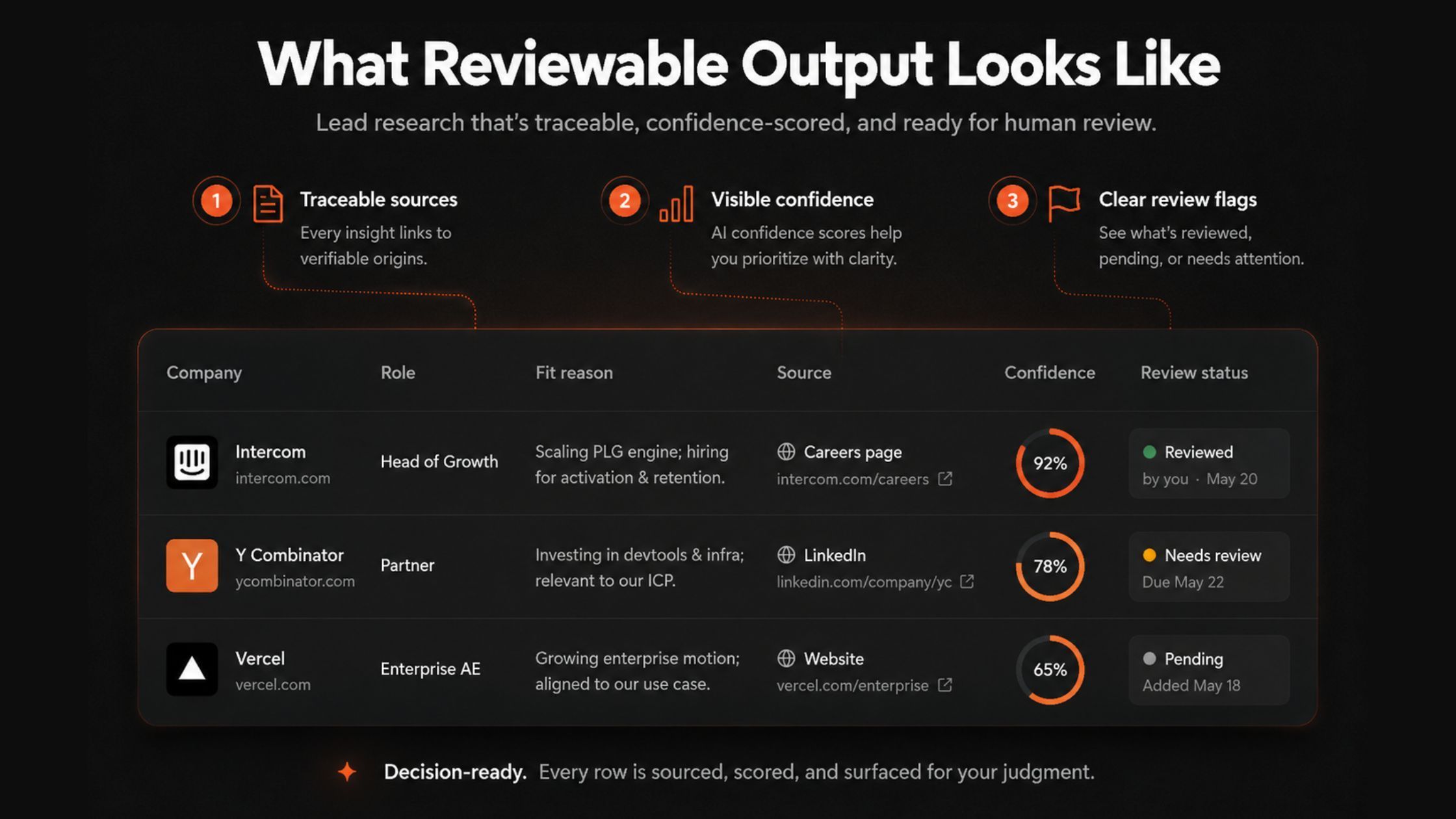
Ask a chatbot and it gives her a solid method: define an ICP, suggest where to search, list signals worth checking, draft outreach angles. She still runs the whole process. Give the same task to an agent with clear rules (ICP, qualification criteria, excluded categories, required fields, output format) and the first pass comes back as a structured, reviewable list rather than a method. This is not hypothetical. In a documented MoClaw run, the research prompt returned 20 directionally-strong leads in 9 minutes (about 2,900 credits), and a full research-plus-audit pass delivered a sortable spreadsheet with source links in under 30 minutes for about 6,600 credits, against roughly 4 hours of manual work across Apollo, Crunchbase, and LinkedIn Sales Navigator (full write-up). The output is not the final judgment. It is a structured first pass the team can inspect faster than building from scratch.
The best agent output is not confident. It is auditable: company names, decision-maker roles, qualification reasons, source links, confidence notes, and a clear flag for anything that needs human judgment before it moves forward. For a closer look at how this plays out, see our guide on how I found 15+ qualified leads with MoClaw.
Section summary: Same task, different finish line. The chatbot hands back a method; the agent hands back reviewable work.
The Three Biggest Mistakes Startup Teams Make
Most AI failures come from unclear workflows and wrong use cases, not weak models.
Buying autonomy before mapping the workflow. An agent cannot execute a process your team has not clarified. If the inputs, rules, and success criteria are vague, you are automating confusion, not eliminating it.
Mistaking a chat window for real integration. An intuitive interface does not mean the system can navigate your CRM, inboxes, or internal files. Many products have a conversational front end with no real connection to the tools where the work actually lives.
Skipping guardrails on high-stakes tasks. A 12-person fintech once let an agent update customer records directly; one wrong field rule touched 80 accounts before anyone caught it. Updating an internal draft is not the same as changing a customer record, sending a client message, or modifying payment data. Define where human approval is required before you hand over the keys.
Section summary: The failure mode is workflow design, not the model. Map the process, integrate for real, and gate the high-stakes steps.
How to Choose Between an AI Chatbot and an AI Agent: A Founder's Framework
The right question is not "AI chatbot or agent?" It is where the work actually gets stuck. Work through five questions before committing to either path: Volume (does this happen often enough to justify setup?), Stakes (what breaks if it gets it wrong?), Inputs (are the rules, sources, and success criteria clear enough to brief a system?), Review (can a human approve the output before risk increases?), and Payback (will the time saved beat the cost of setup, monitoring, and occasional fixes?).
A chatbot is genuinely the right answer when the work ends inside the conversation: drafting, summarizing, explaining, rewriting, with low stakes and no external tools. An agent earns its place when a human has to keep pushing the workflow forward at every step, especially for tasks that repeat on a schedule, need live data or external tools, span multiple systems, or need structured output ready for review. Open-source frameworks like LangChain exist precisely for that second category.
Section summary: Do not pick by capability. Pick by where the friction sits after the system runs.
Where MoClaw Fits: When Advice Is Not Enough
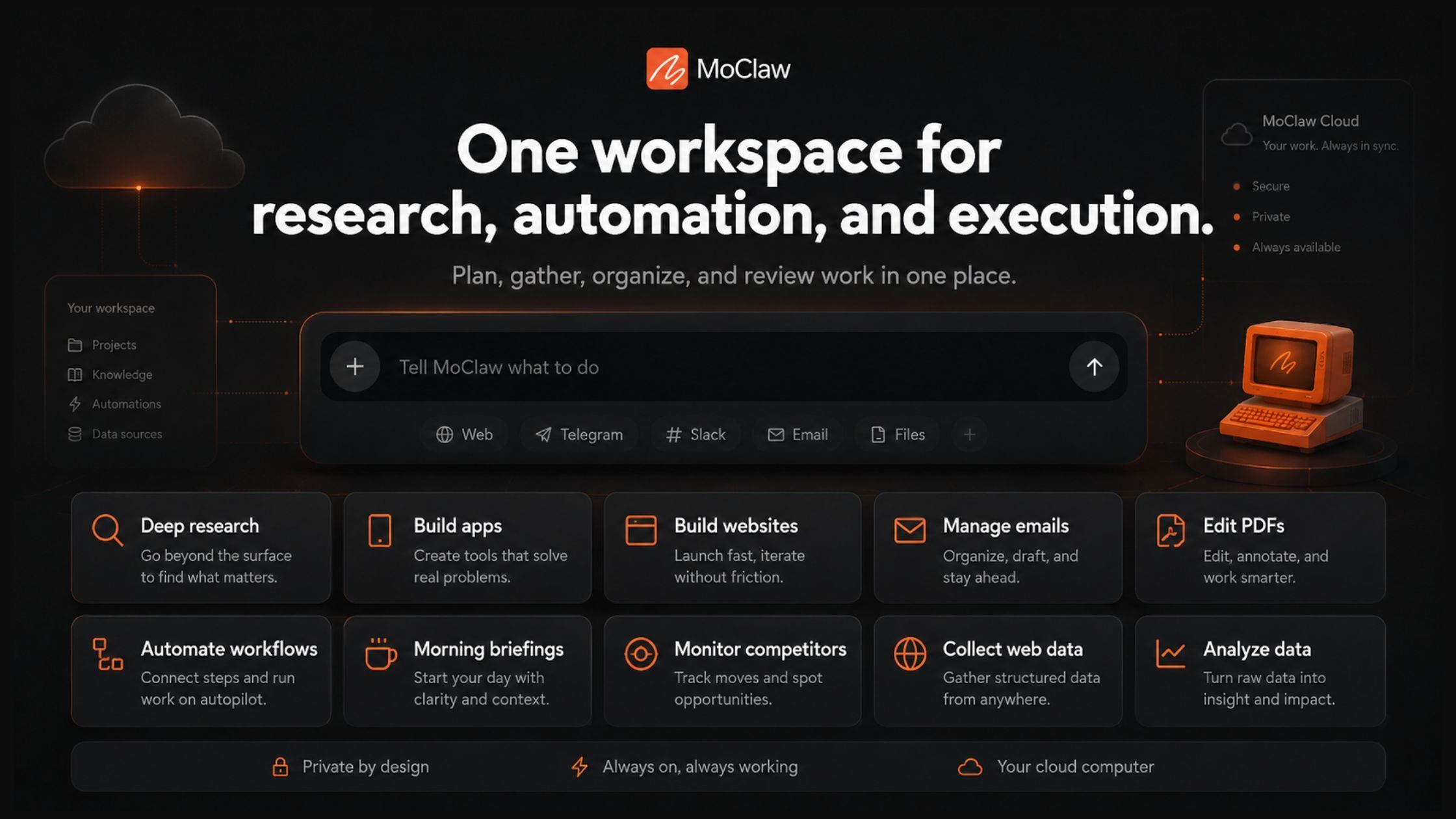
MoClaw fits when the task is clear but the execution is spread across browsers, files, schedules, and connected tools. It gives AI a real operating environment: browsers to navigate, files to work with, scheduled tasks to run, context to retain, and structured results to return for review. Instead of taking an answer and figuring out the next five steps yourself, you define the task once and review what comes back.
MoClaw is strongest when the work is recurring, source-heavy, and easier to review than to build from scratch: competitor monitoring, lead research and qualification, weekly briefings from multiple sources, inbox triage, content source gathering, and sales account research before outreach. These tasks follow clear rules, produce tangible outputs, and benefit from running without manual coordination at every step. You can see more patterns in our use-case library and blog, or compare plans on the pricing page.
Section summary: When the bottleneck is execution across tools rather than understanding, an operating environment beats one more answer.
FAQ
Is ChatGPT an AI chatbot or an AI agent?
It depends on how it is used. In a basic chat setup it acts like a chatbot, responding to prompts and leaving the next step to you. Connected to tools, files, browsing, or external systems, it can support more agent-like workflows.
Can a chatbot become an AI agent with the right prompts?
No. Better prompts improve the response, but they do not create tool access, task state, workflow logic, permissions, or stopping rules.
Do AI agents always need access to business tools?
Not always. Some agent workflows only need public sources or uploaded files. Business-tool access becomes necessary when the task requires internal records, customer data, inboxes, CRMs, or operational systems.
Are AI agents safe to run on important data?
They can be, when control matches capability: clear permissions, defined limits, review points before high-stakes actions, and logs. The risk is not the model; it is handing over an action without a guardrail.
AI Chatbot vs AI Agent: Choose by Workflow, Not Capability
Most teams lose time because every answer creates another chain of work: source checks, format cleanup, tool switching, follow-up, handoff. The real question before choosing any AI tool is not "which one is more capable?" It is this: after the system runs, is there less of that chain sitting on your plate? If the answer is no, you do not have the wrong model. You have the wrong workflow design. Framed that way, the AI chatbot vs AI agent choice is less about which model is smarter and more about which one carries the next step.
Try MoClaw free and see what shifts when AI works through the task rather than just explaining it.
Continue Reading
More Comparison
Generative AI vs AI Agents vs Agentic AI

Best AI Automation Tool in 2026: Honest Cost-at-Scale Picks

Lindy vs MoClaw: Teammate or Cloud Computer?
DeepSeek vs ChatGPT: Research, Code, Price

ChatGPT vs Microsoft Copilot: Which Fits You?

Gemini vs ChatGPT for Work: Which Is Better?
The MoClaw editorial team writes about workflow automation, AI agents, and the tools we build. Default byline for industry overviews, listicles, and collaborative pieces.
Choosing between tools? Let MoClaw run the work.
Always-on AI assistant on its own cloud computer. No switching required, no setup.
References: IBM: What is a chatbot? · IBM: What are AI agents? · Salesforce: AI Agent vs Chatbot · Zendesk: AI agents vs AI chatbots · Slack: AI agent vs chatbot business impact · Anthropic: Building effective agents · Gartner: 40%+ of agentic AI projects canceled by 2027