Voice Assistant vs Voice Agent: What Changes?

Voice assistant vs voice agent explained: why listening, deciding, tool use, human review, and cloud execution change what voice AI can do at work.
Table of Contents
Voice assistant vs voice agent is the difference between voice AI that answers a request and voice AI that can interpret the request, choose tools, create a task record, and move work toward completion.
Key takeaways:
- A real-time voice assistant helps with spoken answers, reminders, search, or simple commands.
- A voice agent is closer to tool-using voice AI because it can start structured work after the conversation.
- Voice alone is not enough for reliable execution. The workflow still needs cloud context, logs, files, approvals, and handoff.
- Human review matters most when voice agent automation can send, buy, delete, update, publish, or change records.
- The best voice experience is not the one that talks the most. It is the one that knows when to stop and create a reviewable task.
I started taking voice AI more seriously when I noticed how often my spoken requests were not really "questions." I was saying things like, "Check that customer thread and draft the follow-up," or "Look at the latest pricing pages and tell me what changed." A normal assistant can answer part of that. An AI that takes action needs a layer of work behind the voice.
Quick Difference: Answering vs Acting
A voice assistant usually listens, responds, and maybe performs a simple command. It can answer a question, set a timer, search the web, summarize a message, or start a basic app action. The main output is the spoken response.
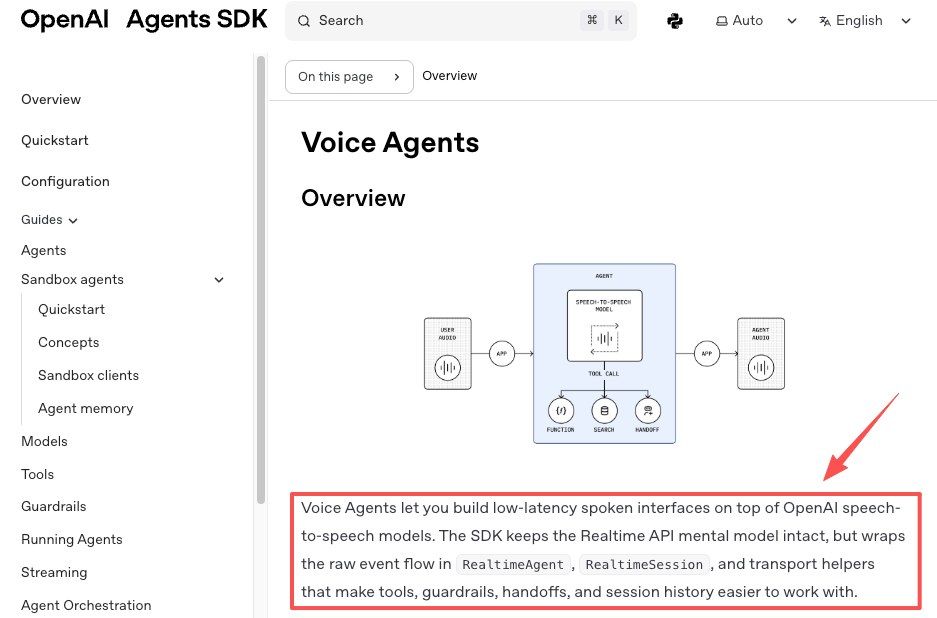
A voice agent changes jobs. It listens for intent, selects tools, performs structured steps, saves evidence, and hands off a result after the conversation ends. OpenAI's voice agent stack lets you build low-latency spoken interfaces with tools, guardrails, handoffs, and session history, which is an important shift: the voice interface is only the entry point.
The difference is practical. "What's on my calendar?" is assistant-shaped. "Find a time with Maya, draft the agenda from last week's notes, and wait for my approval before sending" is agent-shaped.
What Makes a Voice Agent Different
A voice agent is not just a better microphone or a more natural speaker. It changes the workflow after the words are captured.
Listening and intent capture
Listening is not only transcription. A voice agent has to capture intent, constraints, missing details, and risk. If I say, "Send the revised deck to the client," the system should know that "the client," "the revised deck," and "send" are not safe assumptions.
The agent should ask follow-up questions when the intent is under-specified. Which client? Which deck version? Email or shared folder? Should it send now or prepare a draft? In voice workflows, clarification matters because spoken requests are often casual and incomplete.
Tool selection and structured actions
A voice agent becomes useful when it can choose the right tool for the job. That may mean opening a calendar, searching a workspace, checking a browser page, reading a file, drafting a reply, or creating a task.
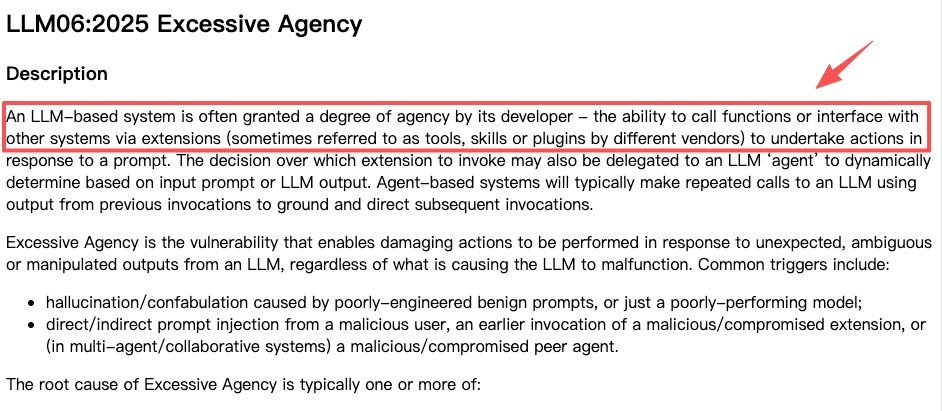
This is also where risk begins. OWASP describes excessive agency as a risk when an LLM-based system can call tools or interface with other systems and perform actions based on ambiguous or manipulated outputs. In voice, ambiguity is normal, so tool access should be narrow, logged, and reviewable.
Result handoff after the conversation
A normal voice assistant often ends when the call ends. A voice agent should leave something behind: a task record, draft, file, summary, source list, notification, or approval request.
That handoff is what makes voice agent automation useful for real work. If the user cannot find what happened after the conversation, the agent did not complete the operational loop. It only sounded helpful.
Why Voice Alone Is Not Enough
Voice is a convenient input, not a complete work system. It is fast for giving intent, but weak for reviewing exact details. Nobody wants to approve a long invoice number, file path, legal clause, or customer list entirely by ear.
For example, I might say, "Compare Zendesk, Intercom, and Help Scout for our support team. Focus on price, seat limits, data retention, admin controls, and whether each one supports our current help center workflow." Voice is a good way to start that task because the intent is simple.
It is a bad way to finish the task. I should not approve a vendor recommendation just by listening to the agent read back prices, contract caveats, security notes, and migration risks. The agent should move the work into a visible artifact: a comparison table with source links, a short recommendation, open questions, and an approval checklist.
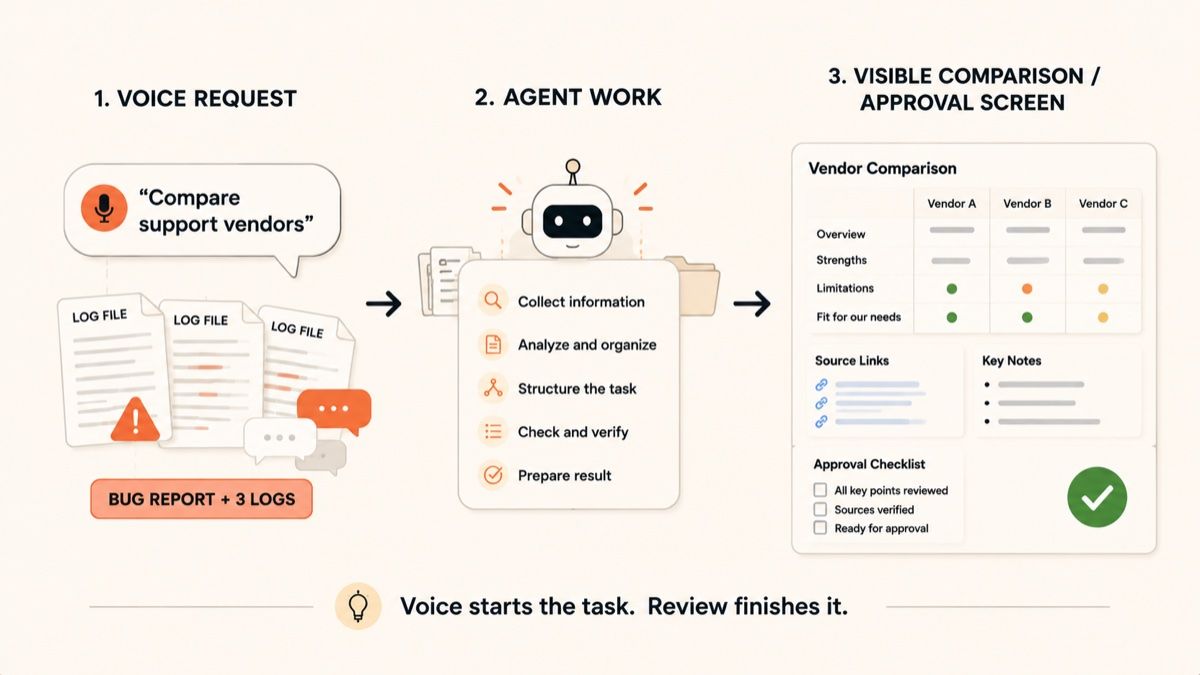
This is why a voice agent should not try to finish everything in the live conversation. Some work belongs after the call, where the user can inspect details calmly before anything is purchased, shared, updated, or signed.
Where Cloud Execution Fits
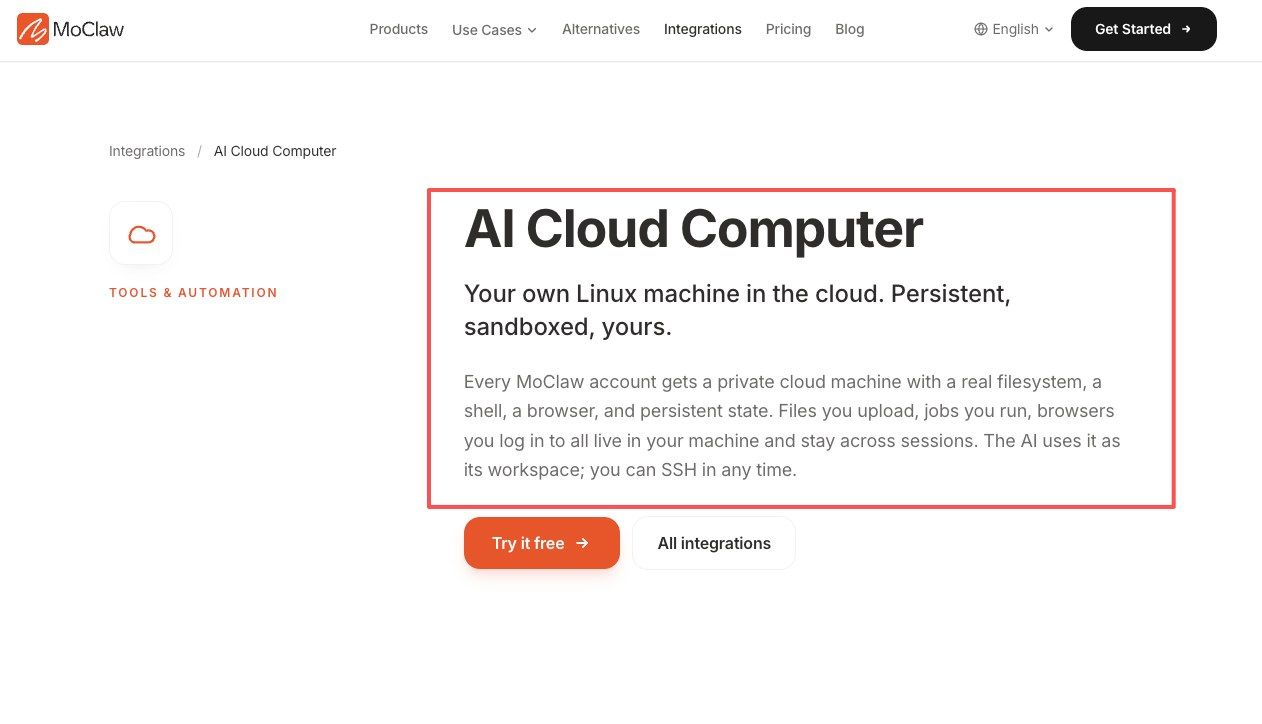
Cloud execution is the layer that turns a voice-started request into durable work. It gives the agent somewhere to run browser checks, manage files, store logs, and continue after the user stops talking.
MoClaw's AI workflow automation is a useful reference for this layer because recurring digital work usually needs browser tasks, files, reports, schedules, and review records. A voice agent can start the job, but the cloud workspace carries the job.
For teams thinking about voice plus execution, MoClaw's AI Cloud Computer integration is the more relevant internal layer than a chat transcript. The important idea is persistence: the task should have a place to run, pause, show evidence, and hand back a result.
A realistic workflow looks like this: I say, "Check our five approved competitor sources: pricing page, changelog, product update blog, help-center article, and status page. Tell me what changed since last Monday." The voice layer captures the request. The cloud layer opens the approved links, records timestamps, compares the current pages with the last saved notes, and separates confirmed changes from unclear signals. Then it drafts a short summary with source links, open questions, and a review checklist before anything is shared.
That is very different from a spoken answer generated on the spot. The value is not that the agent talks back quickly. The value is that it turns a voice request into reviewable work.
Limits, Mishearing, and Human Review
Voice agents need stronger review rules because speech creates extra failure modes. They can mishear names, dates, numbers, account labels, commands, or urgency. They can also infer too much from a casual phrase.
NIST's AI Risk Management Framework emphasizes continuous governance, mapping, measurement, and management of AI risk across the system lifecycle. That mindset fits voice agents well because the risk is not only the model response. It is the whole chain: audio capture, intent interpretation, tool selection, action, record, and review.
Human review should be required before any voice-started task sends an external message, updates a system of record, buys something, deletes data, changes permissions, publishes content, or affects a customer. For low-risk work, the agent can draft and queue. For higher-risk work, it should wait.
The safest pattern is "voice to draft, text to confirm, logs to audit." Let users start by speaking. Let them approve in a visible interface. Keep the record after the conversation.
FAQ
Can a voice-started task continue on another device?
Yes, if the system creates a persistent task record that is not tied only to the live voice session. The user should be able to start by phone, review on desktop, and receive the final artifact in the normal workspace. Without that record, cross-device continuation becomes fragile.
How should users find the task record after the call?
The agent should send or save a clear task card with the title, timestamp, requester, source list, current status, next approval step, and output location. A transcript alone is not enough. The user needs an operational record, not just a conversation memory.
When should a voice agent send an async notification?
Send an async notification when the task needs review, hits a blocker, completes a draft, detects a risk, or is about to miss the expected delivery time. Avoid notifications for every minor step. Good voice agent automation should reduce attention load, not create a new alert stream.
Can a user cancel a task by text after starting it by voice?
Yes, if the workflow supports shared task state across input modes. The cancellation should be logged with time, user, channel, and affected task. For higher-risk actions, the system should confirm whether any step has already run, especially if the agent touched files, messages, or external systems.
Voice Agents Need a Work Layer After the Call
The real change in voice assistant vs voice agent is not personality or speech quality. It is an execution design. A real-time voice assistant can make interaction feel natural, but a voice agent needs tools, cloud context, logs, review gates, and a clear handoff after the conversation. Voice is the front door. The work layer is what makes the task trustworthy.
Vera Note: This article compares voice AI workflow patterns rather than ranking specific products. Product capabilities, availability, and permissions should be verified against current official documentation.
Continue Reading
More Comparison
Lindy vs MoClaw: Teammate or Cloud Computer?

DeepSeek vs ChatGPT: Research, Code, Price

ChatGPT vs Microsoft Copilot: Which Fits You?

Gemini vs ChatGPT for Work: Which Is Better?

Cursor Cloud Agent vs Grok Bot

GPT-5.6 Sol vs Terra vs Luna: Pick One
The MoClaw editorial team writes about workflow automation, AI agents, and the tools we build. Default byline for industry overviews, listicles, and collaborative pieces.
Choosing between tools? Let MoClaw run the work.
Always-on AI assistant on its own cloud computer. No switching required, no setup.
References: OpenAI Agents SDK — Voice agents · OWASP — LLM06 Excessive Agency · NIST — AI Risk Management Framework