8 Best AI SRE Tools for Incident Response

AI SRE tools investigate alerts, find root causes, and automate incident response. We compare 8 tools, from open-source agents to platform-native AI.
Table of Contents
AI SRE tools are software agents that investigate alerts, correlate telemetry, propose or execute root-cause fixes, and cut the manual toil out of incident response. The best ones in 2026 fall into three lanes: pure autonomous SRE agents that investigate on their own, observability platforms that bolted on an AI investigator, and incident-management tools that added AI to an existing workflow.
The category exploded in under two years. The community-maintained awesome-ai-sre list now tracks over 100 tools and resources across autonomous agents, AIOps, and self-healing infrastructure, which is both the good news and the problem: there is a tool for every situation, and no obvious way to tell them apart. This guide compares eight that represent the real spread of the market, with every vendor performance number labeled as exactly that, a vendor claim, not a benchmark.
Key Takeaways:
- AI SRE tools sort into three lanes: autonomous agents (Flawless, Cleric, Resolve.ai, Komodor), observability add-ons (Datadog Bits AI, Middleware OpsAI), and incident-management-with-AI (PagerDuty, incident.io).
- The sharpest divide is remediation stance: read-only investigators, human-approval-gated executors, and fully autonomous remediators are three different risk profiles.
- Vendor-reported numbers are strong (Datadog claims investigations in about 3 to 4 minutes; Komodor claims up to 80% MTTR reduction; Middleware claims 6x to 10x faster time-to-resolution) but none are independently benchmarked.
- Match the tool to your binding constraint: investigation depth, your existing observability stack, or your incident process.
- General-purpose agents are not root-cause engines. They cover the surrounding work: postmortems, runbook docs, and status-page comms.
What Is AI SRE?
AI SRE means applying AI agents to site reliability engineering: the work of keeping production systems up, investigating what broke when they are not, and reducing mean time to resolution. The phrase "agentic ops" (or AgenticOps) describes the same shift, from dashboards a human reads to agents that read the dashboards for you and reason about what they see.
The reason 2026 is the year is capability spillover. The same reasoning and tool-use that made coding agents useful turned out to map cleanly onto on-call work: read an alert, query the metrics, form a hypothesis, check it against logs, and report a cause. That loop is an SRE's job, and it is exactly what a modern agent can now run.
The landscape sorts into three lanes, and keeping them straight is the whole game:
- Pure autonomous SRE agents. Purpose-built to investigate and, in some cases, remediate on their own. Flawless, Cleric, Resolve.ai, and Komodor live here.
- Observability-platform add-ons. An AI investigator built into a monitoring platform you may already run. Datadog Bits AI and Middleware OpsAI are the clearest examples, with OpsAI going further into autonomous remediation.
- Incident-management with AI features. Tools that own your on-call process and incident comms, now with AI layered on. PagerDuty and incident.io lead this lane.
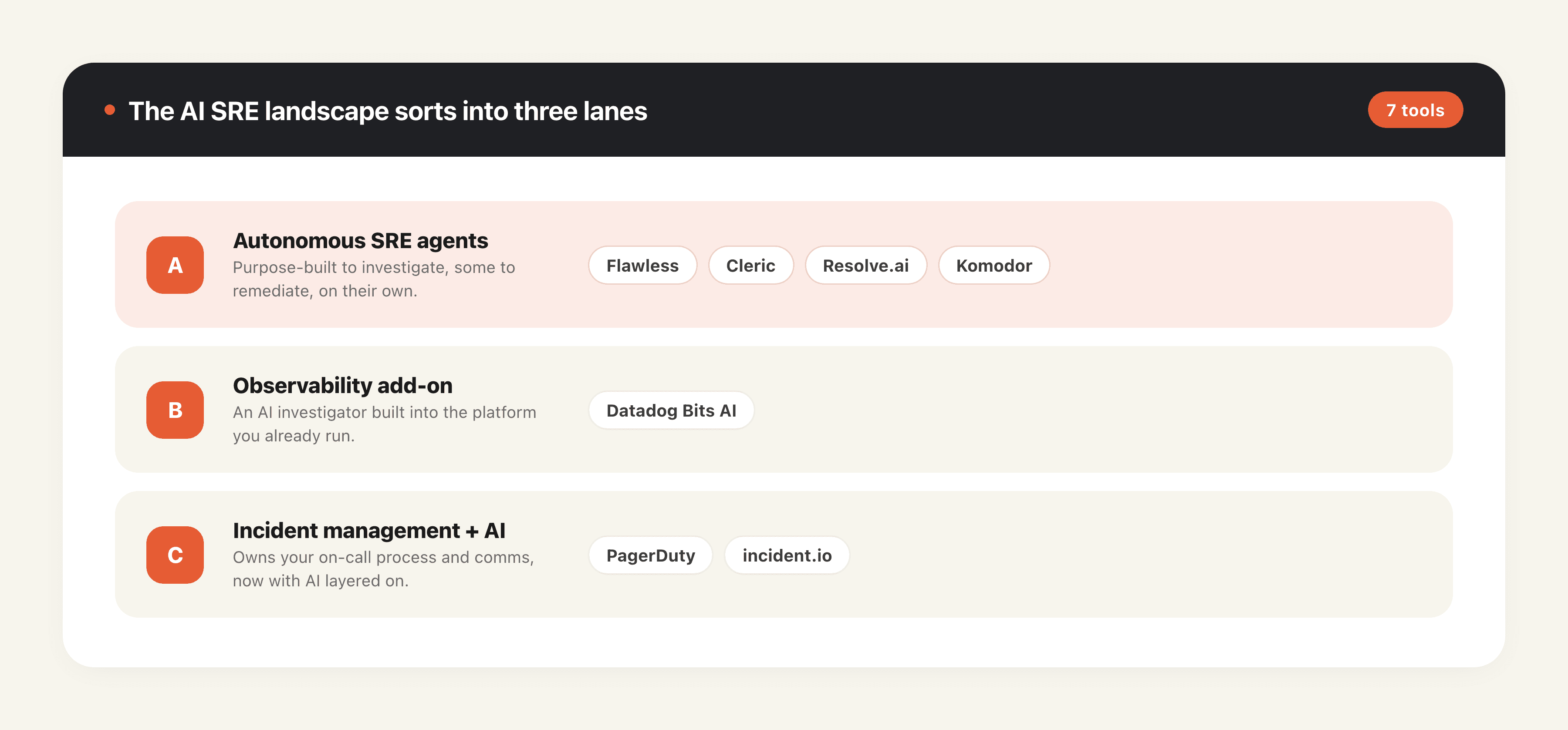
What this resolved: A definition and a three-lane map to sort every tool by.
What it left unsolved: The lanes are converging. Incident-management tools are growing autonomous agents, so the labels blur at the edges.
What engineers are actually saying. The shift is not just vendor decks. Here is a slice of the real conversation on X right now, founders shipping self-healing tools, practitioners building on-call agents, a big platform vendor, and a healthy dose of skeptics:
In 2026, software moves fast.
But monitoring and observability are still manual and slow.
@sazabi is a next-generation observability platform for fast-moving engineering teams.
Not another AI SRE.
Not another LLM observability tool.
A new, general sol…
This is Google SRE. The team that invented Site Reliability Engineering 20 years ago. Every major tech company copied their model. Now they just published exactly how they are rebuilding it with agentic AI.
Here is…
Check it out →
Most incident responses typically require site reliability engineers to:
• Jump between logs, metrics, and traces
• G…
The setup took 37 minutes.
It's all in a new workshop. One of their engineers builds an incident-response agent from scratch, on camera. Writes the instructions, gives it tools and a runtime, wires up a session that streams every…
As organizations deploy more pipelines, models, dashboards, and apps, maintaining production workloads has become a growing challenge. Genie ZeroOps mo…
I'd do this.
Stage 1: Python + Observability Foundations
asyncio, FastAPI, structured logging, OpenTelemetry, Prometheus metrics, distributed tracing basics.
Stage 2: AI System Failure Modes
Hallucinations, context overflow, tool failures, r…
Isabella He walked through building a hosted incident investigator: subagents, memory, the whole server-side loop, defined in their console.
it's a clean look at where agents are going. it's also hosted, on their infrastructure.
you can…
➜ AI writes all your Terraform, pipelines run themselves
➜ One prompt and the entire infrastructure is deployed
➜ Kubernetes self-heals everything automatically
➜ GitOps means you never touch production manually again
➜ Agentic AI handles incidents…
The 8 Best AI SRE Tools in 2026
These eight cover the full spread, from a source-available agent you host yourself to fully autonomous platform-native AI. Read the remediation stance for each closely, because that is what determines how much you can actually trust it in production.
1. Flawless (open lane, self-hosted AgenticOps)
Flawless is, per its README, "an AI-native SRE control plane for Kubernetes and cloud infrastructure" that connects "alerts, evidence, topology, human approval, controlled remediation, and recovery verification in one auditable AgenticOps loop." Its pitch is that "your infrastructure can explain itself, heal safely, and prove it recovered," running a discover, diagnose, preview, approve, execute, verify, learn cycle.
Standout capability: it is the representative of lane A you can actually run yourself and read the source of. One correction worth making up front, because it matters for procurement: Flawless is source-available, not OSI open-source. It ships under the PolyForm Noncommercial License, so commercial use requires authorization. Remediation is gated on explicit human approval, which makes it a safer starting point than a fully autonomous agent. Best for Kubernetes-heavy teams that want an auditable, self-hosted agent and can live with the noncommercial license.
2. Datadog Bits AI SRE (observability add-on)
Bits AI SRE is Datadog's autonomous investigator, generally available and built directly into the platform. Its standout mechanic is a hypothesis-testing loop: per Datadog, Bits "dynamically generates multiple root cause hypotheses and tests them by querying data across your environment," then classifies each hypothesis as "validated, invalidated, or inconclusive." That last label is the honest touch, an agent that will admit when it does not know.
Datadog reports investigations completing "in approximately 3-4 minutes" and services restored "90% faster," both vendor-reported figures, not independent benchmarks. Deployment is SaaS, inside Datadog. Best for teams already standardized on Datadog, where the agent has native access to all your telemetry on day one.
3. Middleware OpsAI (observability-native, autonomous remediation)
Middleware OpsAI is built directly on Middleware's full-stack observability platform, correlating APM, RUM, logs, and Kubernetes telemetry to trace an incident to the exact line of code and open a pull request with the fix. Unlike a bolted-on investigator, it also ingests third-party alerts from Datadog and Grafana, so teams can run it without migrating off their existing stack.
Standout capability: it closes the loop that other tools split across products, detection, diagnosis, and fix, in a single flow, and gates execution on a confidence threshold rather than a blanket approval step, acting only above 95% confidence, with human review before anything merges. Middleware reports resolving more than 80% of its own production issues automatically, and 6x to 10x faster time-to-resolution than competing AI SRE agents in its own head-to-head benchmarks, both vendor-reported. Deployment is SaaS, inside Middleware's observability platform. Best for teams that want an SRE agent with native access to their full telemetry stack rather than one bolted onto a separate tool.
4. PagerDuty AI Agent Suite (incident management, moving into autonomy)
PagerDuty launched what it calls the industry's first end-to-end AI agent suite on October 8, 2025, spanning four agents: SRE, Scribe, Shift, and Insights. The SRE Agent "acts as a virtual responder by analyzing past failures, running your approved automations, and confirming the fix worked," with runbooks that "get smarter as the agent learns from each incident."
PagerDuty reports that customers trying the suite "resolve incidents up to 50% faster," a suite-level vendor claim from the launch release. Deployment is SaaS, and remediation runs only pre-approved automations, so autonomy is real but bounded. Best for teams already living in PagerDuty for on-call who want AI inside the process they already run.
5. incident.io (incident management, Slack-native)
incident.io is the Slack-native incident platform, and its adoption is the strongest social proof in this list: "more than 600 organizations, including Netflix, Etsy, OpenAI, Airbnb, Ramp, and Intercom, rely on the platform." Its AI SRE feature helps identify root causes and recommend actions.
The honest boundary: incident.io recommends rather than auto-executes. It is a copilot for the human running the incident, not an agent that fixes things unattended. Deployment is SaaS. Best for teams whose pain is coordination and communication during an incident, where being where the team already talks (Slack) beats deep autonomy.
6. Cleric (autonomous investigator, read-only)
Cleric is an autonomous SRE agent that investigates production incidents and delivers root-cause analysis, with automatic service mapping and dependency detection, and it "compounds context over time," learning from each incident. Cleric reports reaching root cause in about 5 minutes, a 92% actionable-findings rate, and over 200,000 production investigations, all vendor-reported.
Its defining choice is safety: Cleric is "read-only by default." It investigates and recommends, and ships fixes only when you explicitly authorize and collaborate. Deployment is SaaS, working through Slack and dashboards. Best for teams that want deep autonomous investigation but are not ready to hand an agent a write path to production.
7. Resolve.ai (autonomous investigator, human-in-the-loop)
Resolve.ai deploys AI agents for on-call, incident investigation, and production operations. Its site describes engineers and agents co-working: "co-work with agents and engineers to resolve incidents," with "engineers step in to direct and take action." Resolve reports "up to 5x faster MTTR" and "75% higher productivity," both vendor-reported.
A note for accuracy: while Resolve.ai is often described as closed-loop remediation, its own homepage emphasizes a human-in-the-loop model rather than fully unattended fixes, so treat autonomous execution as something to confirm against your own use, not a given. Deployment is SaaS. Best for teams wanting an investigation-heavy agent with a collaborative, engineer-directed remediation flow.
8. Komodor (autonomous remediation, Kubernetes-native)
Komodor sits at the autonomous end of the spectrum. Its agent, Klaudia, is built for Kubernetes and covers "detecting, investigating, remediating, validating, and learning," the most complete auto-remediation stance in this list. Komodor reports 97%+ accuracy, up to 80% MTTR reduction, roughly 40% fewer tickets, and up to 30% cost savings, all vendor-reported.
Deployment is SaaS, purpose-built for Kubernetes environments. Best for Kubernetes-first teams ready to let an agent take remediation actions autonomously, and who want the strongest self-healing posture rather than a read-only investigator.
Comparison table
| Tool | Lane | Model | Deployment | Remediation stance |
|---|---|---|---|---|
| Flawless | Autonomous agent | Source-available (PolyForm NC) | Self-hosted, K8s/cloud | Approval-gated execute |
| Datadog Bits AI | Observability add-on | Commercial SaaS | Inside Datadog | Investigate + recommend |
| Middleware OpsAI | Observability add-on | Commercial SaaS | SaaS, full-stack observability | Auto-fix above confidence threshold (PR for code, direct for K8s) |
| PagerDuty | Incident mgmt + AI | Commercial SaaS | SaaS | Runs approved automations |
| incident.io | Incident mgmt + AI | Commercial SaaS | SaaS, Slack-native | Recommend only |
| Cleric | Autonomous agent | Commercial SaaS | SaaS | Read-only by default |
| Resolve.ai | Autonomous agent | Commercial SaaS | SaaS | Human-in-the-loop |
| Komodor | Autonomous agent | Commercial SaaS | SaaS, Kubernetes | Fully autonomous remediation |
What this resolved: Eight tools mapped by lane, model, deployment, and how much autonomy each one actually takes.
What it left unsolved: Every performance figure here is vendor-reported. Run a trial on your own incidents before believing any of them.
How to Choose an AI SRE Tool
Do not shop for "the best AI SRE tool." Shop for the tool that fits your binding constraint, the one thing that actually hurts. Three questions settle most decisions.
Is your pain investigation, or process? If on-call engineers burn hours reconstructing what happened, you want lane A: an autonomous investigator like Cleric, Resolve.ai, or Komodor. If the incident itself is chaos, unclear ownership, messy comms, missed updates, you want lane C: incident.io or PagerDuty.
What do you already run? If your telemetry lives in Datadog, Bits AI SRE starts with a native data advantage no external agent can match on day one. If you are Kubernetes-first, Komodor and Flawless were built for that shape. Fighting your existing stack to adopt a tool is how six-month migrations start.
How much write access will you grant? This is the question teams skip and regret. A read-only investigator (Cleric) and a fully autonomous remediator (Komodor) are different risk profiles. Be honest about how much you trust an agent with a path to production before you buy one that assumes you do.
Mei, an SRE lead at a 40-engineer Kubernetes shop, almost bought a fully autonomous remediation tool because the demo was dazzling. She ran a two-week trial first, shadowing the agent in read-only mode, and found it was right on service mapping but wrong on two of five proposed fixes. She kept the tool, kept it read-only for a quarter, and only widened its permissions once the team trusted its track record. The dazzling demo was real. So were the two wrong fixes.
What this resolved: A three-question filter: investigation vs process, your existing stack, and your tolerance for agent write access.
What it left unsolved: The right answer changes as your team's trust grows. Revisit the write-access decision every quarter.
How AI Agents Automate Incident Response
Incident response automation is not one thing an agent does. It is a five-stage pipeline, and today's tools automate the stages unevenly. Understanding which stage each tool targets is how you avoid buying autonomy where you needed a copilot.
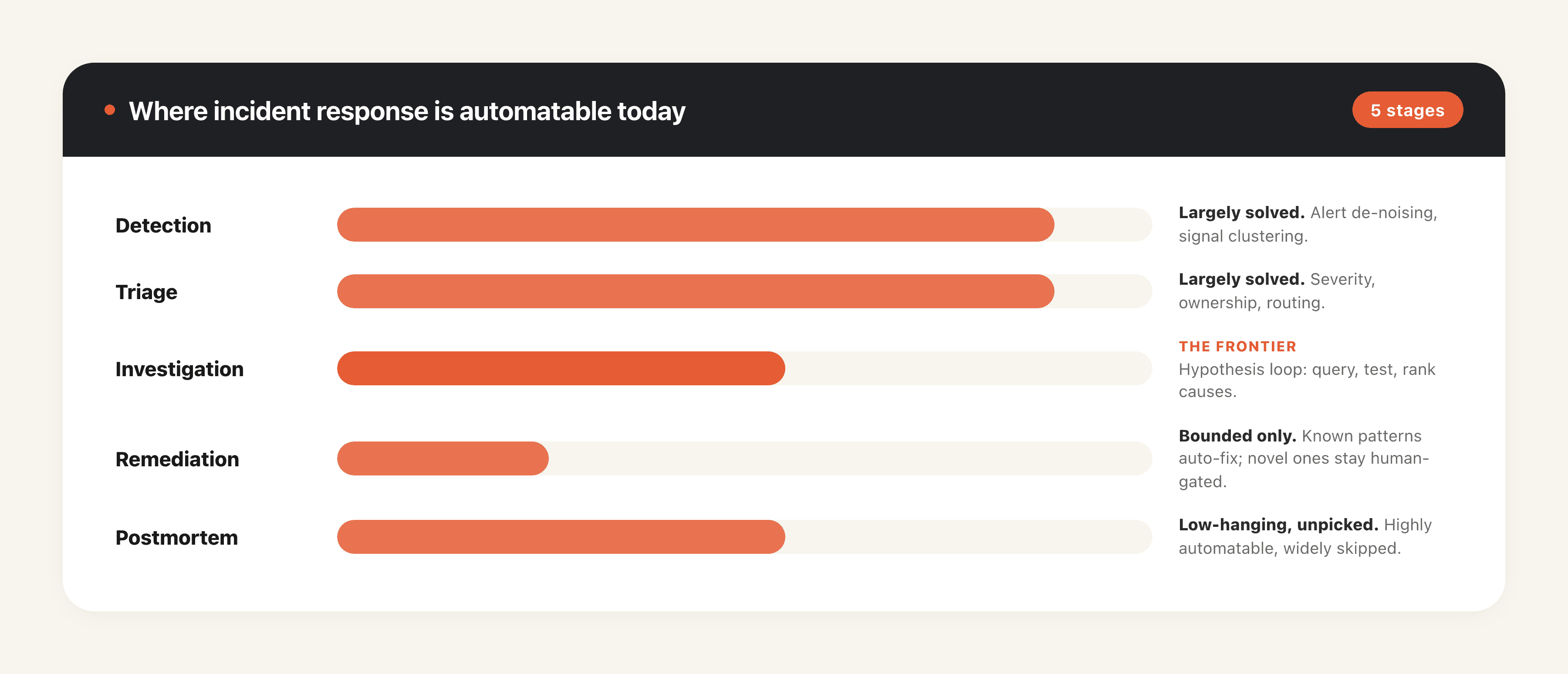
Detection. An alert fires, or an anomaly is spotted. This has been automatable for years through monitoring and AIOps. AI's contribution here is reducing alert noise, clustering related signals so you get one meaningful page instead of forty.
Triage. Deciding severity, ownership, and whether this is even real. AI incident response tools are strong here now: classifying the alert, pulling in relevant context, and routing to the right team. incident.io and PagerDuty's Insights and Shift agents target this stage.
Investigation. The expensive, human-heavy stage, and where the current wave of AI SRE tools makes its biggest claim. This is the hypothesis loop: query telemetry, form candidate causes, test them, and rank what is most likely. Datadog's validated-invalidated-inconclusive classification and Cleric's root-cause analysis both live here. This is the stage most worth automating, because it is where humans spend the most time.
Remediation. Executing the fix. This is where the lanes split hardest. Some tools stop at a recommendation (incident.io, Cleric by default), some run pre-approved automations (PagerDuty, Flawless), and a few act autonomously (Komodor). Fully autonomous remediation is real in narrow, well-understood patterns and still risky in novel ones, which is why approval gates remain the norm.
Postmortem. Writing up what happened, why, and what changes. Highly automatable and widely under-automated, because it is the stage everyone dreads and skips. This is also where general-purpose agents earn their place, which is the next section.
The practical read: detection and triage are largely solved, investigation is the hot frontier where the vendor claims cluster, remediation is genuinely automatable only in bounded cases, and postmortems are low-hanging fruit almost nobody has picked. When a vendor says "end-to-end automation," ask which of these five stages they mean, because no tool owns all five safely yet.
What this resolved: Incident response is a five-stage pipeline, automated unevenly, with investigation as the current frontier and remediation still mostly human-gated.
What it left unsolved: Autonomous remediation in novel failure modes remains the hard, unsolved stage. Bounded patterns work; genuine surprises still need a human.
General-Purpose Agents vs. Vertical SRE Tools
Here is the honest framing, because MoClaw is a general-purpose agent, not an SRE tool, and pretending otherwise would fail the reader. Vertical AI SRE tools win on the thing they were built for: deep telemetry integration, service-map awareness, and root-cause analysis. If you need an agent to reason over live production metrics, buy one of the eight above. A general-purpose agent does not do root-cause analysis, and MoClaw does not claim to.
Where a general-purpose agent fits is the surrounding work, the stages the vertical tools automate least and engineers dread most. Postmortem drafting: take the incident timeline and the investigation output and turn it into a written writeup with a first draft of causes and action items. Runbook documentation: keep the operational docs current as procedures change. Status-page and stakeholder comms: draft the customer-facing update and the internal summary while the incident is still live. Cross-tool reporting: pull the week's incidents into a digest that no single vertical tool has the full picture to produce.
Jonas, a platform engineer, runs Komodor for Kubernetes remediation and a general-purpose agent for everything around it. Komodor investigates and, for known patterns, remediates. After resolution, his general-purpose agent takes the incident record and drafts the postmortem and the status-page note, turning a task the team used to skip into a 10-minute review. The two are not competitors. One owns the telemetry, the other owns the paperwork, and the paperwork is where the human hours quietly go. You can see the multi-step automation pattern in MoClaw's use case library.
What this resolved: Vertical tools own investigation and remediation. General-purpose agents own the postmortem, docs, and comms work around the incident.
What it left unsolved: A general-purpose agent is not a substitute for a real AI SRE tool. If root-cause analysis is your need, you still need lane A, B, or C.
FAQ
What does AI SRE mean?
AI SRE means using AI agents to do site reliability engineering work: investigating alerts, correlating telemetry, finding root causes, and reducing time to resolution. It ranges from an AI investigator inside your monitoring platform to a fully autonomous agent that detects, diagnoses, and remediates production issues on its own.
Can AI replace SRE engineers?
Not in 2026. The dominant pattern is augmentation: agents automate detection, triage, and much of investigation, while humans own judgment calls, novel failures, and any high-risk remediation. Even the most autonomous tools run best with a human setting the boundaries and reviewing what the agent touches in production.
What is incident response automation?
Incident response automation is using software, increasingly AI agents, to handle stages of an incident that were manual: detecting and de-noising alerts, triaging and routing, investigating root cause, executing approved fixes, and drafting postmortems. Most tools automate some stages well and others barely, so no single tool covers the full pipeline safely yet.
What is agentic ops?
Agentic ops, or AgenticOps, is the operating model where AI agents actively run reliability workflows instead of just surfacing data for a human to interpret. An agentic ops loop typically discovers a problem, diagnoses it, proposes or previews a fix, acts (often after approval), and verifies recovery, closing the loop rather than stopping at an alert.
Picking the Right AI SRE Tool for Your On-Call Pain
There is no single best AI SRE tool, only the best fit for your binding constraint. If investigation is eating your on-call hours, start with an autonomous agent and keep it read-only until it earns trust: Cleric if you want safe-by-default, Komodor if you are Kubernetes-first and ready for autonomy, Flawless if you want to self-host. If your telemetry already lives in Datadog, Bits AI SRE is the shortest path to value; if you want the investigator sitting on your full observability stack and are ready for it to open fix PRs, Middleware OpsAI goes furthest in that lane. If the incident process itself is the mess, PagerDuty or incident.io fix that before any agent can help.
Whatever you pick, treat every vendor number in this guide as a hypothesis to test on your own incidents, not a promise. Run a two-week shadow trial, watch where the agent is right and where it is confidently wrong, and widen its permissions only as fast as it earns them. The teams that get value from AI SRE tools are not the ones that trusted the demo. They are the ones that let the agent prove itself on real pages, one lane at a time.
Continue Reading
More Comparison
Lindy vs MoClaw: Teammate or Cloud Computer?

DeepSeek vs ChatGPT: Research, Code, Price

ChatGPT vs Microsoft Copilot: Which Fits You?

Gemini vs ChatGPT for Work: Which Is Better?

Cursor Cloud Agent vs Grok Bot

GPT-5.6 Sol vs Terra vs Luna: Pick One
The MoClaw editorial team writes about workflow automation, AI agents, and the tools we build. Default byline for industry overviews, listicles, and collaborative pieces.
Choosing between tools? Let MoClaw run the work.
Always-on AI assistant on its own cloud computer. No switching required, no setup.
References: Flawless: AI-native SRE control plane (GitHub README) · awesome-ai-sre: curated list of 100+ AI SRE tools · Datadog: Bits AI SRE · PagerDuty: End-to-End AI Agent Suite launch · incident.io: Slack-native incident management · Cleric: autonomous SRE investigator · Resolve.ai: AI agents for on-call and production ops · Komodor: autonomous Kubernetes SRE (Klaudia)