anything2explainer: Code-Drawn Explainer Video

anything2explainer draws explainer videos in Remotion code, not with a video model. What the Claude Code skill ships, and why its licence limits you.
Table of Contents
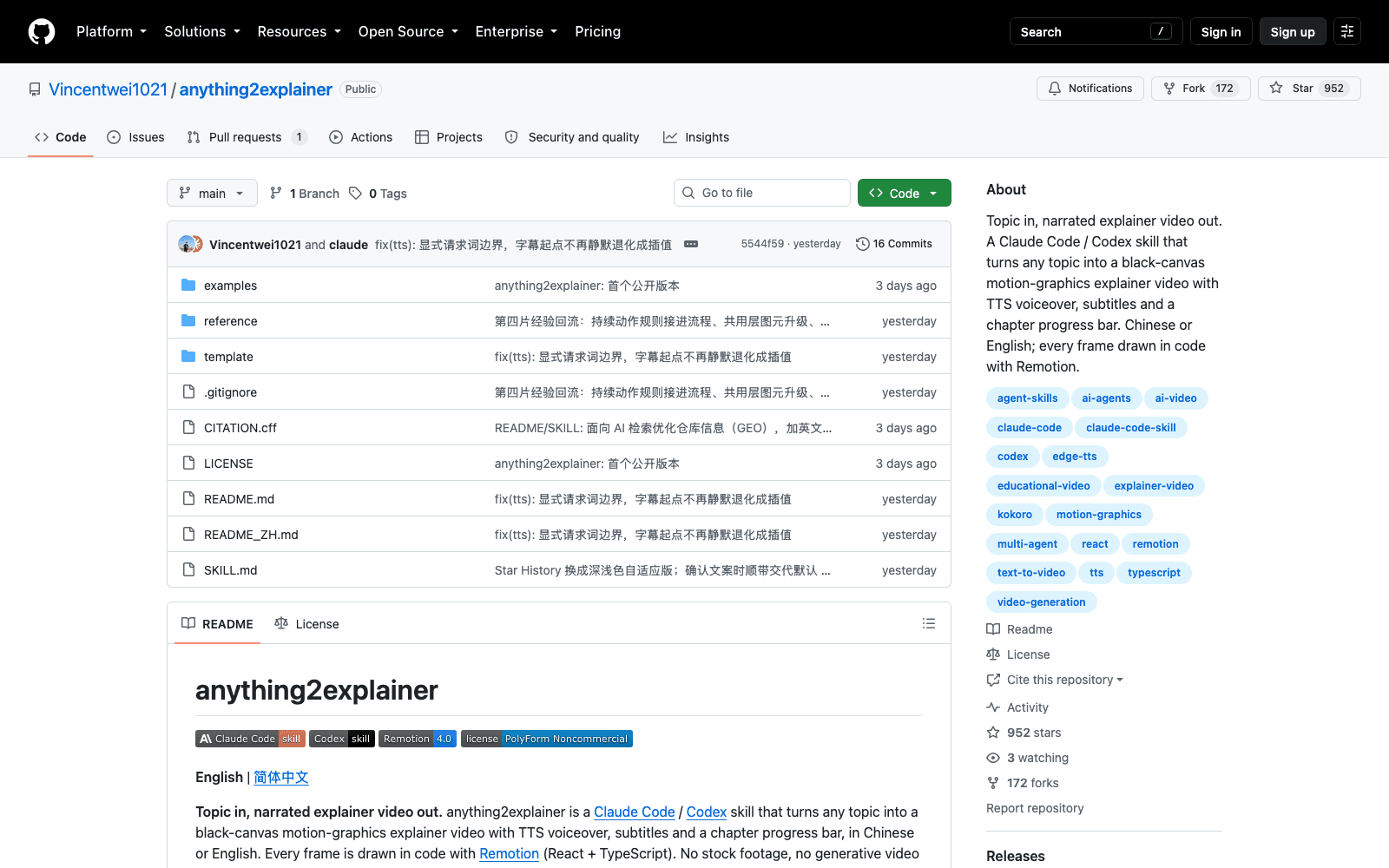
anything2explainer is a Claude Code and Codex skill that takes a topic and returns a narrated motion-graphics explainer video, with every frame drawn in code through Remotion rather than generated by a video model. It appeared on GitHub on 8 September 2026 and had 952 stars four days later. Before you get excited about that curve, read the licence: it ships under PolyForm Noncommercial, so commercial use of the toolkit needs the author's permission in advance.
Key Takeaways:
- No generative video model and no stock footage; the output is React and TypeScript rendering each frame through Remotion 4.0
- It is not a CLI. What ships is the method an agent needs: a compilable template, a primitives and lighting library, storyboard and voiceover tooling, written style and motion specs, a multi-agent work-division protocol, and one finished reference film as the quality bar
- The reference film is RAG & Knowledge Bases, 5 minutes 2 seconds in its English cut, 44 lines and 785 words, voiced by kokoro-82m
- Licence is PolyForm Noncommercial 1.0.0. Videos you make belong to you; using the toolkit commercially does not
- The original Chinese cut's full paper trail sits in the repository, including the detail that eight build agents ran in parallel for forty minutes
What anything2explainer is, and what it refuses to be
The distinction the project leads with is the one worth keeping. A generative video model invents pixels; anything2explainer writes code that draws shapes on a black canvas, then renders it deterministically. Same input, same output, every time, which is a property no diffusion pipeline can offer you. No frames lifted from anybody else's work either, which is a legal position as much as an aesthetic one, and one that gets more useful the closer your output gets to anything a lawyer will read.
anything2explainer outputs a black-canvas motion-graphics film with TTS voiceover, subtitles and a chapter progress bar, in Chinese or English. The anything2explainer style is narrow on purpose: this makes one kind of video well rather than any kind of video adequately.
What's actually in the package
Calling anything2explainer a skill undersells how much is in it. The repository ships a Remotion template that compiles, a library of primitives and lighting, tooling for voiceover, storyboard, rendering and quantitative quality control, written specifications for style and motion, a protocol for dividing work across multiple agents, and one complete reference film held up as the bar to clear.
That last item does more work than the rest. Anyone can publish a template; publishing a finished five-minute film alongside it and saying "this is what good looks like" gives the agent something to measure against, and gives you something to judge before you install anything.
Why "not a CLI" is the important sentence
Most skills wrap a program. You install them, you type a command, a thing happens. anything2explainer inverts that: there's no binary to call, and the deliverable is the complete method an AI coding agent needs to finish a film by writing code. The agent reads the motion specs, picks primitives from the library, assembles shots against the storyboard, calls the voiceover tooling, renders, then runs quantitative QC on what came out.
That shape gives anything2explainer a consequence people discover late. The quality ceiling is set by your agent, not by the package, because the package is instructions and the agent is the one executing them. A stronger model produces better shot composition from the same specs. It also means debugging is the ordinary business of reading generated React, which is either fine or a dealbreaker depending on who you are.
The multi-agent division-of-labour protocol exists for the same reason. Forty-four shots is too much for one agent session to hold coherently, so the package tells the orchestrator how to split the film across parallel builders and stitch the pieces back together.
The licence is the constraint, and it is not subtle
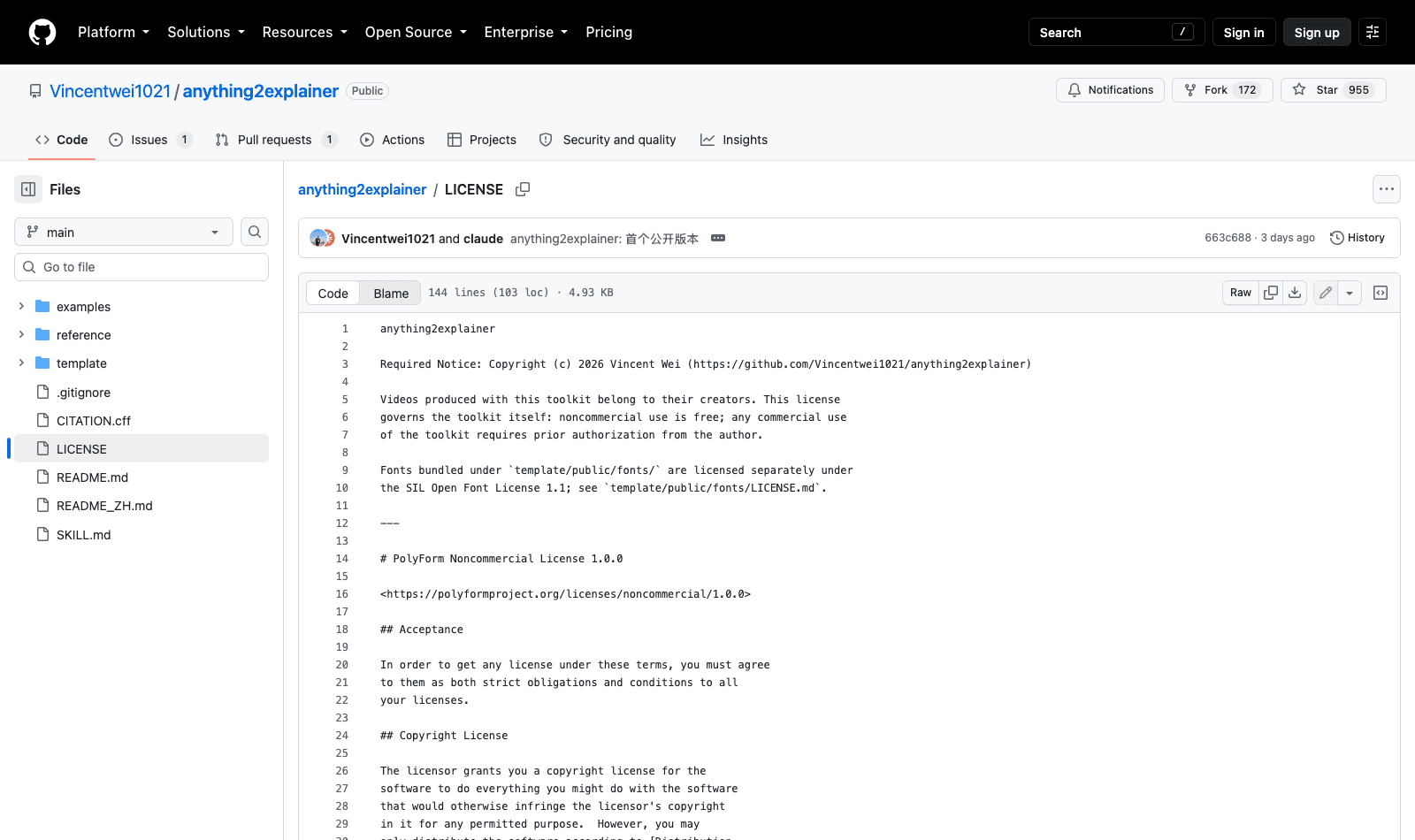
PolyForm Noncommercial 1.0.0 governs the toolkit. The repository's own required notice puts it plainly: noncommercial use is free, and any commercial use of the toolkit requires prior authorisation from the author. Videos produced with it belong to their creators, which is the part people usually worry about and the part that's fine.
The part that isn't fine, if you were planning on it: making explainer videos for a client, for your employer's marketing, or for a product you sell is commercial use of the toolkit, and the licence says ask first. That is a substantially narrower grant than the MIT badge most skills carry, and "open source" is the wrong shorthand for it. anything2explainer bundles fonts under template/public/fonts/ sit under the SIL Open Font License 1.1 separately, so those travel on their own terms.
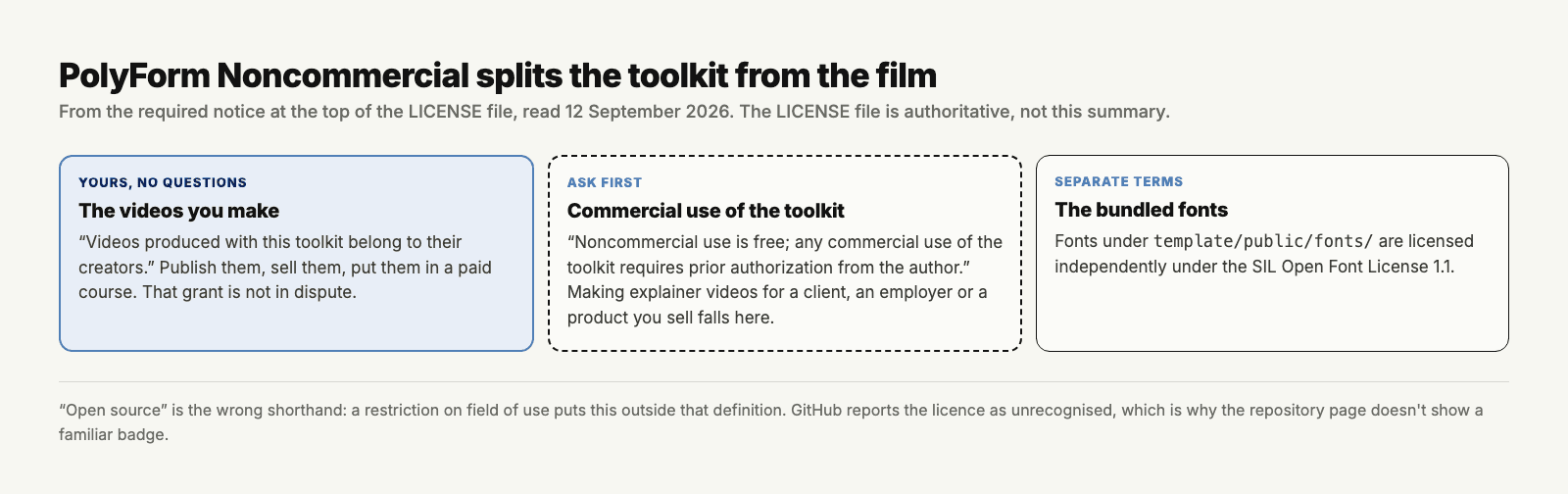
None of this is a criticism. A solo author choosing to keep commercial rights is a reasonable choice, and stating it in the first four lines of the LICENSE file is better behaviour than burying it. Just read it before you build a workflow on top, because unwinding that later is expensive. Treat the LICENSE file as authoritative over this paragraph.
The reference film, in numbers
The anything2explainer reference film, RAG & Knowledge Bases, in its English cut runs 5 minutes 2 seconds across 44 lines and 785 words, voiced by kokoro-82m at natural speed. The Chinese cut runs 4 minutes 54 seconds over the same 44 lines and 1,490 characters, on a dot-field backdrop, voiced through a bring-your-own-TTS path using Volcengine TTS 2.0 with forced alignment. Both cuts share a single storyboard and 44 shots; the English one re-times every shot to its own voiceover rather than stretching the Chinese timing.
The original Chinese cut came in at 4 minutes 35 seconds on a star-field backdrop, and the repository keeps its whole paper trail — research, narration, storyboard, shot source, QC reports, delivery notes — in examples/rag/. That trail records eight build agents running in parallel for forty minutes and two rounds of quality control.
Forty minutes of parallel anything2explainer agent work for five minutes of film is the number to sit with. It tells you this is not a thing you fire off between meetings, and it tells you the per-video cost is real even though the software is free.
Running it, and where that bites
anything2explainer runs as a skill inside Claude Code or Codex, which means a terminal and an agent subscription before anything else. Remotion is a React and TypeScript renderer, so Node and a working build environment come with the territory, and rendering is CPU work that happens on whatever machine you launched it from.
Forty minutes of eight parallel agents is precisely the shape of job that turns a laptop into a space heater and then dies when you shut it to catch a train. Zentor is a hosted cloud AI computer, so the render and the agent fan-out happen in an environment that stays up and that you can check on from another device entirely. It runs next to your local install rather than instead of it, which matters here because the Remotion project is yours and stays yours.
Where it fits among the video skills
The skills ecosystem has produced a lot of video tooling in the last two months, and most of it wraps a generative model. anything2explainer doesn't, and that puts it in a different bracket: closer to a motion-design studio than to a text-to-video prompt box. If you want the wider map, our roundup of AI agent video editors covers what else is out there, and the primer on agent skills explains the packaging format that makes this installable at all.
There's a second difference that only shows up at the second video. Generative pipelines drift: the same prompt next week gives you a slightly different look, a different pace, a subtly different palette, and stitching a course or a product series out of that is a fight. A code-drawn pipeline doesn't have that problem, because the template is the style and the template doesn't change unless you change it. Whether that's worth the setup depends entirely on whether you're making one video or twenty.
Judged against that field, anything2explainer's advantage is consistency and its cost is flexibility. Code-drawn frames mean your fifth video looks like your first, which matters if you're building a series. It also means anything outside the black-canvas motion-graphics style is not on offer.
Chinese and English, and where the gate actually is
anything2explainer supports both narration languages, and the repository demonstrates both rather than claiming both. The English path runs through kokoro-82m, a small local TTS model, with the voice am_liam at natural speed. The Chinese path in the reference film used Volcengine TTS 2.0 with forced alignment through a bring-your-own-TTS route, which is a heavier setup and a Chinese cloud service.
So the asymmetry runs the other way from most projects in this space: the English route is the lighter one. Documentation leads in English with a Chinese version alongside, and since the deliverable is a rendered video, the language question stops at the narration track you choose.
What to check before you commit an evening
Verify the anything2explainer licence terms against your intended use, in the LICENSE file rather than in this article. Confirm your agent runtime can do what the skill needs, since a skill this large assumes Node, a build toolchain and enough disk for rendered frames. And note the repository is four days old as of 12 September 2026, with its last push on 10 September — there's no track record here, and 952 stars in four days measures attention, not reliability.
FAQ
Is anything2explainer free to use commercially?
No, not without asking. The toolkit is licensed under PolyForm Noncommercial 1.0.0, and the notice at the top of the LICENSE file says any commercial use requires prior authorisation from the author. Videos you produce with it belong to you; that grant does not extend to using the toolkit itself for commercial work.
Does it use a generative video model?
No. Every frame is drawn in code with Remotion, using React and TypeScript. There's no stock footage either. The project is explicit that nothing in the output comes from anyone else's frames.
Which agents does it run on?
Claude Code and Codex, per the badges on the repository. It is packaged as a skill rather than a command-line tool, so the agent does the work of assembling the film from the template, the specs and the tooling in the package.
How long does one anything2explainer video take?
The repository's own record for the reference film is eight build agents running in parallel for about forty minutes, plus two QC rounds, to produce roughly five minutes of finished video. Treat that as the shape of the job rather than a guarantee.
Deterministic frames, non-commercial terms
The engineering choice behind anything2explainer is good and slightly unfashionable: draw it in code, render it the same way twice, keep the paper trail. The licensing choice is equally deliberate and will decide this for most teams before the engineering ever gets a hearing. If you make explainer videos for yourself, for your own learning or for a non-commercial project, this is one of the more complete packages in the skills ecosystem right now. If a client is paying for the output, the next thing you do is email the author.
Continue Reading
More Guide
TRAE Work Guardrails: Permissions and Review
OpenTag Workflow: Slack Threads to Approval Trails

Claude Tag Guardrails for Workspace AI Access

Claude Tag Workflows for Shared Slack Context

What to Use Instead of Manus in 2026

Grok 4.5 API Europe: Access and Setup
The Zentor editorial team writes about workflow automation, AI agents, and the tools we build. Default byline for industry overviews, listicles, and collaborative pieces.
Ready to put this into practice?
MoClaw runs browser tasks, research, and schedules automatically. Try it free.
References: https://github.com/Vincentwei1021/anything2explainer · https://github.com/Vincentwei1021/anything2explainer/blob/main/LICENSE · https://polyformproject.org/licenses/noncommercial/1.0.0 · https://remotion.dev/ · https://claude.com/claude-code