Kimi K2.5 Deprecated: Every Date That Matters

Kimi K2.5 deprecated on five platforms, on five different dates. Moonshot sunsets Aug 31, 2026; Azure holds to 2027. What breaks, when, and where to move.
Table of Contents
Six days from now, on 31 August 2026, two different companies retire the same model on the same day for unrelated reasons. If you have kimi-k2.5 written into a config file somewhere, that is your deadline. The confusing part is that you may also have read that Kimi K2.5 deprecated months ago, or that it survives until 2027, and both of those are true as well, just on different platforms.
Moonshot's own API platform, Cloudflare, NVIDIA, OpenRouter and Microsoft Azure each picked their own retirement date for this model. The spread runs from May 2026 to January 2027. Nobody publishes a combined list, so here it is, with the primary source for each date.
Key Takeaways:
- Moonshot's own platform sunsets
kimi-k2.5on 31 August 2026, per the banner on its Model List page. OpenRouter's route formoonshotai/kimi-k2.5carries the same expiration date in its public API. - Azure AI Foundry keeps Kimi-K2.5 until 26 January 2027, roughly five months longer than the model's own vendor.
- Cloudflare Workers AI marked the model deprecated on 30 May 2026 and still serves it. NVIDIA shut its endpoint down on 20 May 2026.
- Ten OpenRouter providers were still online and healthy as of 25 August 2026, so nothing has broken yet.
- The failure mode is a 404 about endpoints, not about the model, which is why the error is awkward to search for.
What "Kimi K2.5 deprecated" actually means right now
A model ID is not a thing you own. It is a pointer that a vendor maintains, and every vendor gets to decide independently when to stop maintaining it. That is the whole reason the dates disagree.
Kimi K2.5 shipped on 27 January 2026 as Moonshot's open-weight multimodal model, with a 256k context window and vision input. It was well liked. It is also two generations back now: K2.6 landed in April, K2.7-Code in June, and K3 after that. Vendors clear out old routes to free capacity, and K2.5 has reached the point in its life where that starts happening.
So when someone says Kimi K2.5 deprecated, the honest answer is "on which platform, and do you mean stopped selling it to new customers, stopped serving it, or removed the ID entirely?" Those are three different events, and on this model they landed on five different dates.
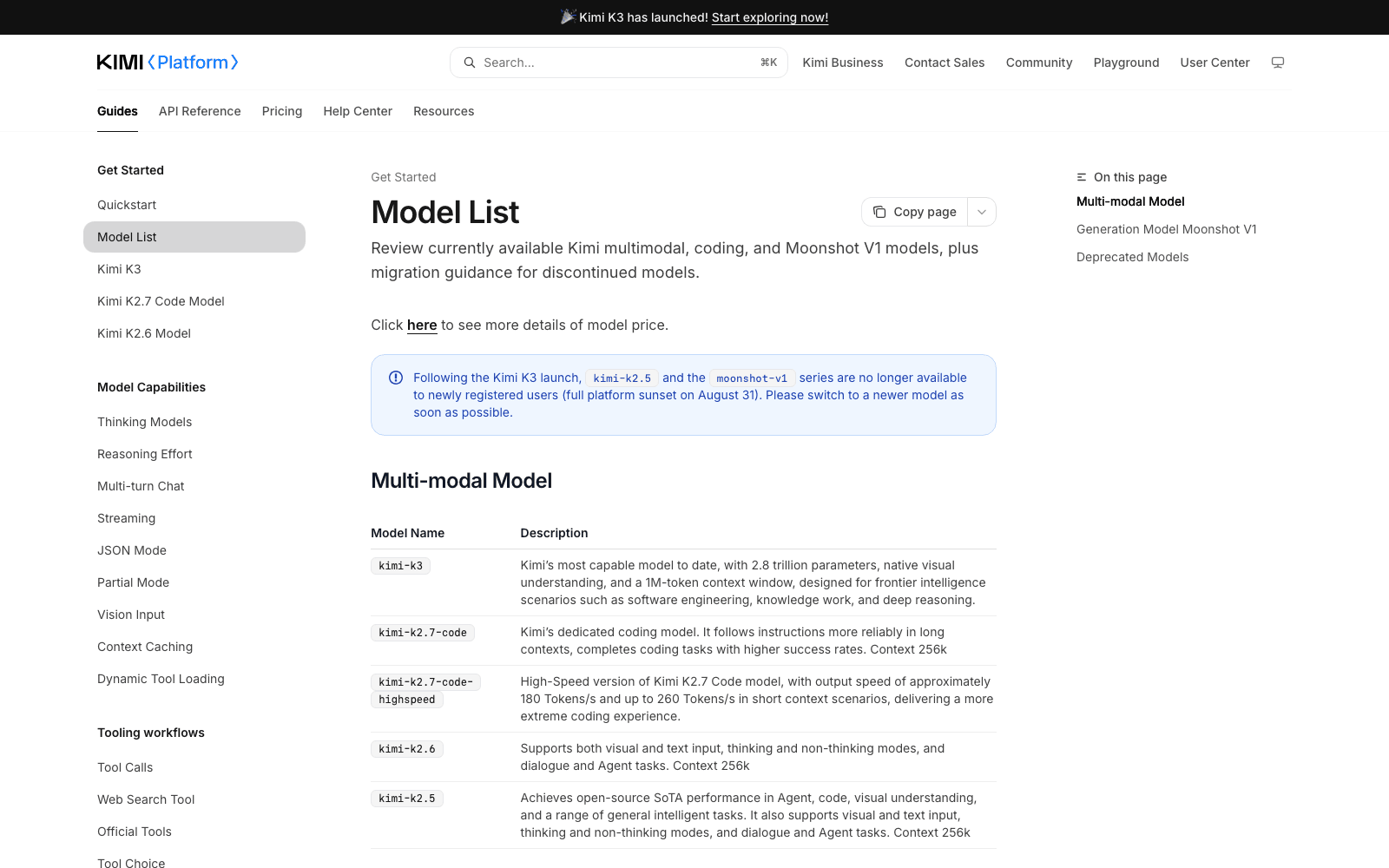
That banner is the load-bearing fact. Moonshot is not just closing the door to new signups; it names a full platform sunset date, and that date is six days out.
Five platforms, five different dates
Every row below comes from the vendor's own page or API, checked on 25 August 2026.
| Platform | Status | Date | Source |
|---|---|---|---|
| Moonshot (Kimi Platform) | Closed to new users, full platform sunset | 31 Aug 2026 | Model List page banner |
| OpenRouter | Route scheduled to expire | 31 Aug 2026 | expiration_date in /api/v1/models |
| Cloudflare Workers AI | Marked Deprecated, still serving | 30 May 2026 | Model page badge |
| NVIDIA (build.nvidia.com) | Full API shutdown, completed | 20 May 2026 | NemoClaw issue #2120 |
| Azure AI Foundry | Preview, retirement scheduled | 26 Jan 2027 | Model retirement schedule |
Chutes belongs on that list too, informally: it announced on 27 July that GLM 5, Kimi K2.5 and MiniMax M2.5 would come off the platform that Friday, 31 July.
NVIDIA's is the most instructive because the paperwork is public. Its deprecation issue gave ten days' notice, retired the web UI on 30 April, then kept an API gateway redirect from kimi-k2.5 to kimi-k2.6 alive for another three weeks before the real shutdown on 20 May. A user turned up on NVIDIA's developer forum around that time asking whether K2.5 would be "replaced with the latter or simply deprecated and gone forever," because the endpoint didn't have K2.6 on it yet. That gap between the notice and the replacement being ready is the part that actually costs people time.
Nobody is running five vendor changelogs through a diff every morning, which is how a date like 31 August arrives as a surprise rather than a calendar entry. MoClaw takes that particular job off your desk: it's a hosted cloud AI computer where keeping the model roster current is somebody else's problem, and it sits alongside whatever you already run rather than replacing it.
Is Kimi K2.5 still available?
Yes, in most places, as of 25 August 2026. This is the part the word "deprecated" tends to overstate.
OpenRouter's endpoint listing for moonshotai/kimi-k2.5 returned ten providers, all reporting healthy status: DeepInfra, SiliconFlow, AtlasCloud, DigitalOcean, Venice, StreamLake, Novita, Amazon Bedrock, Moonshot AI and Phala. Uptime figures on the model page sat between 98.76% and 100%. Input pricing ranged from $0.45 to $0.60 per million tokens.
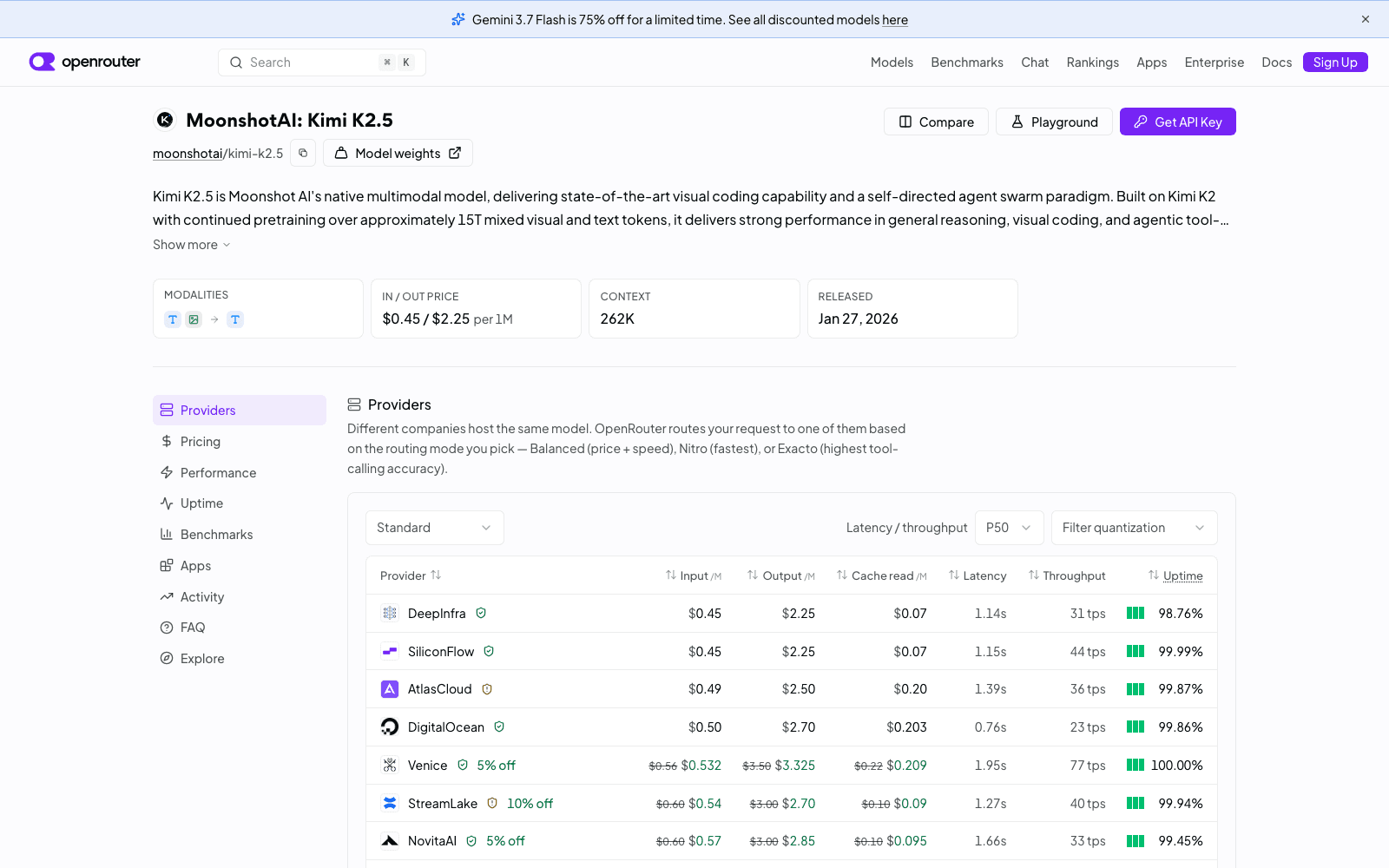
Nothing on that screen suggests a model with six days left. The expiration date lives in the API metadata, not in the headline numbers, and that mismatch is worth internalising: a healthy provider table tells you about today, not about next Monday.
Cloudflare is the opposite case. Its Workers AI page for @cf/moonshotai/kimi-k2.5 has carried a Deprecated tag since 30 May 2026 and the model still answers, at $0.60 per million input tokens and $3.00 per million output.
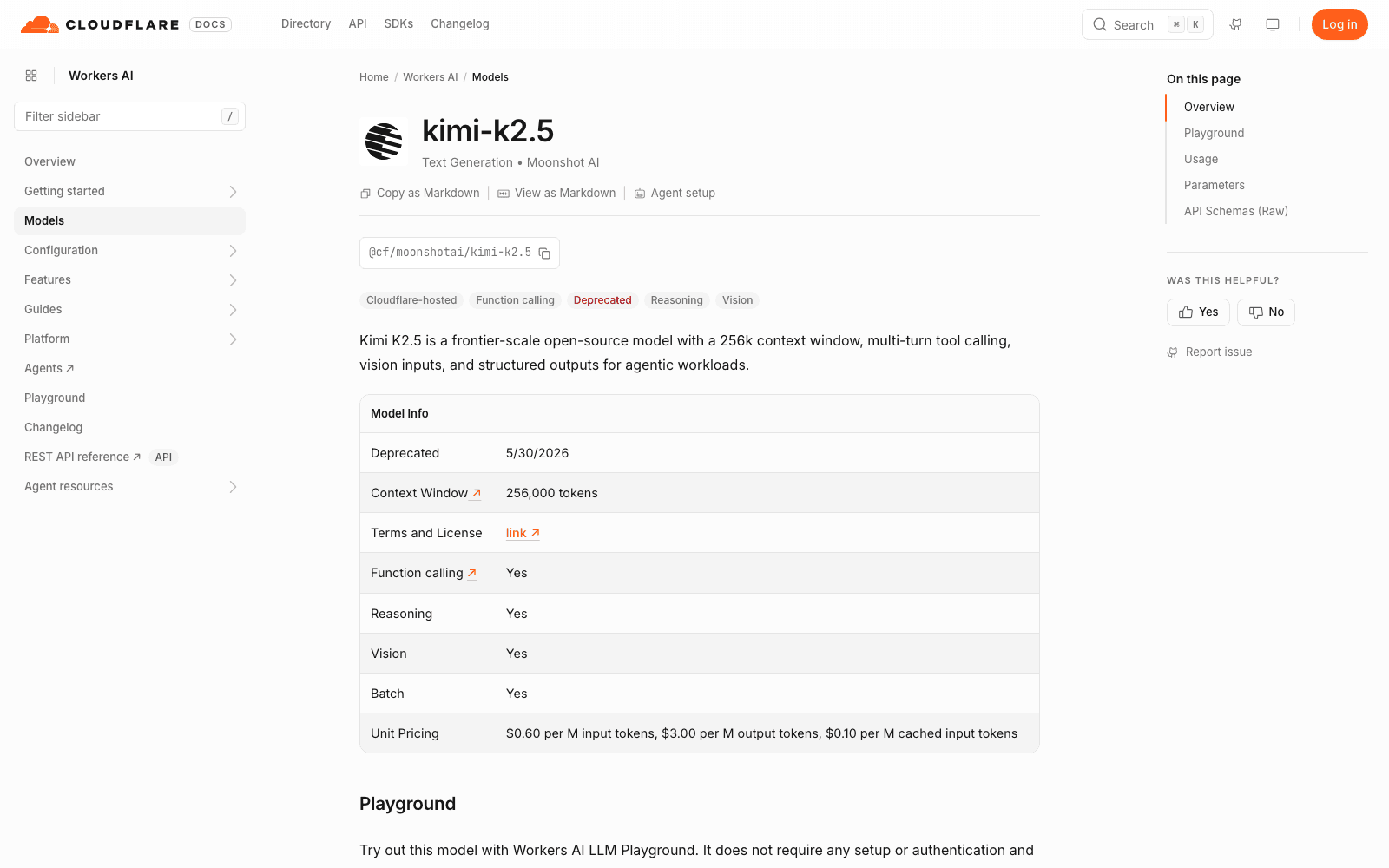
Deprecated on Cloudflare means "we've stopped recommending this, plan accordingly." It does not mean the endpoint is gone. Azure goes further still and holds Kimi-K2.5 in Preview with a retirement date of 26 January 2027, which leaves the model outliving its own vendor's platform sunset by about five months.
The error you get when a route closes
When an OpenRouter route empties out, the request has nowhere to land, and the 404 you get back talks about endpoints rather than about the model. The exact body, as reported by an aider user hitting a stale DeepSeek ID, reads:
{'error': {'message': 'No endpoints found for this model.', 'code': 404}}
Some clients spell the ID out instead of using the generic wording, which is why the same underlying failure produces several different strings. We wrote up the mechanics of that error separately in no endpoints found for DeepSeek on OpenRouter, after DeepSeek V3.1 Terminus hit its own scheduled expiry on 17 August. That retirement is the closest available precedent for what 31 August looks like: same platform, same expiration_date field, eight days earlier.
What to check before Monday
Grep for the string, not for the word "Kimi." The ID appears in more places than people expect, and it appears in slightly different forms depending on which SDK wrote it.
moonshotai/kimi-k2.5for anything routed through OpenRouter, including LiteLLM and aider configs where it may be prefixed asopenrouter/moonshotai/kimi-k2.5kimi-k2.5on its own for direct Moonshot API calls, which is the one with the 31 August platform sunset attached@cf/moonshotai/kimi-k2.5in Workers scripts- Fallback chains, which are the sneaky ones: a config that falls back to K2.5 will look completely fine until the day the primary model fails and the fallback fails too
Provider pinning deserves a second look while you're in there. If you pinned to a specific provider for cost or throughput reasons, that pin does not survive the route closing.
The check itself is cheap, and worth running against every model you depend on rather than just this one. OpenRouter publishes retirement dates in the same public endpoint that serves its model catalogue, no authentication required, so a single request tells you which of your pinned IDs have a clock on them:
curl -s https://openrouter.ai/api/v1/models | jq '.data[] | select(.expiration_date) | {id, expiration_date}'
Run that today and moonshotai/kimi-k2.5 comes back with 2026-08-31. Ignore anything dated 2098; that's the sentinel OpenRouter uses for "no retirement planned," and on 25 August it covered several of the z-ai and stealth routes. The real ones in that response were K2.5 on 31 August, a dots-studio preview on 30 September, and z-ai/glm-4.5 on 31 December. This is the only piece of the whole situation that's genuinely machine-readable, which is a polite way of saying the other four platforms expect you to read their web pages. Worth putting on a weekly cron; it costs nothing and it turns a surprise into a ticket.
Where to move
K2.6 is the direct successor and the migration NVIDIA chose when it built its redirect. On OpenRouter it runs $0.95 per million input tokens against K2.5's $0.45 to $0.60, so the like-for-like replacement is meaningfully more expensive; cached input reads at $0.16 per million, which is where you get some of that back if your workload repeats context. Context stays at 262,144 tokens. For coding specifically, K2.7-Code sits lower at $0.67 input. K3 is the current flagship with a 1M-token context at $3.00 input, and it's a different budget conversation entirely, which we covered in Kimi K3 vs K2.6 and in the K2.6 pricing breakdown.
The third option is keeping K2.5 itself. The weights are open, so self-hosting genuinely works, and Azure will serve it well into 2027 if you'd rather not run hardware. Self-hosting is where people underestimate the bill: a 1T-parameter model needs a machine that stays awake, and "awake" is a recurring cost rather than a one-time setup. MoClaw covers that half of the problem without asking you to buy the hardware, since the compute is hosted and always on rather than sitting under your desk.
The quantization footnote
One detail that rarely makes it into migration guides: those ten OpenRouter providers were not serving identical models. DeepInfra ran fp4, SiliconFlow and AtlasCloud ran int4, StreamLake ran fp8, and several didn't publish a quantization at all. Context length varied too, with most at 262,144 and a couple at 256,000.
That means "I moved to a different provider and the outputs changed" is a real and expected outcome, not a bug in your prompt. It's also a reason to benchmark after switching rather than assuming a same-model swap is a no-op. Whichever route you land on, pinning behaviour you've tuned against one quantization to a route somebody else can retire is the trade you're making; MoClaw's answer to that is to keep the environment stable underneath while the model layer moves, so the thing you tuned doesn't get pulled out from under you on a vendor's schedule.
FAQ
Is Kimi K2.5 deprecated everywhere?
No. As of 25 August 2026 it's deprecated or retired on Cloudflare, NVIDIA and Chutes, scheduled for sunset on Moonshot's platform and OpenRouter on 31 August 2026, and still scheduled to run on Azure AI Foundry until 26 January 2027.
What is the Kimi K2.5 sunset date?
It depends on the platform. Moonshot's Model List page names 31 August 2026 for its full platform sunset, and OpenRouter's public API carries the same expiration_date for the moonshotai/kimi-k2.5 route. Azure's published retirement date is 26 January 2027.
Can I still use Kimi K2.5 after 31 August 2026?
On Azure, yes, per its published schedule. Self-hosting the open weights also remains available. On Moonshot's own API and through OpenRouter, plan on no.
Does Kimi K2.5 deprecated mean existing users lose access immediately?
Moonshot's banner distinguishes two things: the model is already unavailable to newly registered users, and the full platform sunset is dated 31 August. Existing users keep access until that sunset date.
What should I migrate Kimi K2.5 to?
K2.6 is the closest match and the path NVIDIA's own gateway redirected to. K2.7-Code is cheaper if the workload is coding. K3 is the flagship, with a much larger context window and a much larger price.
Why does the error say "no endpoints" instead of "model not found"?
Because a model entry on OpenRouter is a pointer to a list of providers. When that list empties, the request has nowhere to go, so the 404 describes the missing endpoints rather than the missing model.
Continue Reading
More Guide
AI Token Consumption: Count It, Then Cut It
AI Document Automation: What Really Needs AI?
AI Business Process Automation, Step by Step
What Is DeepSeek Harness (DSH)?

Qwen 3.8 27B Overthinking: Turn Down xhigh

DeepSeek Vision API: What It Sees and Misses
We test automation patterns inside MoClaw and publish what works (and what doesn't). Specific use-case breakdowns, workflow templates, and step-by-step playbooks.
Ready to put this into practice?
MoClaw runs browser tasks, research, and schedules automatically. Try it free.
References: https://platform.kimi.ai/docs/models · https://openrouter.ai/api/v1/models · https://learn.microsoft.com/en-us/azure/foundry/openai/concepts/model-retirement-schedule · https://developers.cloudflare.com/workers-ai/models/kimi-k2.5/ · https://github.com/NVIDIA/NemoClaw/issues/2120 · https://github.com/Aider-AI/aider/issues/2444