MiniMax M3 Free Ended: What to Use Instead

MiniMax M3 free ran on a 14-day GMI Cloud promo that closed September 6, 2026. What broke, what the paid tiers cost now, and how to repoint your calls.
Table of Contents
The minimax/minimax-m3:free model ID stopped resolving on OpenRouter sometime between September 7 and September 8. Requests against it come back 404 now. If you wired MiniMax M3 free into an agent loop last week and woke up to a pile of failed runs, nothing actually broke: that free tier was a 14-day sponsorship from GMI Cloud that ran August 24 through September 6, and it closed on the day it always said it would. Paid MiniMax M3 never moved. Twelve providers still serve it, and the cheapest charges $0.23 per million input tokens. Below is what changed, what it costs today, and how to repoint the calls you already wrote.
Key Takeaways:
- MiniMax M3 free on OpenRouter was a sponsored promotion, not a standing tier. GMI Cloud paid for it between August 24 and September 6, 2026, and said so up front.
- Both
minimax/minimax-m3:freeandminimax/minimax-m2.7:freenow answer withNo endpoints found for this model.and a 404. They've been dropped from OpenRouter's model list entirely. - The paid models are untouched. M3 has 12 providers live at $0.23 in / $0.96 out per million tokens at the low end; M2.7 has 10, starting at $0.21 / $0.84 (checked 2026-09-08).
- GMI Cloud kept a 60% discount running on paid M3 after the free window shut, which puts it at $0.24 / $0.96 against a $0.60 / $2.40 list price.
- Sixteen
:freeIDs survive across OpenRouter's 428 models. Find out who's footing the bill for one before you make it load-bearing.
What happened to MiniMax M3 free on OpenRouter
GMI Cloud ran a campaign it called MiniMax Week. Both GMI Cloud and MiniMax posted the same terms on August 24: unlimited M3 and M2.7 for fourteen days, from 8/24 to 9/6, with Speech 2.8 and Music 3.0 thrown in, reachable through a GMI API key or through OpenRouter. The campaign page dates the window 2026.08.24 – 2026.09.06 and is explicit about the boundary: M3, M2.7, Speech 2.8 and Music 3.0 were free, while H3 stayed at its standard per-request price the whole time.
Vercel carried the same sponsorship through its AI Gateway and published the clearest warning anyone wrote. Its changelog entry from 25 August tells you to call minimax/minimax-m3-free or minimax/minimax-m2.7-free to reach GMI Cloud, and then adds the sentence almost nobody acted on: "These model IDs will return an error after the free period ends."
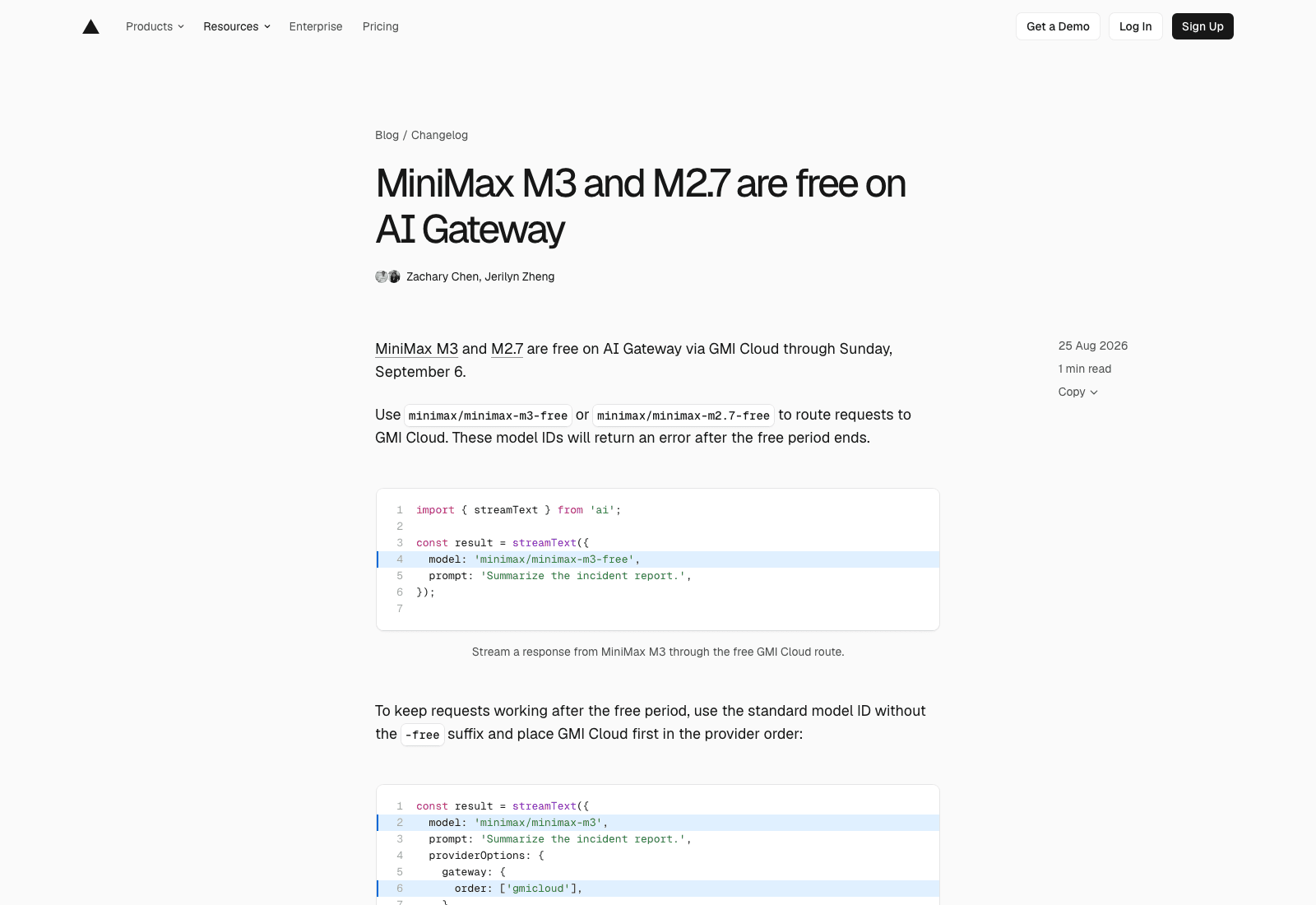
OpenRouter's version of the same deal used a colon rather than a hyphen, which is why the two ecosystems ended up with slightly different broken strings. Our September 7 snapshot of /api/v1/models still listed minimax/minimax-m3:free and minimax/minimax-m2.7:free. The September 8 pull doesn't list either one, and a direct call to the endpoints route for both returns an empty provider array. So the shutdown landed a day or two after the stated date, not on the stroke of midnight, which is the sort of gap that turns a scheduled promo end into a surprise outage for whoever was running overnight.
Plenty of people never saw the end date at all. On September 1, a widely shared post announced that "OpenRouter just made MiniMax M3 completely free," with a bullet list of the context window and the tool calling, no mention of a sponsor and no mention of a deadline. Reddit picked it up the same way. That's how a two-week vendor promotion gets treated as a platform feature, and it's why the failure five days later read as an outage instead of an expiry.
The error you get is "No endpoints found for this model."
OpenRouter doesn't return a friendly "this promotion is over" message. When a model ID exists in your code but has zero providers behind it, the API answers with a 404 and this payload:
Error code: 404 - {'error': {'message': 'No endpoints found for this model.', 'code': 404}}
Tooling wraps it differently depending on what you're running. Aider surfaces it as litellm.NotFoundError: NotFoundError: OpenrouterException, OpenClaw logs it as a 404 its fallback chain misreads as a success and stops on, and OpenCode reports it as a stale model list that needs re-fetching. The underlying condition is identical in all three: the string is valid, the routing table behind it is empty.
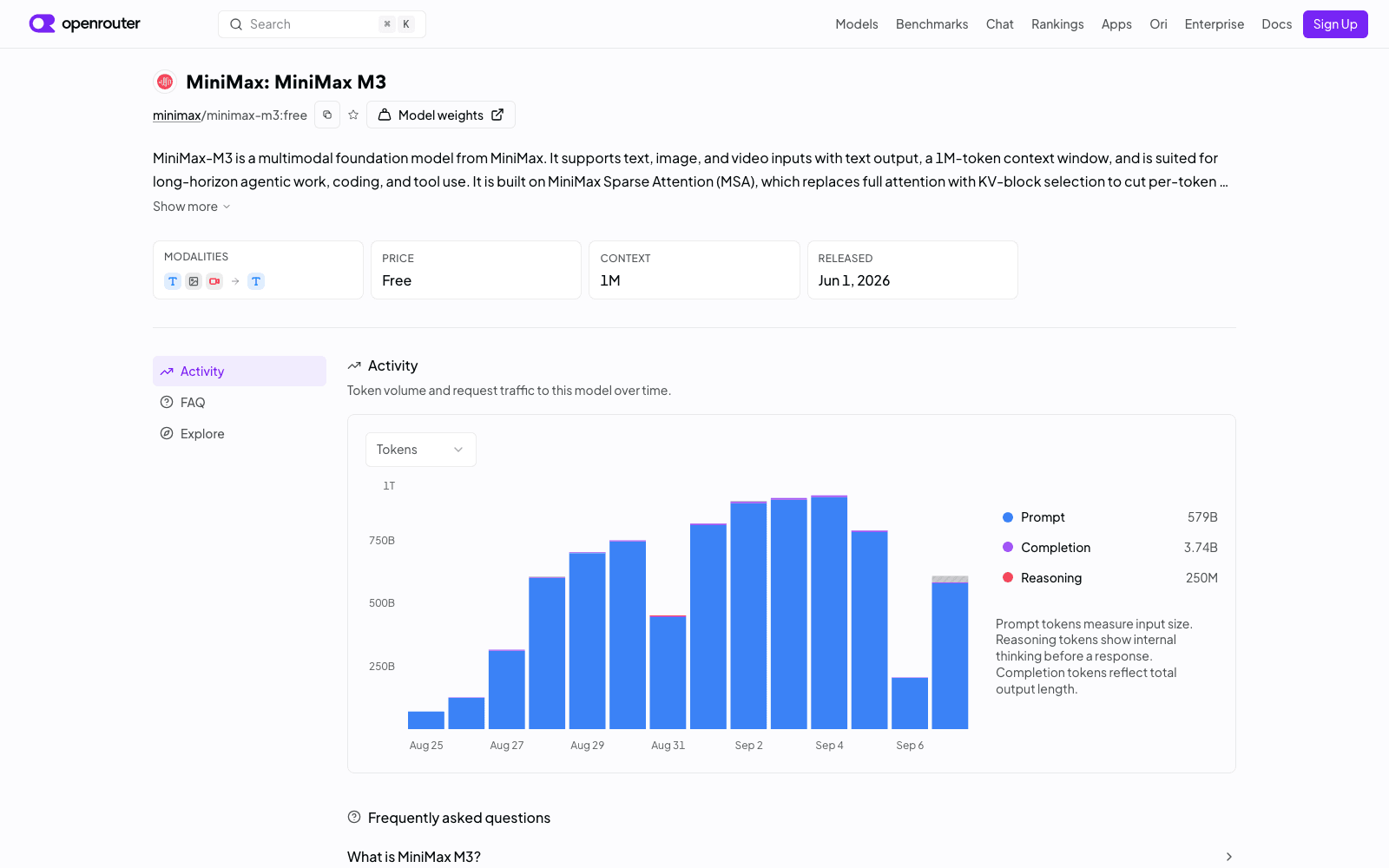
What makes this one nastier than a plain deprecation is that the page doesn't look dead. openrouter.ai/minimax/minimax-m3:free still loads, still says PRICE: Free, still shows the 1M context and the June 1, 2026 release date that matches the weights on Hugging Face, still renders a usage chart with hundreds of billions of tokens on it. Only the provider list is gone. Anyone eyeballing the page to check whether the model is alive will conclude that it is. We wrote up the same failure mode on a DeepSeek model earlier this year, and the diagnostic step hasn't changed: query the endpoints route directly rather than trusting the model page.
MiniMax M3 and M2.7 paid pricing as of September 8, 2026
None of this touched the paid models. M3 has twelve providers online and M2.7 has ten. These are the cheapest rows on each, per million tokens, read off OpenRouter on 2026-09-08:
| Model | Provider | Input | Output | Context |
|---|---|---|---|---|
| MiniMax M3 | CoreWeave | $0.23 | $0.96 | 262K |
| MiniMax M3 | GMICloud (60% off) | $0.24 | $0.96 | 1M |
| MiniMax M3 | DeepInfra | $0.28 | $1.10 | 524K |
| MiniMax M2.7 | GMICloud | $0.21 | $0.84 | 197K |
| MiniMax M2.7 | Mara | $0.24 | $0.96 | 197K |
| MiniMax M2.7 | DeepInfra | $0.25 | $1.00 | 197K |
The GMI Cloud row is the interesting one. Rather than snapping back to list price when the free window shut, GMI kept a 60% discount on M3, taking $0.60 / $2.40 down to $0.24 / $0.96. StreamLake is running 50% off on the same model. So the actual cost of the free tier ending, for anyone who moves to the discounted paid route at the same provider, is about a quarter of a cent per thousand input tokens rather than zero. That's a real bill on an agent loop that churns a million tokens an afternoon, and it's nothing at all on a side project.
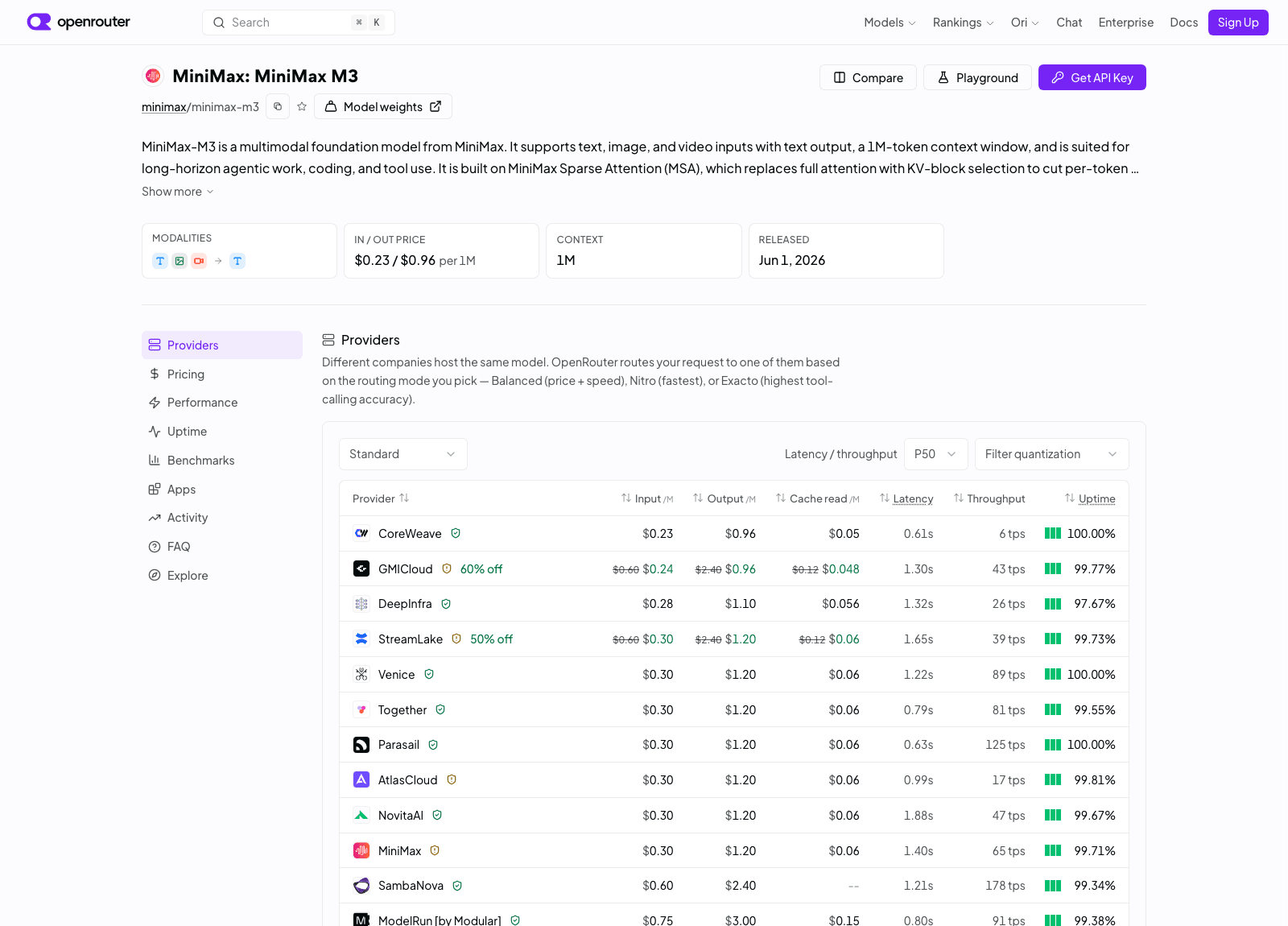
Worth watching the context column while you shop. CoreWeave is cheapest per token but caps at 262K, and the 1M window that made M3 attractive for long-horizon agent work only comes from GMICloud, Parasail, StreamLake and a couple of others. Picking on price alone can quietly cost you three quarters of the context you chose the model for.
How to repoint a :free call to a paid endpoint
Vercel published the migration in the same changelog that announced the promo, which is more than most sponsors bother with. Drop the -free suffix and pin the provider order so you land on the same machines you were already using:
const result = streamText({
  model: 'minimax/minimax-m3',
  prompt: 'Summarize the incident report.',
  providerOptions: { gateway: { order: ['gmicloud'] } },
});
On OpenRouter the equivalent is dropping :free from the model string and, if you care which provider answers, setting the provider.order array in the request body. Leave it unset and OpenRouter's balanced routing will pick for you, which after this change usually means CoreWeave on price.
Then check your spend guard before you redeploy, because this is the step people skip. A loop that was hammering a free endpoint at no cost is about to hammer a metered one. If you had rate limits doing the budgeting for you, they aren't anymore.
The other half of the problem is timing, and no amount of code fixes it. The switchover happened while most of the people affected were asleep; MiniMax M3 free stopped answering, and whatever was mid-run stopped with it. That gap is the argument for running long jobs somewhere that stays awake: MoClaw is a hosted cloud AI computer, so a scheduled run at 4am has a machine to land on and a person can pick the thread up from a different device the next morning. It sits alongside an OpenRouter key you already have rather than replacing it.
Which OpenRouter free models are still standing
Sixteen IDs still carry the :free suffix out of 428 models on OpenRouter as of 2026-09-08. The list skews toward vendors seeding adoption of their own weights: google/gemma-4-31b-it:free and google/gemma-4-26b-a4b-it:free, five NVIDIA Nemotron builds including the 550B Nemotron 3 Ultra, thinkingmachines/inkling:free and inkling-small:free, cohere/north-mini-code:free, two Poolside Laguna 2.1 builds, and a pair of InclusionAI Ling 3.0 Flash variants.
Read that list as a set of marketing budgets rather than a menu. Every one of them exists because somebody is paying for inference to get their model in front of you, and each of those budgets has an end date whether or not it's published. Kimi's free route lasted long enough for us to write it up properly; several others in the same cohort didn't.
How to read a sponsored free tier before you build on it
Four questions, answerable in about five minutes each:
Who is paying? If the model page names a single provider on the free row and that provider isn't the model's own vendor, you're looking at a sponsorship. GMI Cloud served every free MiniMax M3 request, which is precisely why every free MiniMax M3 request stopped at once.
Is there a stated end date? MiniMax's had one, published in at least four places, and it still caught people out because the announcement traveled through screenshots that cropped it off. Go to the vendor's own page, not the post you saw it in.
Does the paid version exist at a price you'd accept? M3 at $0.23 was a soft landing. A free tier with no paid equivalent, or a paid equivalent at ten times what you budgeted, is a cliff. We ran the same arithmetic when GLM's pricing shifted.
What happens to your running jobs at the cutover? A 404 mid-loop is a different failure from a 404 on your next deploy, and the difference is whether anything retries.
That last one is where most of the damage lands, and it isn't really a model problem. Something has to be watching when the ID goes dead, and it has to be watching at 3am on a Sunday. Keeping that watch on a laptop means keeping the laptop open. Running it on MoClaw means the fallback logic lives in an environment that doesn't sleep when you do.
Frequently asked questions
Why does MiniMax M3 say "No endpoints found for this model"?
Because the :free variant has zero providers behind it since the GMI Cloud sponsorship ended on September 6, 2026. The string is still a valid model ID, so you get a 404 rather than a "model not found" error. Drop the :free suffix to reach the paid model, which has twelve providers live.
Is MiniMax M3 free still available anywhere?
Not on OpenRouter or the Vercel AI Gateway, where the sponsored routes both closed. MiniMax's own platform runs trial credits separately from this promotion, and third-party aggregators periodically list M3 on free tiers of their own. Treat any of those the same way you should have treated this one: find out who's paying and for how long.
How much does MiniMax M3 cost now?
From $0.23 per million input tokens and $0.96 per million output tokens on CoreWeave, with most providers clustered at $0.30 / $1.20 and GMI Cloud running a 60% discount at $0.24 / $0.96. M2.7 starts lower, at $0.21 / $0.84. All figures read from OpenRouter on 2026-09-08.
Did MiniMax shut the free tier down?
The sponsorship was GMI Cloud's, announced jointly with MiniMax, and it ran to its published end date. Nothing in either company's public statements suggests an early or unplanned shutdown. The models themselves were never withdrawn.
Where to point MiniMax M3 free traffic now
The honest summary is that nothing went wrong here. A vendor bought fourteen days of attention, the fourteen days ended, and a lot of code written during those fourteen days now points at an ID that doesn't resolve. The fix takes about a minute: drop the suffix, pin GMI Cloud if you want the 1M context and the discount, set a spend cap you can live with.
The part worth keeping is the habit. Free model IDs are advertising, they expire, and they expire on someone else's calendar. If your workflow can survive that, it's because something in it is watching model availability on your behalf and can swap routes without waking you up. That's the layer MoClaw is built to be: a hosted cloud AI computer where model choice, scheduling and the machine itself are ours to keep running, sitting next to the OpenRouter account and the local setup you already have rather than asking you to abandon either.
Continue Reading
More Guide
MarkItDown: When Your Markdown Comes Back Thin

Lightpanda Is Fast Because of What It Skips

OpenAI Deprecated Its Codex Skills Repo

Open Science: The AI Workbench for Researchers

How to Use GPT-6 Astra: What It Really Costs

GLM 5.2 Free Is Gone From OpenRouter
The MoClaw editorial team writes about workflow automation, AI agents, and the tools we build. Default byline for industry overviews, listicles, and collaborative pieces.
Ready to put this into practice?
MoClaw runs browser tasks, research, and schedules automatically. Try it free.
References: https://www.gmicloud.ai/minimax-week · https://vercel.com/changelog/minimax-m3-and-m2-7-are-free-on-ai-gateway · https://openrouter.ai/minimax/minimax-m3 · https://openrouter.ai/minimax/minimax-m3:free · https://openrouter.ai/minimax/minimax-m2.7 · https://huggingface.co/MiniMaxAI/MiniMax-M3 · https://www.minimax.io/models/text/m3 · https://github.com/Aider-AI/aider/issues/2444 · https://x.com/gmi_cloud/status/2091925007756857368