How to Use GPT-6 Astra: What It Really Costs

How to use GPT-6 Astra without overpaying: the five live routes, the 272K re-rating rule, and why Astra Pro costs the same. As of 7 Sept 2026.
Table of Contents
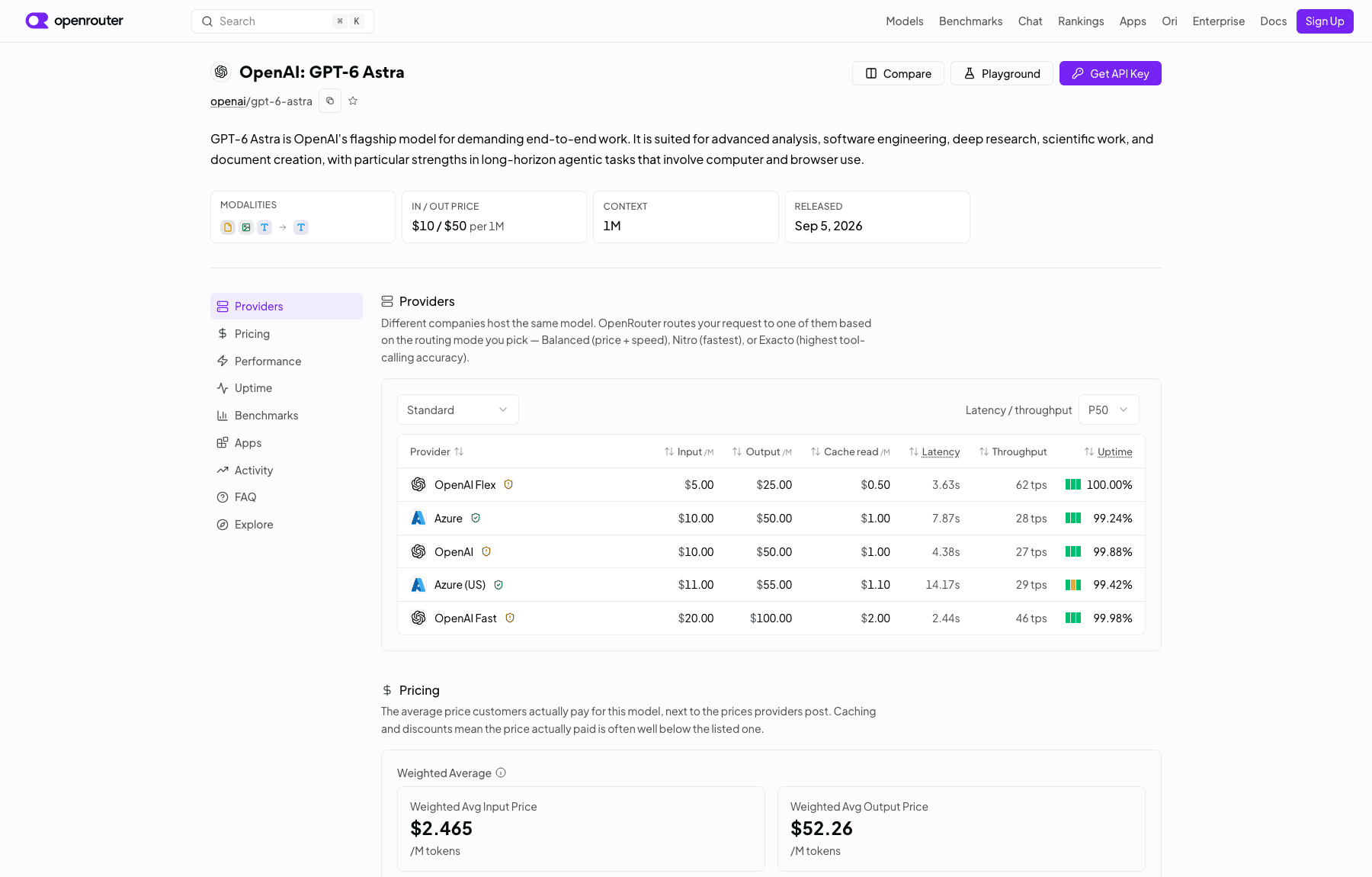
The headline number for OpenAI's new flagship is $10 in, $50 out per million tokens. Anyone working out how to use GPT-6 Astra on a real budget will find that neither figure survives contact with the actual routing table: the cheapest live route charges $5 / $25, the fastest charges $20 / $100, and OpenRouter's own weighted average of what customers genuinely paid this week is $2.465 in and $52.26 out. One of those numbers is below list. The other is above it.
Key Takeaways:
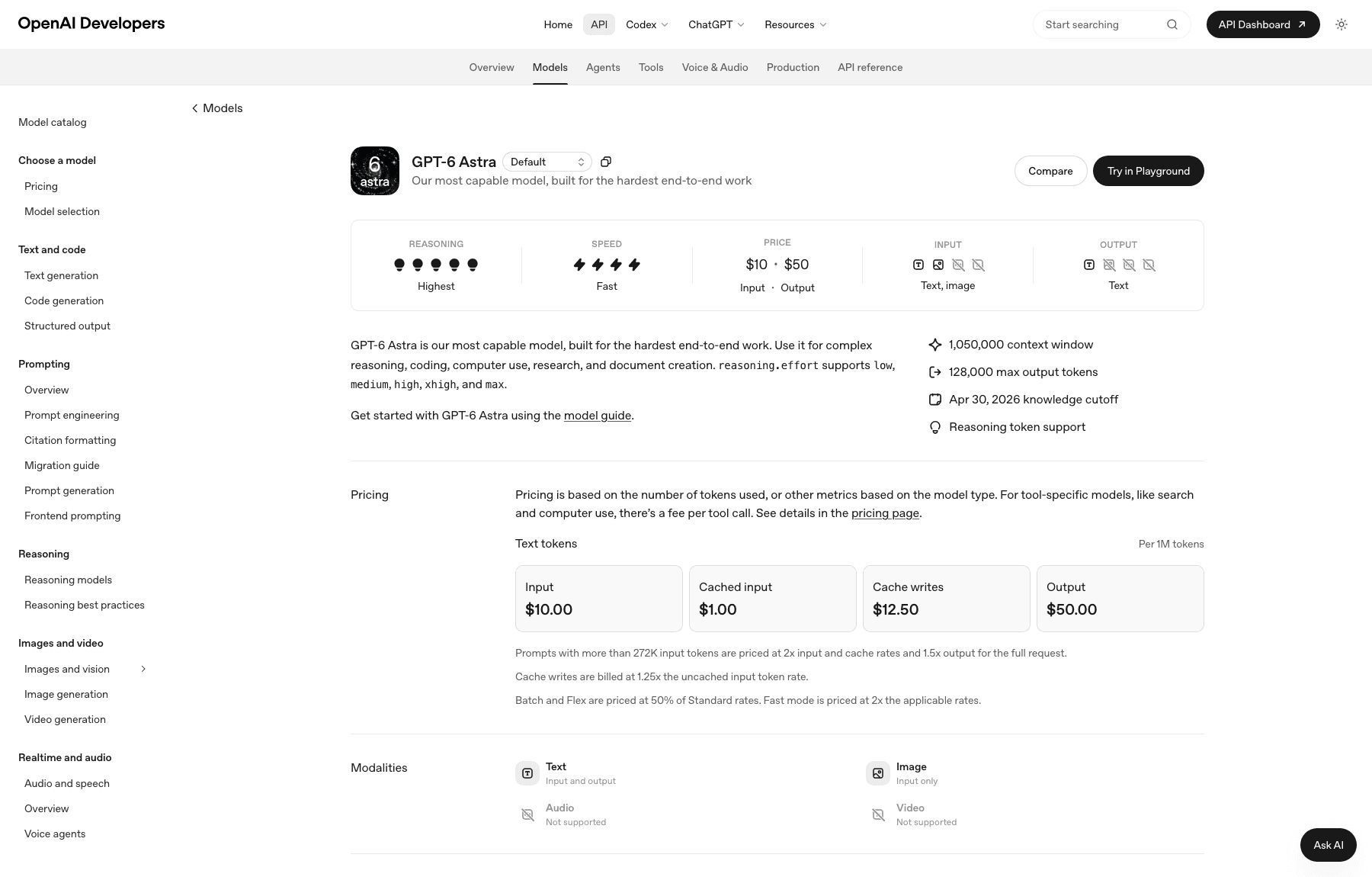
- GPT-6 Astra listed on OpenRouter on 5 September 2026 at $10 input / $50 output per 1M tokens, with a 1,050,000-token context window and 128,000 max output tokens.
- Prompts over 272K input tokens are billed at 2x input and cache rates and 1.5x output for the whole request, so the advertised million-token window gets expensive at roughly a quarter of its length.
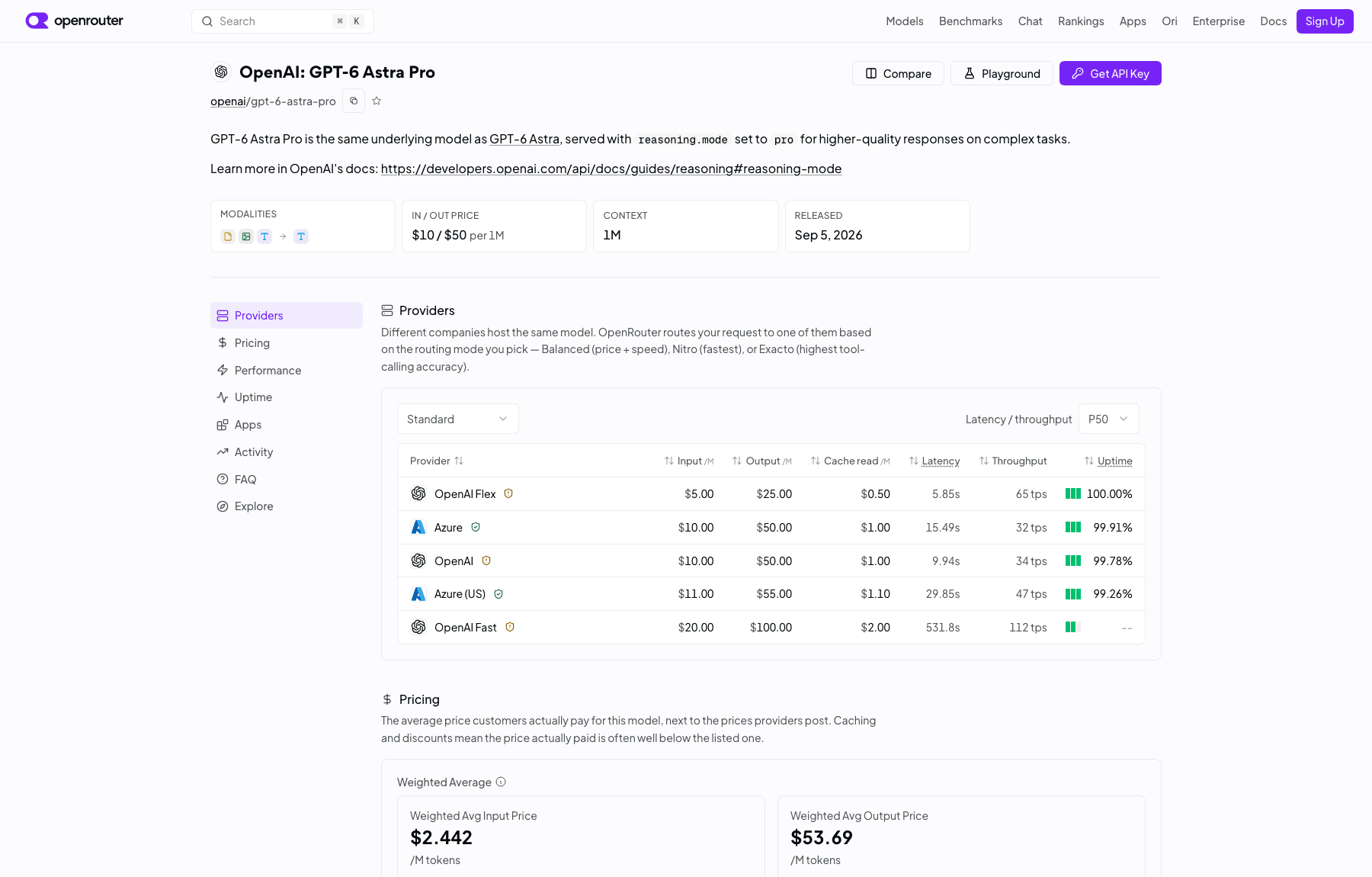
- "GPT-6 Astra Pro" is not a more expensive model. OpenRouter's page describes it as the same underlying model served with
reasoning.modeset topro, at the identical $10 / $50. - Five routes are live and the spread between them is 4x: OpenAI Flex $5 / $25, Azure and OpenAI standard $10 / $50, Azure US $11 / $55, OpenAI Fast $20 / $100.
- Cached input is $1.00 against $10.00 uncached, which is the single biggest lever on the bill for anything that reuses a system prompt.
What GPT-6 Astra is built to do
OpenAI's model page calls it "our most capable model, built for the hardest end-to-end work" and points it at complex reasoning, coding, computer use, research and document creation. The knowledge cutoff is 30 April 2026. reasoning.effort takes five values: low, medium, high, xhigh and max.
What people are actually doing with it looks less like an API benchmark and more like a workstation. On 5 September, an illustrator posting as taiyaki_sun handed it a hand-drawn line sketch and asked it to colour the drawing in Clip Studio Paint, then watched it create layers, zoom and pick brushes while they did nothing; that run took a $100 Pro plan's quota from 78% to 57% at maximum effort. Others have used it to rig models in Blender and to assemble interactive 3D pages. The pattern is long sessions of computer use rather than single prompts, which is exactly the usage pattern that makes the pricing footnotes matter more than the headline.
Long-horizon work needs a machine that stays up
A drawing session that runs for an hour, or an agent loop that runs overnight, does not care about your laptop lid. MoClaw is a hosted cloud AI computer that keeps the session alive on its own hardware, next to the tools you already use rather than in place of them.
The pricing footnotes that move the bill
Three lines sit under the price table on OpenAI's model page, and they matter more than the table does.
The first: "Prompts with more than 272K input tokens are priced at 2x input and cache rates and 1.5x output for the full request." Read that carefully. It is not a surcharge on the tokens above the threshold; it re-rates the entire request. A 280K-token prompt costs $5.60 in input, not $2.72 plus a bit. And 272K is 26% of the 1,050,000-token window the model advertises, so the context you were sold and the context you can afford are different sizes.
The second: cache writes are billed at 1.25x the uncached input rate, which is $12.50 per million. Caching still wins on anything you reuse, since cached reads land at $1.00 against $10.00, but the first pass costs more than it looks.
The third: "Batch and Flex are priced at 50% of Standard rates. Fast mode is priced at 2x the applicable rates." That single sentence explains the entire spread in the routing table.
How to use GPT-6 Astra without paying the Fast tax
Five providers serve openai/gpt-6-astra and the routing choice is worth more than any prompt optimisation you will do this month.
OpenAI Flex sits at $5 / $25 with 100% uptime and 62 tokens per second, answering in about 3.6 seconds at the median. Azure and OpenAI standard both charge $10 / $50; Azure's median latency measured 7.87 seconds against OpenAI's 4.38, for the same money. Azure US costs $11 / $55, a 10% premium for regional pinning. OpenAI Fast charges $20 / $100 and returns first token in 2.44 seconds.
So the question of how to use GPT-6 Astra economically has a boring answer: default to Flex for anything asynchronous, pay standard for interactive work, and treat Fast as a deliberate purchase rather than a routing accident. Half a second of latency is not worth quadrupling a bill you will look at in thirty days. Routing rules like that belong somewhere they get applied every time rather than in a comment above a constant, which is one reason MoClaw keeps model and tier selection at the session level.
The weighted averages tell you what people are actually doing. $2.465 average input against a $10 list means caching is working hard across the userbase. $52.26 average output against a $50 list means enough traffic is landing on Fast to drag the mean above the sticker price. Somebody is paying the Fast tax, and it probably isn't on purpose.
GPT-6 Astra Pro is a parameter, not a plan
This one catches people. There is a separate model id, openai/gpt-6-astra-pro, and the natural assumption is that it is a higher tier with a higher price.
It isn't. OpenRouter's page for it says plainly that Pro "is the same underlying model as GPT-6 Astra, served with reasoning.mode set to pro for higher-quality responses on complex tasks." Same five providers, same $10 / $50, same 1M context, same 5 September listing date. You are not buying a bigger model; you are buying more thinking per answer, and you pay for it in output tokens because the reasoning tokens are output tokens.
The measured difference shows up in latency rather than price. On the Pro id, OpenAI Fast's median latency reads 531.8 seconds with no uptime figure yet, against 2.44 seconds on the standard id. Early sample sizes are unreliable and that number will probably settle, but it is a reasonable warning against wiring Pro into anything with a request timeout.
What Astra will refuse to do
Worth knowing before you architect around it. The model takes text and image input and returns text only. Audio and video are not supported on either side. It is not available for Realtime, Assistants, fine-tuning, embeddings, image generation, video, speech generation, transcription, moderation, or the legacy Completions endpoint.
That list is longer than it is for most flagship launches, and it means Astra is a reasoning and computer-use engine rather than a general replacement for whatever you are running today. If your stack currently pipes audio through one model and text through another, Astra slots into one of those holes and not the other. This is the kind of thing that makes model selection a runtime decision rather than a config constant, which is the job MoClaw takes off your hands: pick the model per task inside the session instead of pinning one id across a codebase and discovering the gap in production.
Getting a task-level cost, not a token-level one
Per-token pricing is the wrong unit for computer use, and most of the launch coverage has been pricing the wrong thing.
A model that costs 2.5x more per token but finishes a job in a third of the turns is cheaper for that job. Latent Space's write-up of the launch made this argument directly, framing Astra as an automated engineer you can run for under $6 an hour. That framing is a claim about task cost, not token cost, and it is not something OpenAI's price table can confirm or deny.
Suppose you want to test it honestly. Pick one task you already run, log total tokens and wall-clock time on your current model, then run the same task on Astra at reasoning.effort: high through Flex, and compare dollars per completed task rather than dollars per million tokens. Do that before you migrate anything. The 272K re-rating rule in particular only shows up in a real run, because it triggers on accumulated conversation length rather than on your initial prompt, and long agent sessions accumulate.
Running that comparison somewhere that survives a closed laptop helps more than it sounds. A MoClaw session holds the working state, the file outputs and the token accounting in one place while the run finishes, and it does that alongside your existing OpenAI account rather than asking you to move off it. Our note on agents versus raw API calls covers why the accounting differs between the two.
FAQ
How much does GPT-6 Astra cost?
$10 per million input tokens and $50 per million output, checked against OpenAI's developer documentation on 7 September 2026. Cached input is $1.00, cache writes are $12.50. Batch and Flex run at half those rates and Fast at double. Prompts above 272K input tokens re-rate the whole request at 2x input and 1.5x output.
Is GPT-6 Astra Pro better than GPT-6 Astra?
It is the same model with reasoning.mode set to pro, so it produces more deliberate answers on hard problems at the same per-token price. You pay for it through longer reasoning output and slower responses rather than a higher rate.
What is the context window?
1,050,000 tokens, with a maximum of 128,000 output tokens per response. The practical planning number is lower: past 272K input tokens the whole request costs double on input and half again on output.
Can GPT-6 Astra handle audio or video?
No. Text and image go in, text comes out. Audio and video are listed as unsupported, and the model is excluded from Realtime, transcription and speech generation endpoints.
Which provider should I route to?
OpenAI Flex at $5 / $25 for anything that tolerates queuing, standard OpenAI at $10 / $50 for interactive work. Azure US costs 10% more and buys regional placement. Fast at $20 / $100 buys roughly two seconds, which is rarely the right trade.
Deciding whether GPT-6 Astra belongs in your stack yet
The model is four days old at the time of writing and the interesting numbers are still moving; the weighted averages above will read differently next week once launch-week Fast traffic settles. Treat every figure here as dated 7 September 2026 and re-check before you commit a budget.
What is unlikely to change is the shape of the decision. Astra is priced as a specialist, restricted to text and image, and billed in a way that punishes long context and rewards caching. If your work is long-horizon computer use, that is a reasonable set of trades. If you mostly need fast, cheap, high-volume completions, the cheaper models we compared earlier still do that job better, and what your token bill is actually made of is worth reading before you switch anything.
Continue Reading
More Guide
MiniMax M3 Free Ended: What to Use Instead

MarkItDown: When Your Markdown Comes Back Thin

Lightpanda Is Fast Because of What It Skips

OpenAI Deprecated Its Codex Skills Repo

Open Science: The AI Workbench for Researchers

GLM 5.2 Free Is Gone From OpenRouter
The MoClaw editorial team writes about workflow automation, AI agents, and the tools we build. Default byline for industry overviews, listicles, and collaborative pieces.
Ready to put this into practice?
MoClaw runs browser tasks, research, and schedules automatically. Try it free.
References: https://developers.openai.com/api/docs/models/gpt-6-astra · https://openrouter.ai/openai/gpt-6-astra · https://openrouter.ai/openai/gpt-6-astra-pro · https://www.latent.space/p/astra · https://x.com/taiyaki_sun/status/2096149368193839455