Open Science: The AI Workbench for Researchers

Open Science by AIPOCH is an open-source, local-first AI workbench that runs Python and R, adds Slurm support in v0.26.0, and logs provenance. (Sep 2026)
Table of Contents
Most AI tools aimed at scientists are chat boxes that read papers for you. The Open Science AI workbench, built by a team calling itself AIPOCH, is trying to be the thing that runs the analysis instead, on your own hardware, with a record of what it did. It went public on 3 July 2026 and has picked up 3,904 stars and 241 forks since; as of September 2026 it shipped four tagged releases in the eight days ending today, which is a release cadence you almost never see outside the first months of a project that has found something.
Whether it deserves a place in your workflow depends on a question the marketing copy won't answer for you: do you need the analysis to be inspectable afterwards, or do you just need an answer? If the second, a chat window is cheaper. If the first, keep reading.
Key Takeaways
- Open Science is an Apache-2.0 desktop workbench for macOS, Windows and Linux that runs Python and R locally and keeps a provenance trail for what it did.
- It's model-agnostic by design: the provider is a setting, so you aren't making a procurement decision every time you start an analysis.
- v0.26.0, released 7 September 2026, adds per-host Slurm submission for HPC clusters plus a reference library for PDFs and citations.
- Four tagged releases landed in the eight days to 7 September. Pin a version before you build a lab protocol on it.
- Two README claims, a "#1" benchmark badge and a Zenodo DOI, didn't check out from the outside. Run the benchmark yourself.
What the Open Science AI workbench actually is
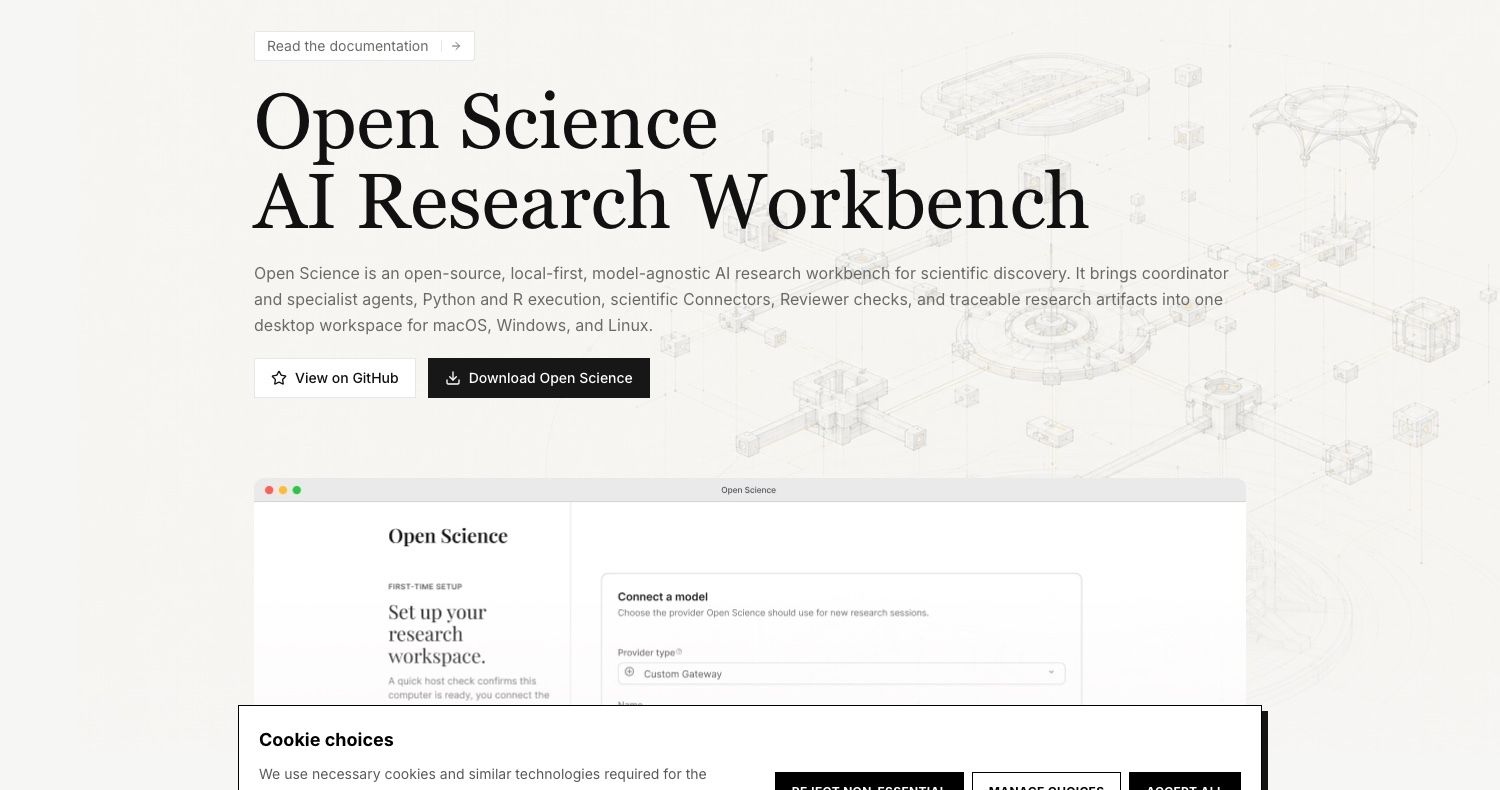
The Open Science AI workbench is a desktop application for macOS, Windows and Linux, written in TypeScript, licensed Apache-2.0. Inside it you get a coordinator agent that dispatches to specialist agents, Python and R execution, connectors to scientific data sources, a reviewer pass that checks work, and a provenance trail attached to whatever comes out.
The phrase the project uses for itself is local-first and model-agnostic. Local-first means the workspace, the notebooks and the artifacts live on your machine rather than in someone's tenant. Model-agnostic means the provider is a setting, not an architecture: you point it at a gateway, pick a model, and swap later without rewriting anything you built on top.
That second property is doing more work than it looks like. A lab that standardises on one vendor's assistant has quietly made a procurement decision about every future analysis, and unwinding it later means redoing the work rather than changing a dropdown.
Reproducibility is the actual pitch, and it's an unusual one
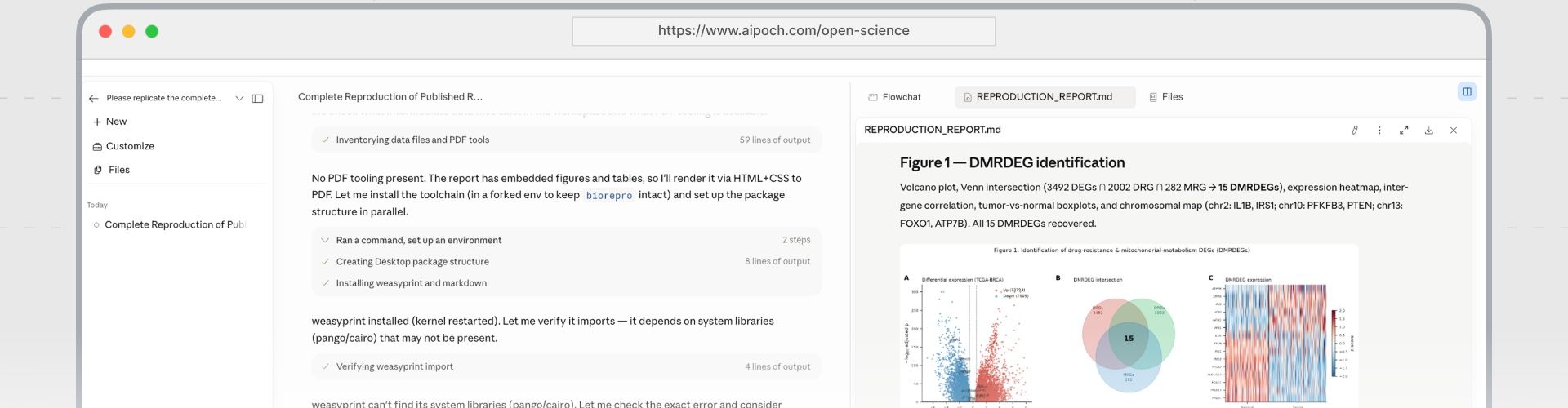
Look at what the session above is doing. It isn't summarising a paper. It's reproducing one: pulling the source figure's analysis apart, running the differential expression, taking the Venn intersection of 3,492 DEGs, 2,002 DRG and 282 MRG down to 15 DMRDEGs, and writing a REPRODUCTION_REPORT.md that says all fifteen were recovered.
The interesting part is the middle, where the agent discovers no PDF tooling exists in the environment, installs weasyprint, finds weasyprint can't locate pango and cairo, and installs the pango stack through conda before continuing. That failure is visible in the transcript. In a chat interface it would have been an apology and a suggestion that you install some dependencies yourself.
This is the distinction worth holding onto: a research assistant that produces text is graded on whether the text sounds right, and a workbench that produces artifacts is graded on whether someone else can rerun it. The second bar is much higher and much more useful. We wrote about the volume problem this exists to address in the arXiv paper explosion; reproduction is the other half of it.
What landed in v0.26.0, and why HPC support is the tell
Today's release pairs two things that don't obviously belong together: cluster compute and a literature workspace.
On the compute side, remote hosts can now pick a per-host execution mode, either direct SSH or Slurm, so a notebook run submits as a Slurm job on an HPC-partitioned cluster. The release notes list durable submission, polling, recovery, cancellation and cleanup, plus a guided Compute Environment Setup skill that walks a user or an administrator through the cluster's exact setup and repair steps. On the literature side there's a new reference library holding references, downloaded PDFs and citations in collections, with identifier-aware imports, duplicate comparison, a bulk merge that preserves attachments, full-text PDF attachment through public open-access sources, and citation formatting with provenance.
Building Slurm integration this early tells you who the project is chasing. Nobody adds job polling and cancellation for a hobbyist; you add it because users are running things that take hours on shared university hardware and keep getting killed. It also quietly concedes the limit of the local-first model, which is that the laptop the workbench runs on is rarely the machine the work belongs on.
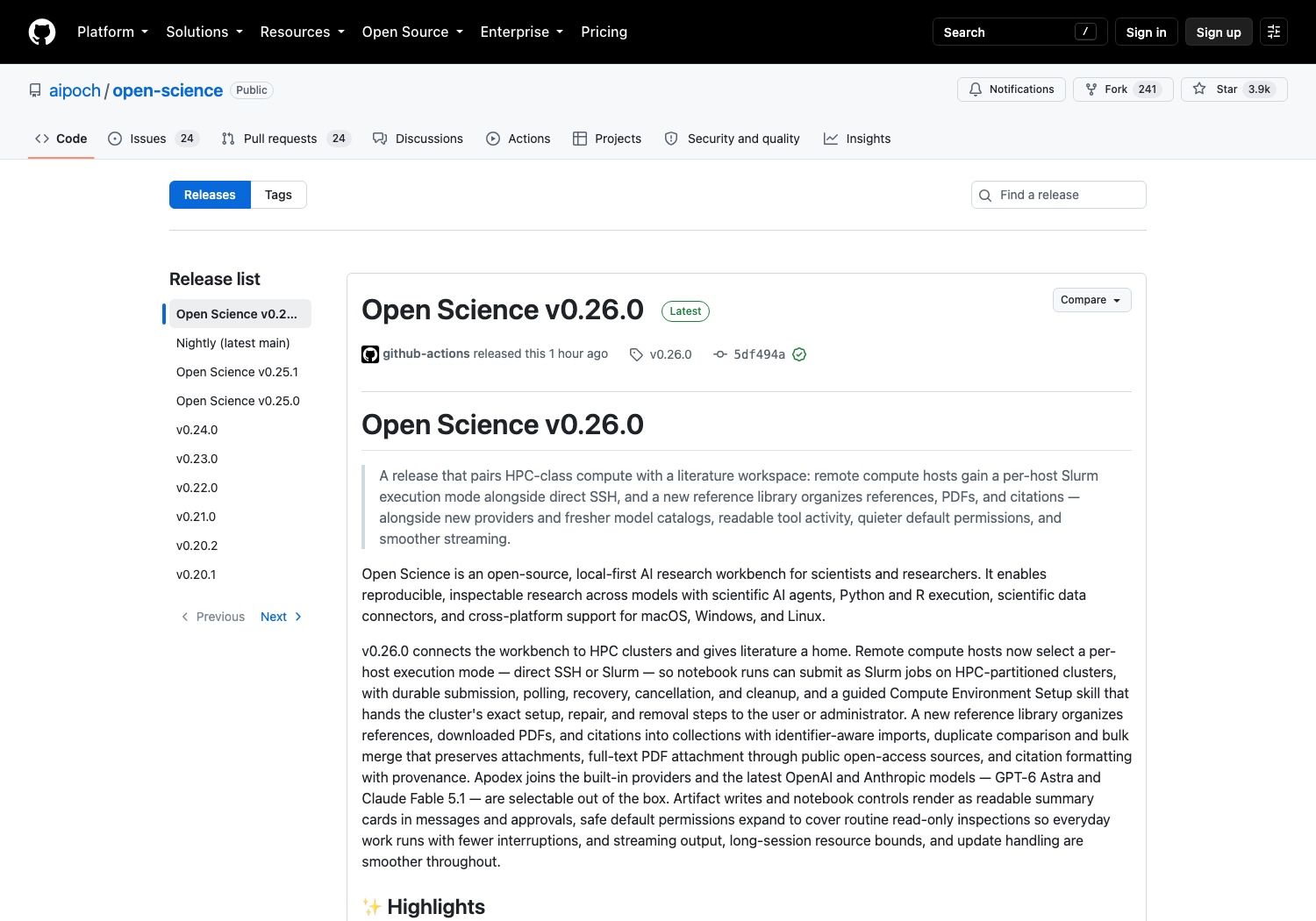
The same release adds Apodex to the built-in providers and makes GPT-6 Astra and Claude Fable 5.1 selectable out of the box, expands the safe-permission defaults to cover routine read-only inspections so fewer prompts interrupt a run, and makes tool activity render as readable summary cards rather than raw output.
Read that cadence as a warning as well as a signal. v0.23.0 landed on 30 August, v0.24.0 the next day, v0.25.0 and v0.25.1 within twenty-four hours of each other on 2 and 3 September, and v0.26.0 this morning. Software moving that fast is software whose defaults are still being argued about, and the permission model changed in this release alone. If you're going to build a lab protocol on top of it, pin a version, write down which one, and upgrade deliberately rather than whenever the app offers.
Who it's for, and who it isn't
The people this fits are researchers who already write some Python or R and are tired of being the glue between a chat window and a terminal. You don't have to be a developer to use it, which is the point of shipping a desktop app rather than a library, but you do need to be someone for whom a notebook is a normal object.
It fits badly in two cases. If your work is mostly writing rather than analysis, the reviewer pass and the provenance trail are overhead you'll route around. And if you're in a group where nobody can install unsigned desktop software on a managed machine, the local-first design becomes the obstacle rather than the feature, and no amount of Apache licensing fixes that.
There's a subtler mismatch worth naming. A workbench that runs Python, R and a browser on your laptop competes with you for that laptop; anyone who has tried to write a discussion section while a differential expression run pegs every core knows the feeling. Moving the heavy half onto a hosted cloud computer is the version of this that doesn't require a cluster account, and it's the split MoClaw is built around: the agent gets its own machine, you keep yours responsive.
Where this fits if you already have a cloud agent
Slurm access solves the "my laptop is too small" problem for people who have a cluster account. Plenty of researchers don't, or have one whose queue makes an eight-hour wait normal for a twenty-minute job.
The gap in between is where a hosted cloud computer earns its keep. A long literature sweep or a batch of reruns doesn't need a 64-core partition; it needs a machine that stays awake and keeps a session alive when yours closes. MoClaw covers exactly that band, sitting alongside a local Open Science install rather than replacing it: you keep the workbench and its provenance trail on your own disk, and hand the jobs that don't fit your day to something that isn't your laptop. The same argument shows up whenever an agent has to hold a task across hours, which we walked through in running research and analysis on a model that stays available.
There's a second, less obvious version of this. Provenance only helps if the artifact survives; a reproduction report on a laptop that gets reimaged before you write it up is not much of a record. Keeping the long-running half of the work on a hosted machine you can reach from a different device means the trail doesn't live or die with one piece of hardware, and it means the person who picks the job back up on Monday can be on a different computer, or a different continent, than the one who started it. That handoff is the part MoClaw makes boring, and boring is the correct target for infrastructure.
What I could not verify, and you shouldn't repeat
Two claims in the project's README don't check out from the outside, and both are the kind that get copied into blog posts unexamined.
The repository badges a "#1 BiomniBench-DA Public 50" result. BiomniBench-DA is real: it's the data-analysis instantiation of BiomniBench, a process-level evaluation framework for LLM agents on biomedical research tasks, with 50 of its 100 tasks publicly released and expert-authored rubrics for grading. The dataset page publishes no leaderboard, so there's nothing there to check a first-place claim against. The README also carries a Zenodo DOI badge; the DOI didn't resolve for me when I tried it on 7 September 2026, which may well be transient, but I'm not going to assert a citable archive I couldn't open.
Neither of these is evidence of anything dishonest. Both are reasons to run the benchmark yourself before you put the claim in a grant application, which is a slightly awkward position for a project whose entire argument is that you should be able to check things.
FAQ
Is Open Science free and open-source?
Yes, Apache-2.0, with the full source on GitHub and installers published as release assets for macOS, Windows and Linux. The models it calls are a separate cost and depend on which provider you connect.
Does it work offline and keep my data local?
The workbench, notebooks and artifacts are local by design; that's what local-first means here. The model calls still go to whichever provider you configure, so "local workspace" and "fully offline" aren't the same claim. A locally hosted model behind a compatible gateway is the only route to the second.
Which AI models does it support?
It's model-agnostic by design, and you choose a provider type during setup rather than being handed one. As of v0.26.0 the built-in provider list includes Apodex, with GPT-6 Astra and Claude Fable 5.1 selectable without extra configuration. Treat any fixed list as a snapshot; the model catalog has changed in most recent releases.
Is it ready for real work?
It's on v0.26.0 with a two-month history, 24 open issues and 24 open pull requests. That's early. Reproducibility tooling is also the category where early software is least dangerous, because the output is designed to be checked rather than trusted.
How is this different from a deep research assistant?
A deep research tool reads and summarises. This one executes: Python and R run, artifacts get written, and a reviewer pass checks them. If what you need is a literature scan rather than an analysis, our deep research integration is the closer fit.
Worth watching, with one condition
The Open Science AI workbench is the most interesting thing in the research-tooling space this quarter, and the reason is narrow: it treats the transcript as the deliverable. The weasyprint failure sitting in plain view in a promotional screenshot is a better argument for the product than any benchmark badge on the README.
The condition is the one the project sets for itself. A tool whose pitch is that you can verify the work has to be verifiable all the way down, including its own claims, and right now two of those don't survive a look. Download it, run something you already know the answer to, and see whether the report matches. That's the test the software is asking you to apply to everything else.
Continue Reading
More Guide
MiniMax M3 Free Ended: What to Use Instead

MarkItDown: When Your Markdown Comes Back Thin

Lightpanda Is Fast Because of What It Skips

OpenAI Deprecated Its Codex Skills Repo

How to Use GPT-6 Astra: What It Really Costs

GLM 5.2 Free Is Gone From OpenRouter
The MoClaw editorial team writes about workflow automation, AI agents, and the tools we build. Default byline for industry overviews, listicles, and collaborative pieces.
Ready to put this into practice?
MoClaw runs browser tasks, research, and schedules automatically. Try it free.
References: aipoch/open-science on GitHub · Open Science v0.26.0 release notes · Open Science product page (AIPOCH) · BiomniBench-DA dataset on Hugging Face · Open Science releases on GitHub