What Is Agent-Reach? Free Eyes for AI Agents
Agent-Reach hit 65K GitHub stars letting AI agents read Twitter, Reddit, YouTube and Chinese platforms with zero API fees. How it works, and the real risks.

Table of Contents
Agent Reach is a free, MIT-licensed Python CLI that gives an AI agent read and search access to Twitter, Reddit, YouTube, Bilibili, XiaoHongShu and roughly a dozen other platforms. It isn't a scraping service and not an API wrapper: it picks a working access path for each platform, installs it, health-checks it, and then gets out of the way while your agent calls those upstream tools directly.
The project passed 65,300 GitHub stars on August 3, 2026. Archived snapshots of its repository page show it sitting at 5,618 stars on March 5, which makes this one of the fastest-growing agent tools of the year and, as the numbers below show, one that grew twice.
Key Takeaways:
- Agent Reach is an installer, a doctor, and a router. The reading is done by upstream open-source tools your agent calls directly, which is exactly why there are no API fees to pay.
- Every platform is an ordered list of backends. When Bilibili started returning 412 errors to yt-dlp in June 2026, the project re-pointed the channel at bili-cli and users did nothing.
- Its Chinese-platform coverage (XiaoHongShu, Bilibili, V2EX, Xueqiu, Xiaoyuzhou) is the part with no real English-language equivalent. Douyin and WeChat articles are not supported, despite what secondhand write-ups claim.
- The cookie-authenticated platforms carry a genuine account-ban risk. The project's own install guide tells you to use a secondary account.
- Star growth stalled at roughly 70 per day through May, then hit roughly 950 per day in June. The second surge, not the first, is what put it near the top of GitHub.
What is Agent Reach?
Agent Reach solves a narrow, annoying problem: your AI agent can technically "go online," but the places worth reading are the places that fight back.
The README lays the pain out in a table that will be familiar to anyone who has tried this. The Twitter API costs real money at moderate usage. Reddit returns 403s to server IPs. XiaoHongShu requires a login to browse anything. Bilibili blocks overseas and datacenter addresses. So connecting an agent to the platforms where information density is actually highest means finding a tool per platform, installing its dependencies, and debugging its config, one at a time, every time you spin up a new agent.
Agent Reach compresses that into a single instruction you paste into your agent. It then installs what is needed, detects what your environment can support, and reports back on what works.
One naming note before you go searching: the repository is Agent-Reach, the README says "Agent Reach," and the command is agent-reach. All three are the same project. It's MIT licensed, needs Python 3.10 or newer, and was at version 1.5.0 at the time of writing.
Why Agent Reach is exploding now
Most coverage of this project treats its growth as one continuous rocket. It was not. Archived snapshots of the GitHub repository page tell a more interesting story, and it's the reason this repo is showing up in feeds again in August rather than in April.
| Date | Stars | Growth since previous |
|---|---|---|
| March 5, 2026 | 5,618 | first surge, roughly 10 days after creation |
| April 29, 2026 | 18,497 | |
| June 4, 2026 | 21,032 | about 70 per day |
| June 26, 2026 | 41,874 | about 947 per day |
| July 15, 2026 | 56,724 | |
| August 3, 2026 | 65,334 | GitHub API, verified at publication |
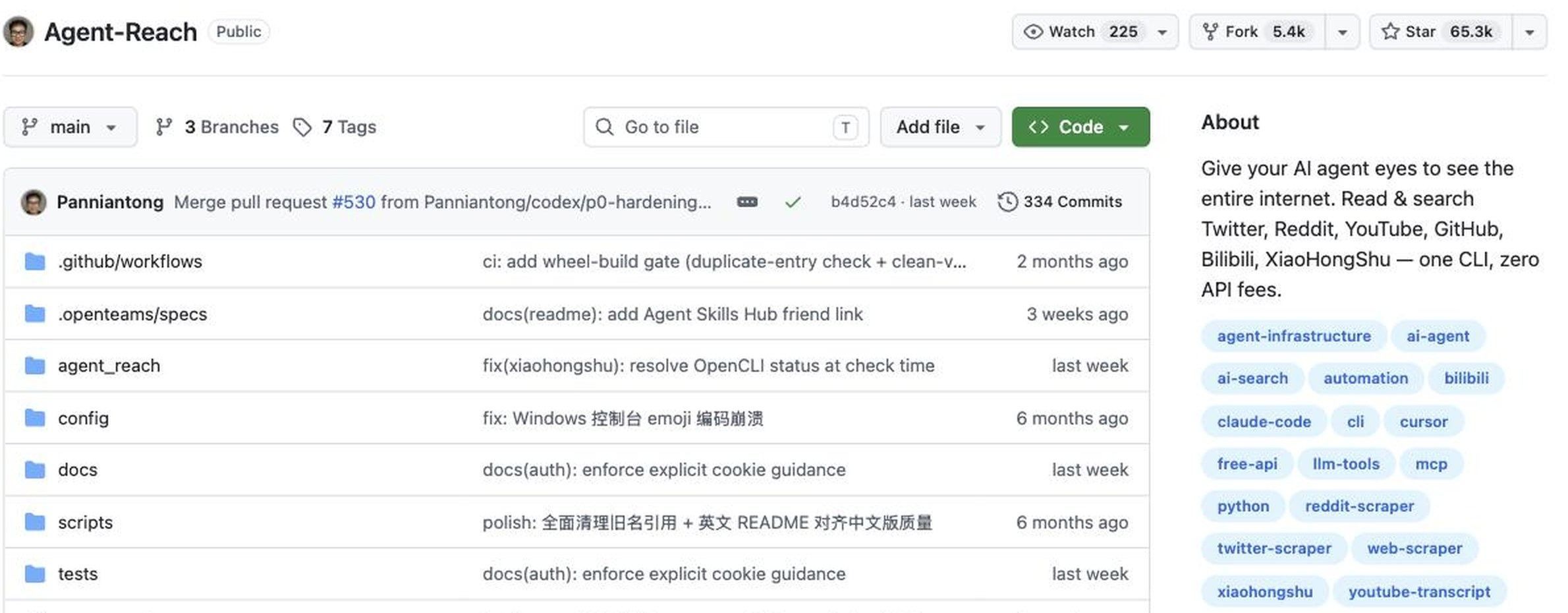
The shape that matters is in the middle. Between late April and early June the project added roughly 70 stars a day, which is a normal decay curve for a repo that had a good launch and then settled. Then something changed in June and the rate went up more than thirteen times, adding almost 21,000 stars in 22 days. The repository carries a Trendshift badge for Repository of the Day, and it's currently ranking again on daily-growth trackers, which is the second wave, not the first.
One detail makes the current run unusual. The last commit to the repository landed on July 25, 2026, and the project has still added roughly 4,700 stars in the ten days since. Growth that continues while the code sits still is being driven by people discovering the project rather than by shipping, which is the signature of a tool that spread through demos and word of mouth rather than through releases.
How it actually works: an installer, not a wrapper
This is the part that most write-ups get wrong, and getting it wrong makes the "zero API fees" claim look like marketing.
The project's own internal documentation is blunt about it. Its CLAUDE.md file describes the positioning in one line: "installer + doctor + config tool. NOT a wrapper, after install, agents call upstream tools directly." The README says the same thing from the other direction: Agent Reach "handles selection, installation, health checks, and routing, not the reading itself."
So the runtime picture looks like this. You ask your agent to read a tweet. Your agent doesn't call Agent Reach. It calls twitter tweet <url>, the CLI that Agent Reach installed and configured for it. Agent Reach is not in the request path at all.
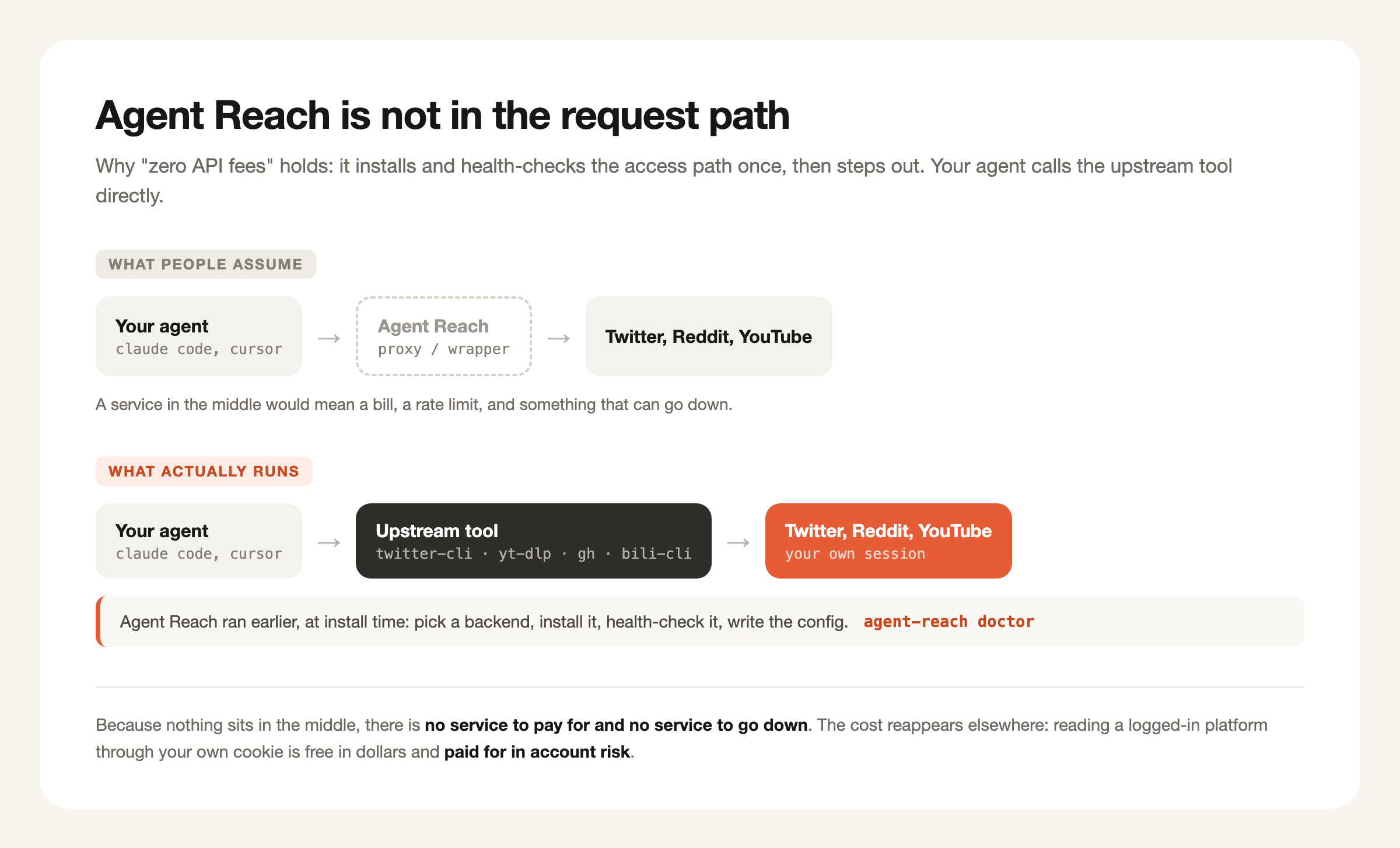
That architecture has three consequences worth understanding:
There's no service to pay for, and no service to go down. Agent Reach has no servers. If the project were abandoned tomorrow, everything it already installed on your machine would keep working.
Every platform is an ordered backend list rather than an integration. The source tree keeps one file per platform, and each one probes its candidate backends in order rather than just checking whether a command exists. The first fully working backend becomes active. Twitter reads twitter-cli, then OpenCLI, then bird. Bilibili reads bili-cli, then OpenCLI, then a search API.
Switching access paths is a config change, not a rewrite. The best real example is in the changelog rather than the pitch: in June 2026 Bilibili began returning 412 errors to yt-dlp, so the project retired that path and moved the channel to bili-cli. Existing users took no action and saw no interruption. The README notes a similar cleanup in March 2026, when a batch of single-platform CLIs went unmaintained at once.
The diagnostic command is the other half of the design. Running agent-reach doctor prints which platforms are ready, which need configuration, and which backend each one is currently using, with a fix suggestion attached to anything broken. The sample output in the README shows a partially configured machine reporting six of nine channels available, which is a more honest default than most projects put in their own documentation.
Supported platforms, including Chinese social media
Count the platforms carefully, because the project's own documents disagree. The README's platform table lists 15 rows. The CLAUDE.md file says 13. The channel registry in the source tree contains 12 files. The gap is not sloppiness so much as a definition problem: a few platforms are served by helper scripts and guides rather than by a channel module, and the podcast transcription path is a shell script rather than a channel.
The English-facing platforms are the ones you would predict: any web page via Jina Reader, YouTube subtitles and search via yt-dlp, GitHub via the official gh CLI, RSS via feedparser, web search via Exa, plus Twitter/X, Reddit, LinkedIn, Facebook and Instagram.
The interesting half is the one that has no equivalent in any comparable English-language project:
| Platform | What it reads | What it needs |
|---|---|---|
| XiaoHongShu (小红书) | Notes, search, comments | An existing Chrome session, or a manual cookie export |
| Bilibili | Search and video detail without login; subtitles via browser session | Zero config |
| V2EX | Hot topics, node topics, thread replies, user profiles | Zero config, public JSON API |
| Xueqiu (雪球) | Stock quotes, search, hot posts, hot stocks | Browser cookie |
| Xiaoyuzhou (小宇宙) | Podcast audio transcribed to full text | A free Groq Whisper key |
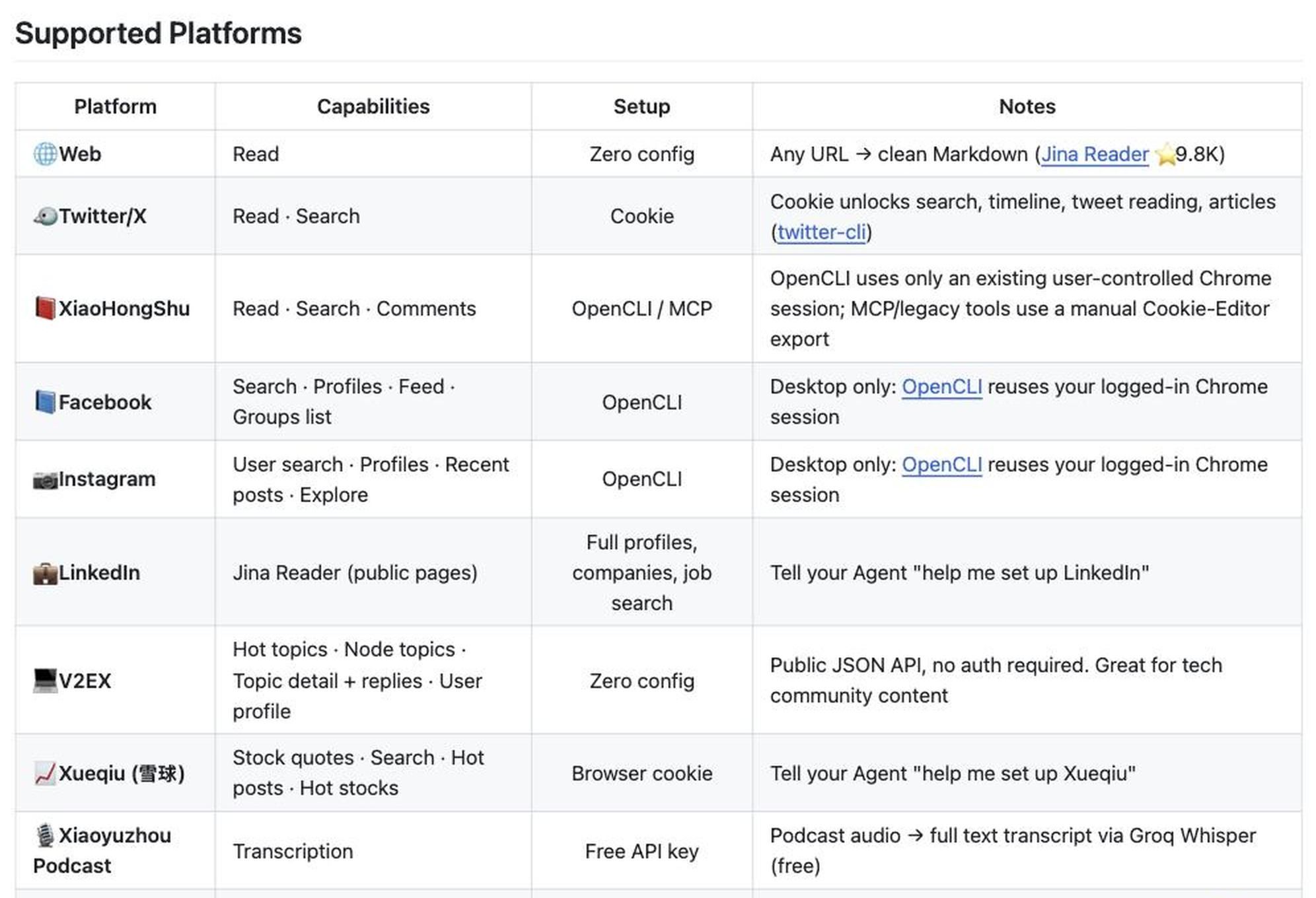
Two of those deserve a flag. V2EX is genuinely zero-config because it exposes a public JSON API, which makes it the easiest Chinese-language developer community for an agent to read. Xueqiu is a retail investor forum, and it is an odd and revealing inclusion: nobody adds a stock-discussion site to a general reading tool unless people asked for it.
One correction, because it is circulating in secondhand coverage of this project: Douyin and WeChat public articles are not supported. Neither appears in the platform table, the channel registry, or the install guide. If you need those, Agent Reach is not the tool.
How is it free? The upstream open-source stack
"Zero API fees" is true, and it is true for a structural reason rather than a generous one. Agent Reach doesn't resell anyone's API because it doesn't call anyone's API. It installs open-source clients and lets your agent run them locally under your own identity.
The stack it assembles is almost entirely other people's work, which the project credits openly:
| Job | Tool | Why it is free |
|---|---|---|
| Read any web page | Jina Reader | Free endpoint, no API key |
| YouTube subtitles and search | yt-dlp | Local binary, no service |
| GitHub | official gh CLI |
Free for public repos |
| RSS | feedparser | Local Python library |
| Web search | Exa via mcporter | Free tier key |
| Twitter, Reddit, XiaoHongShu | twitter-cli, rdt-cli, OpenCLI | Your own session, not an API |
That last row is the one doing the real work, and it's also where the cost reappears in a different currency. Reading Twitter through your own cookie is free in dollars because you're paying in account risk instead. The README's own comparison notes that moderate Twitter API usage runs about $215 a month, which is a fair statement of what is being avoided and a fair hint at why the platform would rather you paid it.
The only cash cost the project acknowledges is a proxy, around $1 a month, and only for networks that block the platforms outright or for server IPs that get flagged.
Risks you should know before installing Agent Reach
The project is unusually direct about this, and repeating it is the point rather than a disclaimer.
Cookie authentication carries a real ban risk. The install guide recommends a dedicated or secondary account for every cookie or browser-session platform, and names two reasons: platforms may detect non-browser API calls and restrict or ban the account, and cookies grant full account access, so a secondary account limits the blast radius if the credentials leak. Treat "use a burner" as the default, not the cautious option.

A cookie is not a scoped token. This is the part people underestimate. An API key can be revoked and usually has limited permissions; an exported session cookie is, functionally, being logged in. Anything holding it can act as you.
Reddit is the hardest case. Anonymous endpoints are blocked and the official API requires manual approval, so there's no zero-config path at all. Server deployments frequently get their datacenter IP flagged, and the documented workaround is a residential proxy at roughly $1 a month. If you're running an agent on a VPS, expect to deal with this.
Terms of service are yours to evaluate. Reading a logged-in platform through an automated client is, on several of these platforms, not what the terms permit. The project is a tool and does not make that call for you.
To the project's credit, cookies stay on your machine and are never uploaded, the whole thing is open source and auditable, and there's a --safe install mode that refuses to install system packages and instead tells you what is missing. If you're thinking about the broader question of what an autonomous agent should be trusted with, our guide to AI agent security risks covers the same ground at the policy level.
One last item, and it says something about the neighborhood this project now lives in: the README opens with a notice that Agent Reach has no token, coin, or crypto affiliation of any kind, and warns against wallet connections claiming otherwise. Popular agent repos are now impersonation targets. Verify you're on github.com/Panniantong/Agent-Reach before running anything.
Agent Reach vs your agent's built-in web search
Claude, ChatGPT and Cursor all ship web search now, so the fair question is what this adds.
| Built-in web search | Agent Reach | |
|---|---|---|
| Public web pages | Yes | Yes, via Jina Reader |
| Google-indexed content | Yes, that is the mechanism | Yes, plus semantic search via Exa |
| A specific user's Twitter timeline | No | Yes, with a cookie |
| Reddit thread search and comments | Partial, only what is indexed | Yes, with a session |
| YouTube transcripts | Rarely, and unreliably | Yes, via yt-dlp |
| XiaoHongShu, Bilibili, V2EX, Xueqiu | No | Yes |
| Cost | Included in your plan | Free, plus optional $1 proxy |
| Account risk | None | Real, on cookie platforms |
The distinction is not "search versus better search." Built-in web search reads the indexed, public, logged-out internet; Agent Reach reads the logged-in internet, which is where discussion, complaints, reviews and reactions actually live. Those are different corpora, and for most research questions the second one is the one you wanted.
The tradeoff is symmetric and you should price it honestly: built-in search costs you nothing and risks nothing; Agent Reach costs you nothing and risks an account.
What an agent does once it has eyes
Perception isn't the point; it's the input to something.
Agent Reach sits at what you might call the sensing layer of the agent stack, distinct from the agent harness that decides what to do with what comes back. The harness runs the loop, manages context, and enforces permissions. Agent Reach just widens what the loop can see. The two are complementary, and confusing them is how people end up expecting a reading tool to do scheduling.
The jobs it unlocks are mostly ones that were previously too tedious to sustain by hand. Watching a handful of subreddits for people describing a problem your product solves. Tracking what changed on a competitor's site and what users said about it the same week. Pulling transcripts from a conference channel to find which themes repeat.
The catch is that these are recurring jobs, and a reading tool on your laptop only runs when the laptop is open and you remember to ask. Standing monitoring needs somewhere to live, which is a hosting question rather than a capability one. It's the shape of workflow behind something like MoClaw's Reddit monitoring runs, where the schedule and the digest matter more than the fetch.
Getting started with Agent Reach
The intended path isn't a manual install. You paste one line into your agent and let it do the work:
Install Agent Reach: https://raw.githubusercontent.com/Panniantong/agent-reach/main/docs/install.md
The agent fetches the guide, installs what is needed, detects your environment, and reports what is ready. If you would rather it not touch system packages, add "use the --safe flag during install" and it'll tell you what's missing instead of installing it.
If you prefer to drive it yourself:
pip install https://github.com/Panniantong/agent-reach/archive/main.zip
agent-reach install --env=auto
Then run agent-reach doctor before configuring anything else. Two notes will save you a support round trip. OpenClaw users need openclaw config set tools.profile "coding" first, because the default messaging profile can't run shell commands and the whole design depends on that. And unlock platforms only as you need them: every cookie you export is a standing risk.
The official install guide is the authoritative reference, and it's maintained more actively than any walkthrough, including this one.
FAQ
Is Agent Reach really free?
Yes. It's MIT licensed, has no hosted service, and no paid tier. Every tool it installs is open source and every API it uses has a free path. The only cash cost the project acknowledges is an optional proxy at roughly $1 a month for restricted networks or flagged server IPs. The real cost is account risk on cookie-authenticated platforms, not money.
Does it work with Claude Code, Cursor and OpenClaw?
Yes, and with anything else that can run shell commands, because that's the entire integration surface. It also installs as a skill via npx skills add Panniantong/Agent-Reach@agent-reach. OpenClaw is the one platform with a prerequisite: switch the tool profile to coding first, or the agent won't be able to run the commands it installs.
Is it safe to use?
The software is auditable and keeps cookies local. The risk isn't the code; it's the credentials you feed it. Use a dedicated secondary account for any platform that needs a cookie or a browser session, as the project's own install guide recommends, and treat an exported cookie as full account access rather than as an API key.
Which Chinese platforms does it support?
XiaoHongShu, Bilibili, V2EX, Xueqiu and Xiaoyuzhou podcasts. Bilibili and V2EX work with no configuration; XiaoHongShu and Xueqiu need a browser session or cookie export. Douyin and WeChat public articles are not supported.
Is Agent Reach a scraper?
Not in the usual sense. It writes no scraping code and runs no crawler of its own. It selects, installs and health-checks other people's open-source clients, and your agent calls those directly. The scraping, where it happens, is done upstream.
Last updated: August 3, 2026. Star counts, license, version and platform coverage verified against the GitHub API and the project's own README, CLAUDE.md and install guide on that date. Historical star figures come from archived snapshots of the repository page, linked inline. Backend routing changes frequently by design, so treat agent-reach doctor on your own machine as more current than any table here.
Continue Reading
More Guide
Grok 4.5 for Research, Writing, and Data Analysis

Grok 4.5 PowerPoint Plugin, Explained

Grok Office Add-ins for Excel & Word

Agent Harness: What the Term Actually Means

AI ROI Measurement Framework for AI Agents

Why Claude Switched Models to Opus 4.8
The MoClaw editorial team writes about workflow automation, AI agents, and the tools we build. Default byline for industry overviews, listicles, and collaborative pieces.
Ready to put this into practice?
MoClaw runs browser tasks, research, and schedules automatically. Try it free.