Whisper-1 Deprecated: What Actually Breaks

OpenAI listed whisper-1 deprecated on Aug 26, 2026, with API removal on Feb 26, 2027. The four models, the named replacements, and the gaps left.
Table of Contents
If you have a transcription step in production, the model string in it probably has a shutdown date now. On August 26, 2026, OpenAI marked four speech-to-text models for removal, and whisper-1 is one of them. Nobody wrote it up. There was no blog post, no email thread on Hacker News, no newsletter item; the notice landed as a new block on the deprecations page and that was the whole announcement. So if you are searching to confirm that whisper-1 deprecated is a real thing and not a rumor, yes. It is on OpenAI's own page, with a date.
The date is February 26, 2027. That is six months out, which is exactly the minimum notice OpenAI commits to for a generally available model. You have time. What you do not have is a clean one-to-one replacement for everything the four models did, and that is the part the announcement skips.
Key Takeaways
- Four models go away on February 26, 2027:
whisper-1,gpt-4o-transcribe,gpt-4o-mini-transcribe, andgpt-4o-transcribe-diarize. - Nothing is broken today. All four still answer API calls; the whisper-1 deprecated status is a countdown, not an outage.
- The named replacements are
gpt-transcribefor recorded files andgpt-live-transcribefor live audio. - Speaker labels, word timestamps, SRT/VTT subtitles, and audio-to-English translation have no successor named anywhere in OpenAI's docs as of September 1, 2026. The guide still routes all four of those jobs to models on the kill list.
- The cheapest model in the lineup is one of the four. Moving off
gpt-4o-mini-transcribeat $0.003/minute togpt-transcribeat $0.0045/minute is a 50% jump per minute of audio.
What OpenAI Retired on August 26, 2026
The block reads plainly enough. Four model IDs, one shutdown date, one recommended-replacement column that says the same thing four times.
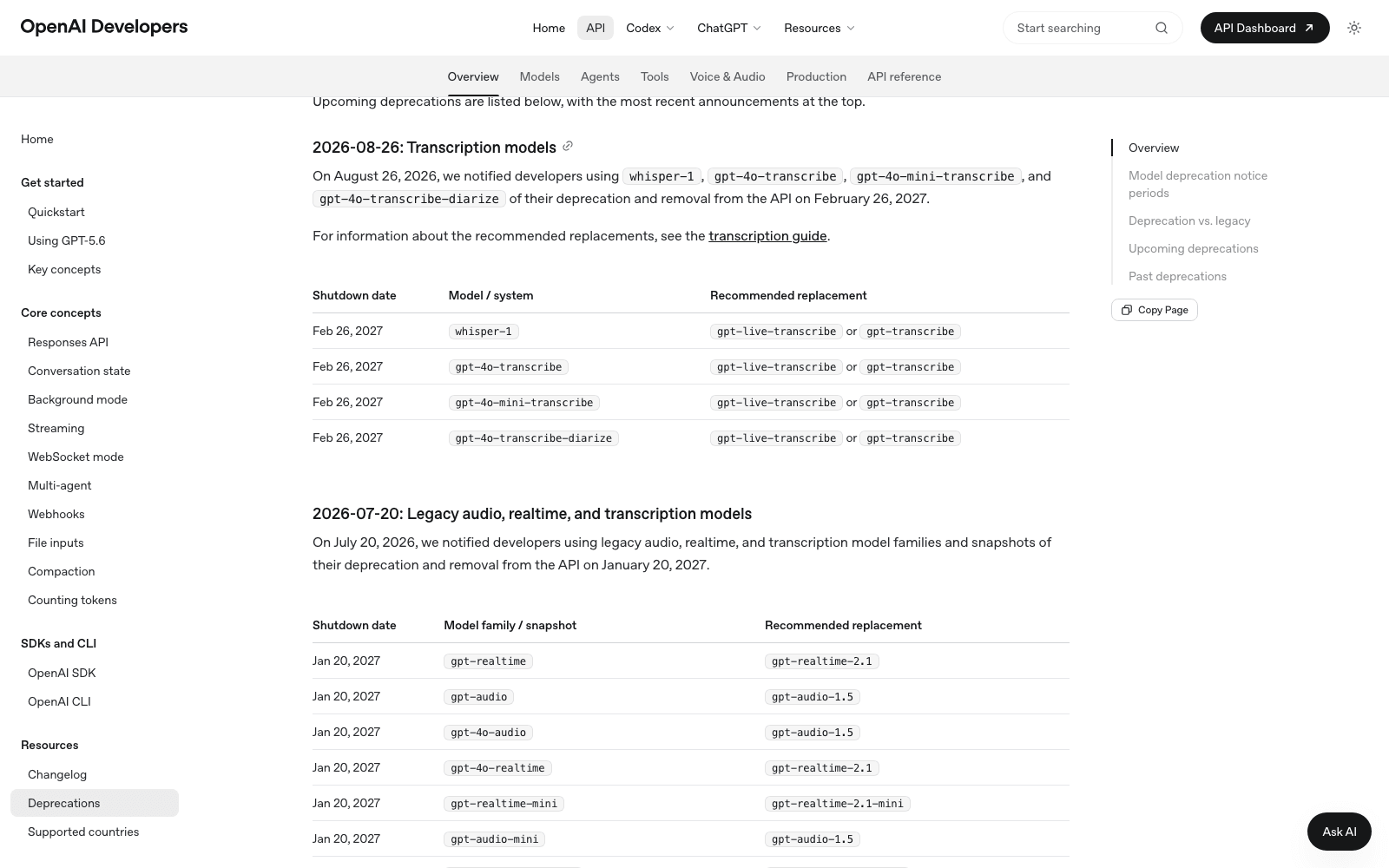
whisper-1 is the one that matters most by install base. It has been the default speech-to-text call since the audio endpoints opened, it is what nearly every tutorial written between 2023 and 2025 hardcodes, and it is baked into a lot of internal tooling that nobody has looked at in two years. Search your codebase for the literal string "whisper-1" and you will probably find it in a place you forgot about.
The whisper-1 deprecated notice is the headline, but the other three models are newer and narrower. gpt-4o-transcribe and gpt-4o-mini-transcribe arrived in March 2025 as the quality-and-cost pair, and gpt-4o-transcribe-diarize came later specifically to answer "who said that." All three die on the same day.
This is the second transcription cull in six weeks, which is the part that should worry you more than any single model ID. The July 20, 2026 block on the same page already scheduled the legacy audio and realtime families for January 20, 2027, including the gpt-4o-mini-transcribe-2025-03-20 snapshot. If you pinned a dated snapshot to avoid surprises, you get the earlier date, not the later one.
That is the awkward shape of running audio on someone else's API: the thing you built against keeps moving, and the notice arrives as a diff on a docs page rather than as anything that pages you. Watching four vendor changelogs is not work anyone volunteers for, and it does not happen at all on the weeks you are busy. That gap is roughly what MoClaw exists to sit in: a hosted cloud AI computer that stays running with your task on it, next to whatever pipeline you already have rather than in place of it, so the boring recurring check has somewhere to live that isn't your own attention.
Is whisper-1 Deprecated Now, or Only Scheduled?
Both, and the distinction matters for how you plan the next six months.
OpenAI defines this precisely on the same page: when a deprecation is announced, the model "immediately becomes deprecated," and separately it gets a shutdown date at which it stops being accessible. So whisper-1 deprecated is true as of August 26, 2026. Whisper-1 removed is not true until February 26, 2027.
Practically: your calls still work. Requests to /v1/audio/transcriptions with model: "whisper-1" return transcripts today, at the same price, with the same behavior. There is no warning header, no soft-fail, no gradual degradation that you can detect from the response. Nothing tells you. The only signal is the docs page and an email to accounts that were actively calling the model, which is a problem if the person who owns that API key left last year.
The Official Replacements, and Where They Stop
OpenAI's transcription guide names two starting models. Use gpt-transcribe when you have a finished recording, and gpt-live-transcribe when audio is arriving from a microphone or a call. That is the whole recommendation, and for a plain "audio in, text out" path, answering whisper-1 deprecated is a one-line change.
The guide also adds three quality inputs the new models accept that the old ones did not: a free-form prompt for context, a keywords list for literal terms like drug names or SKUs, and languages as a plural field replacing the old singular language. If you are passing language today, note that the new models want languages and the docs say not to send both.
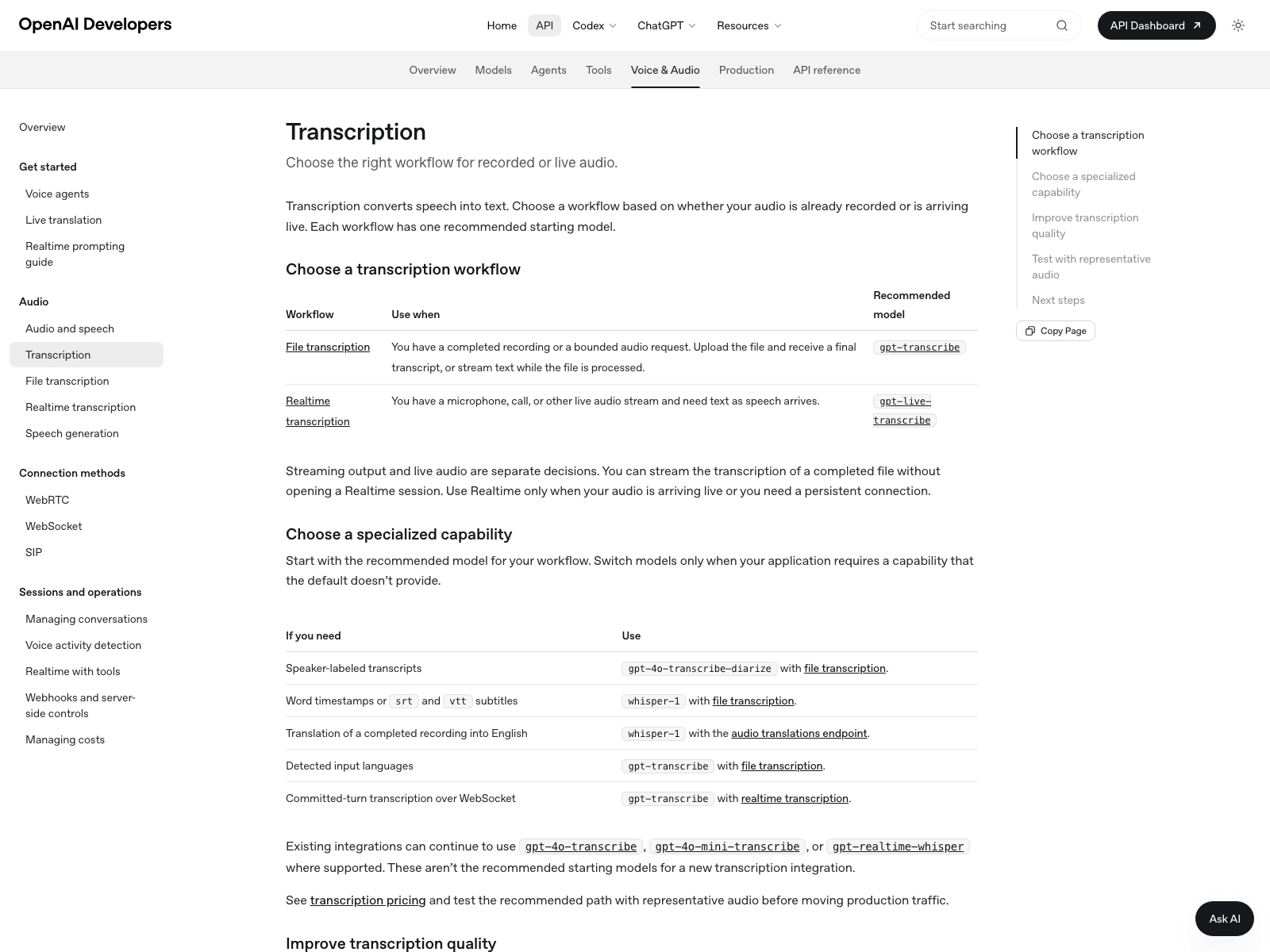
So far, so ordinary. Then you look at the capability table directly underneath.
Three Jobs Left Without a Named Successor
Read that table against the deprecation list and it does not reconcile. As of September 1, 2026, OpenAI's own transcription guide sends you to a retired model for three of the five specialized capabilities it lists:
- Speaker-labeled transcripts point at
gpt-4o-transcribe-diarize. Shutdown February 26, 2027. - Word timestamps and
srt/vttsubtitles point atwhisper-1. Same date. - Translating a recording into English points at
whisper-1again, through the separate/v1/audio/translationsendpoint, which the speech-to-text guide documents with no other model.
The paragraph below the table then says existing integrations "can continue to use" gpt-4o-transcribe and gpt-4o-mini-transcribe where supported. Both of those are also on the list.
I am not claiming these capabilities are being killed with nothing behind them. gpt-transcribe may well gain diarization and timestamp support before February. The honest statement, checked against the live pages today, is narrower and more useful: OpenAI has not published a replacement path for diarization, word-level timestamps, subtitle formats, or audio translation. If your product ships speaker-attributed meeting notes or burned-in captions, you cannot finish planning your migration from the docs that exist right now.
That is worth knowing before you scope the work, because the plain-transcription migration is an afternoon and the diarization migration might be a vendor change.
What the Migration Costs Per Minute
The bill moves when you migrate, and not always downward. The pricing shift is small in absolute terms and easy to miss in a spreadsheet, so here are the real numbers off the pricing page as of September 1, 2026.
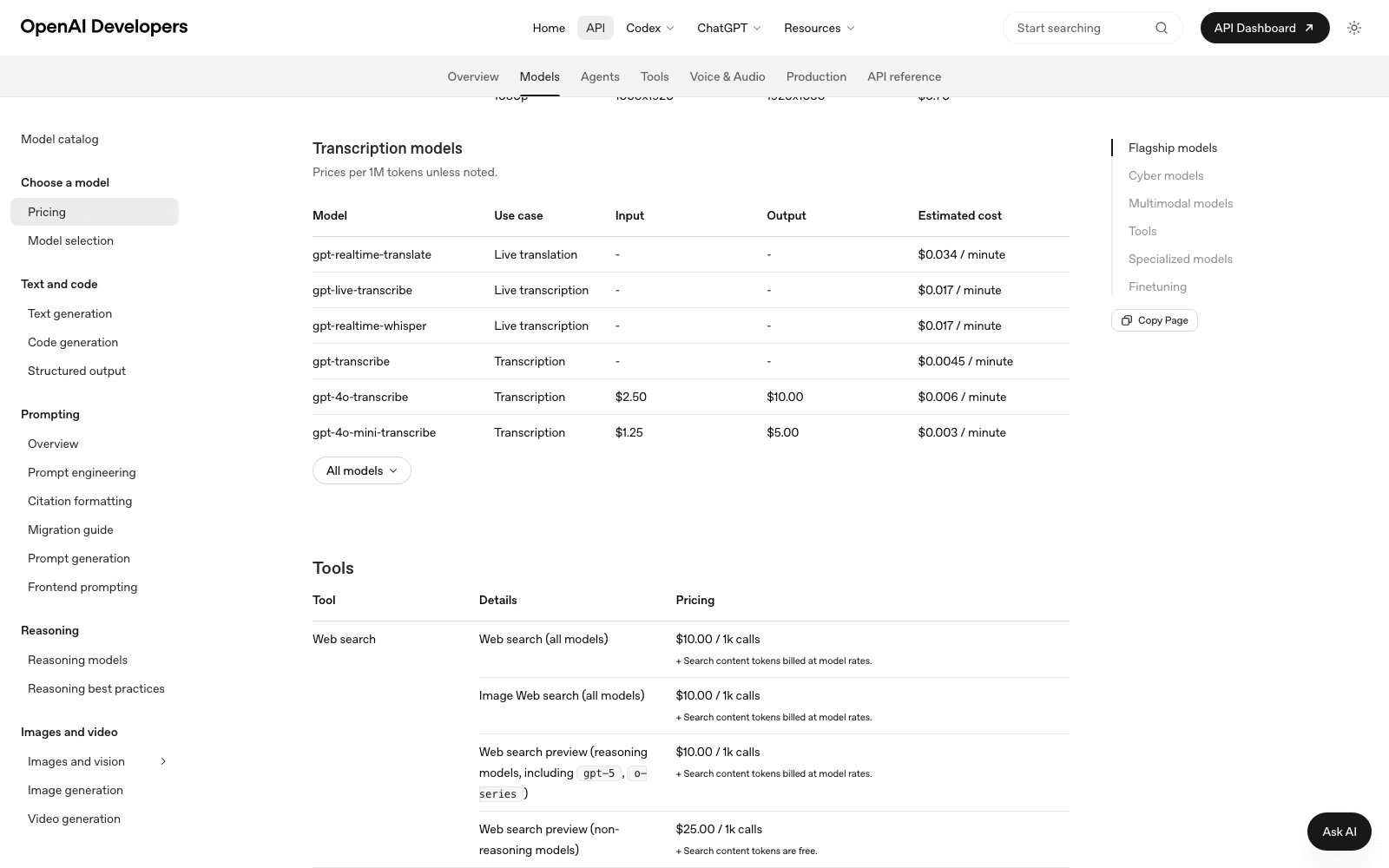
Coming off whisper-1 or gpt-4o-transcribe, both at $0.006 a minute, the move to gpt-transcribe at $0.0045 saves you 25%. Coming off gpt-4o-mini-transcribe at $0.003, the same move costs 50% more. Whether whisper-1 deprecated raises or lowers your bill depends entirely on which of the four models you happened to pick, and the cheap tier is the one that gets worse.
At 20,000 minutes of audio a month, that is $60 becoming $90. Small. At ten times that volume it stops being small, and there is no mini-class replacement listed to fall back to.
One more thing that belongs in the estimate, from someone running this at volume. On August 25, 2026, a developer posting as @Martynas reported: "gpt-transcribe seems to be a shitty model. From over 10k transcribed calls, ~18% got an empty string as the transcription result. Before, we were using gpt-4o-transcribe and we did not have such a big issue with it." They added that re-running the failed audio through gpt-4o-transcribe worked. That is one team's report, not a benchmark, and it may have been fixed since. Treat it as a reason to run your own audio through both models before you cut over, not as a verdict.
A Migration Checklist for Before February 26, 2027
Six months sounds generous until you find the third service that calls the endpoint. Treat whisper-1 deprecated as a scheduling problem rather than an engineering one, because the code change is trivial and the discovery is not.
- Grep for all four literal strings, not just the model you think you use:
whisper-1,gpt-4o-transcribe,gpt-4o-mini-transcribe,gpt-4o-transcribe-diarize. Include config files, environment variables, and notebooks. - Separate the calls into plain transcription and specialized. Plain calls move to
gpt-transcribeorgpt-live-transcribenow. Specialized calls go on a list you revisit in November. - If you send
language, switch tolanguagesand drop the singular field. - Re-run a representative sample through the new model and diff it against your old output. Test the ugly audio, not the demo clip: phone quality, cross-talk, names, order numbers, code-switching.
- Check whether anything downstream parses
response_formatoutput shapes that onlywhisper-1produces, particularlysrtandvtt. - Put February 26, 2027 in a calendar with the migration list attached, and put a second reminder in November to re-read the transcription guide for the diarization answer.
Step six is the one that quietly fails. It depends on a person remembering, in five months, to go re-read a docs page that has no feed and no notification. Handing that to a machine that is already awake works better than handing it to yourself: MoClaw can hold the checklist and the page-watching as a standing task on a cloud machine rather than on the laptop you close at 6pm, which is the difference between catching the diarization update in November and catching it in February.
FAQ
Is whisper-1 being discontinued?
Yes. whisper-1 deprecated became official on August 26, 2026 and will remove it from the API on February 26, 2027. It still works normally until then.
When is the whisper-1 shutdown date?
February 26, 2027, per OpenAI's deprecations page. The same date applies to gpt-4o-transcribe, gpt-4o-mini-transcribe, and gpt-4o-transcribe-diarize.
What replaces gpt-4o-transcribe?
gpt-transcribe for recorded files and gpt-live-transcribe for live audio streams. Those are the only two replacements OpenAI names.
Does gpt-transcribe support diarization?
Not according to any current OpenAI documentation. The transcription guide still directs speaker-labeled transcripts to gpt-4o-transcribe-diarize, which is itself scheduled for removal, and no successor for that capability has been published as of September 1, 2026.
Will my code break on February 27, 2027?
If it still passes one of the four model IDs, yes. A whisper-1 deprecated model returns normal responses until the shutdown date and then stops answering. There is no gradual failure to alert you first, and no warning field in the response body.
Is this related to the Assistants API sunset?
Only in pattern. The Assistants API shut down on August 26, 2026 after a year of notice, and the transcription notice landed the same day. Different systems, same operating lesson about pinned identifiers.
Where to Point Your Transcription Step Now That whisper-1 Is Deprecated
For plain transcription, the answer is boring and you should just do it: swap to gpt-transcribe, test on real audio, ship. For diarization and subtitles, wait or shop. OpenAI has not answered yet, and Google shipped Gemini 3.5 Transcribe on August 26, 2026, the same day the deprecation notice went up, with speaker diarization and word-level timestamps documented at launch. That timing is a coincidence, but it does mean the capability gap has somewhere to go if OpenAI stays quiet through the autumn.
The structural lesson is older than either announcement. Any model ID you hardcode is a lease, not a purchase, and the expiry gets published somewhere you are not reading. Whether you are building a voice agent for work or just cleaning up meeting recordings, the piece that survives is the one that treats the model string as configuration and keeps a machine watching the vendor pages. MoClaw does the second half: a hosted cloud AI computer sitting alongside your existing setup, holding the recurring check and the migration list, so the next deprecation reaches you as a note rather than as a 500 in production.
Six months is enough time. It is not enough time if you start in February.
Continue Reading
More Guide
MiniMax M3 Free Ended: What to Use Instead

MarkItDown: When Your Markdown Comes Back Thin

Lightpanda Is Fast Because of What It Skips

OpenAI Deprecated Its Codex Skills Repo

Open Science: The AI Workbench for Researchers

How to Use GPT-6 Astra: What It Really Costs
The MoClaw editorial team writes about workflow automation, AI agents, and the tools we build. Default byline for industry overviews, listicles, and collaborative pieces.
Ready to put this into practice?
MoClaw runs browser tasks, research, and schedules automatically. Try it free.
References: https://developers.openai.com/api/docs/deprecations · https://developers.openai.com/api/docs/guides/transcription · https://developers.openai.com/api/docs/guides/speech-to-text · https://developers.openai.com/api/docs/pricing · https://ai.google.dev/gemini-api/docs/models/gemini-3.5-transcribe · https://x.com/Martynas/status/2092155909170516369