AI Chief of Staff for Solopreneurs: Worth It?

AI chief of staff guidance for solopreneurs: decide whether coordination, decision tracking, and recurring briefings justify adding this role.
Table of Contents
An AI chief of staff is a decision-support role for people carrying too many unresolved commitments. For a solopreneur, it is worth testing when the hard part is not one task, but choosing what deserves attention across clients, inboxes, meetings, notes, and projects.
Key Takeaways:
- Test an AI chief of staff when priority sorting and commitment tracking are the bottleneck.
- Use a solopreneur AI assistant or task system when the work is mostly execution.
- Keep client records, financial decisions, legal material, and external sends under human review.
- PILOT is a useful category example, but early-access details need verification.
I think of this role through a Wednesday afternoon problem. A solo consultant finishes two client calls, opens three half-written proposals, remembers a partner intro, then notices a calendar note that says only "follow up." Nothing is visibly broken. The business is moving, but the decision trail is leaking.
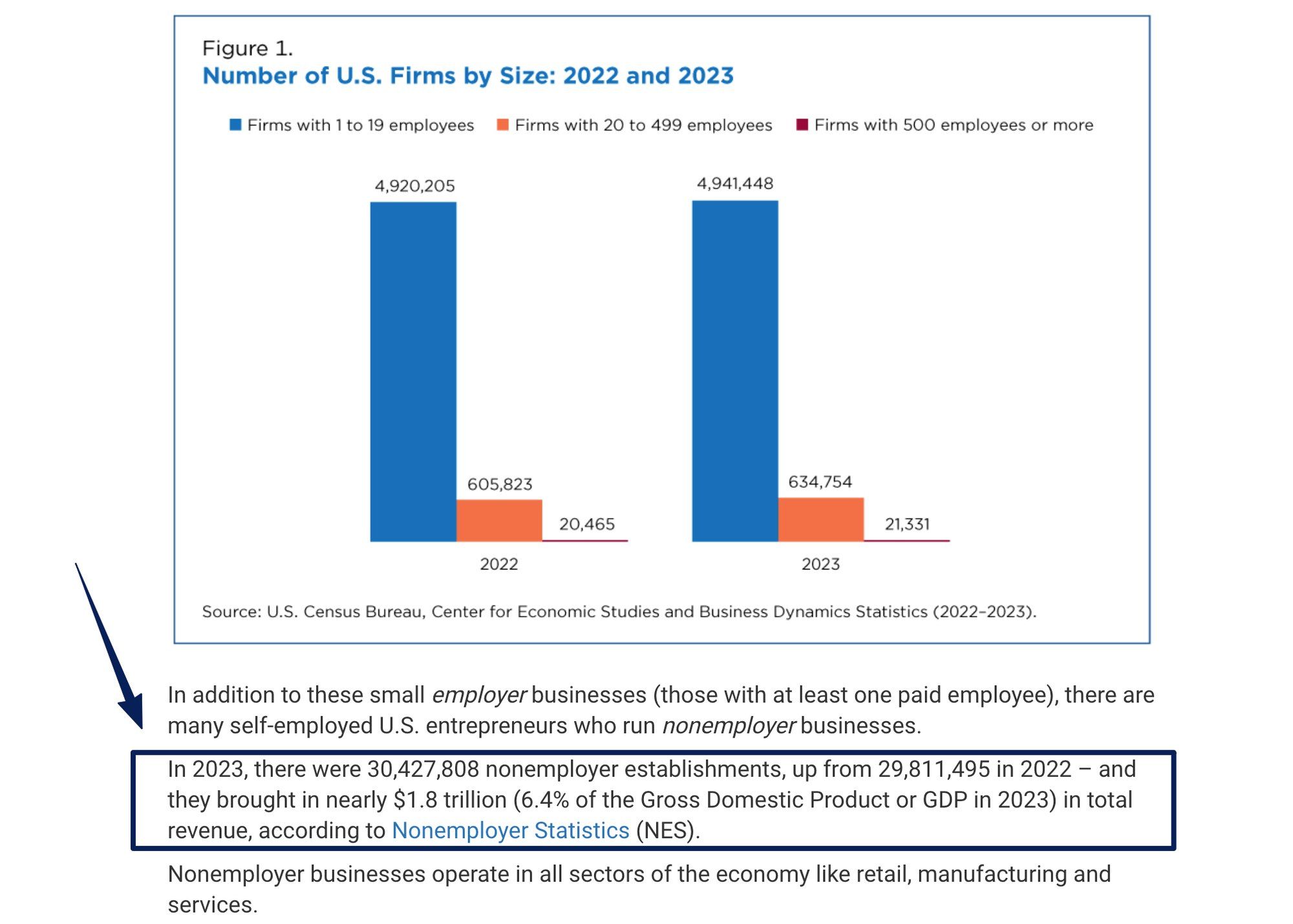
The U.S. Census Bureau counted 30,427,808 nonemployer establishments in 2023, businesses with no paid employees and nearly $1.8 trillion in revenue. Many operators need a tighter weekly decision rhythm, not a staff meeting.
Quick Answer for a One-Person Business
An AI chief of staff is worth testing if your week fails at the coordination layer: unresolved promises, lost meeting context, or too much energy deciding what matters.
It is not worth testing first if commitments are few or your main pain is completing known tasks. A task manager, calendar system, or execution-focused assistant may be enough.
Identify the Work a Chief of Staff Would Own
Before trying any executive workflow AI, name the work a chief of staff would remove from your head: priorities, commitments, briefing, and decision memory.
Priorities and Unresolved Commitments
The strongest use case is not "remind me to do things." It is "show me which open loop affects trust, revenue, or delivery." A useful AI chief of staff for founders should notice when a proposal, refund decision, investor note, or client promise becomes stale.
The test is whether the system separates urgency from noise. A client complaint, expiring offer, delayed invoice, and casual newsletter idea should not all look equal.
Information Across Meetings, Inboxes, and Projects
Solopreneurs often hold the business model in their head. One client detail lives in email, a pricing note sits in a document, and a strategic decision was spoken after a call. Founder decision support becomes valuable when it reconnects those pieces before review.
The role matters only if context stays reusable and reviewable.

When the Role Is Worth Testing
Test the role when you already have a repeated decision cadence. A weekly review is better than an open-ended "manage my business" prompt.
Use one real but low-risk workflow: review the week, list unresolved commitments, identify the one decision that changes next week, and prepare questions. If the output catches something you would have missed and explains why it matters, the role may deserve a trial.
When an Assistant or Task System Is Enough
A chief-of-staff layer may be unnecessary when prioritization is already clear and the remaining problem is mostly repeatable execution across tools. If you need recurring research, browser checks, file updates, or report drafts, a cloud execution agent may fit better.
For that adjacent layer, MoClaw's AI agents for solopreneurs guide gives concrete work examples, while the always-on AI agent guide covers recurring work after decisions are made.
What PILOT's Current Positioning Suggests
PILOT is useful here because it does not present itself as a generic productivity bot. It frames a private AI chief of staff around morning briefings, commitments, people, projects, email, calendar, voice, and approval before outbound sends.
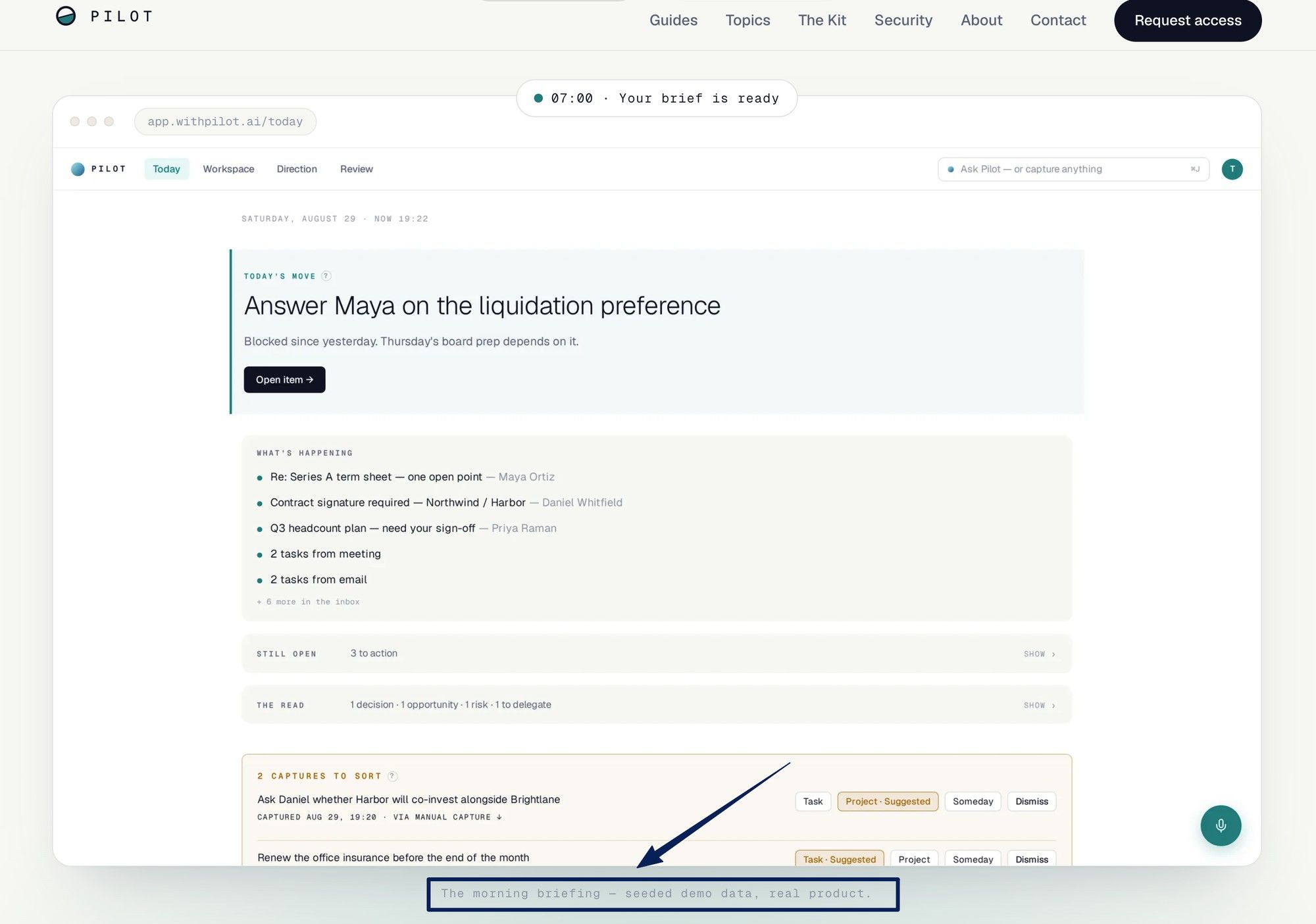
For a solopreneur, that makes the more useful question whether the system can turn scattered context into a better weekly decision rhythm. Early-access buyers should verify availability, pricing, source visibility, workspace separation, export, and approval behavior before connecting live business data. The PILOT AI review works through that verification list in more detail.
Start With One Weekly Decision Cadence
A useful first test would be a weekly decision cadence rather than an open-ended “manage my business” prompt.
I would start with a small set of dummy commitments: an overdue client proposal, an unpaid invoice, a pricing decision before an upcoming call, a partner follow-up, and a content idea with no deadline. The question is not whether PILOT can capture all five. It is whether the briefing gives more attention to the commitments that affect trust, revenue, or an upcoming decision without manufacturing urgency around the low-priority idea.
That is the standard I would use before connecting live client data: did it surface a real commitment, explain why it matters, help identify the next action, and leave genuinely low-priority work alone?
Keep Final Decisions and External Actions Human
Final decisions and external actions should stay human: client pricing, refunds, legal commitments, hiring choices, account deletion, financial approvals, and sensitive messages.
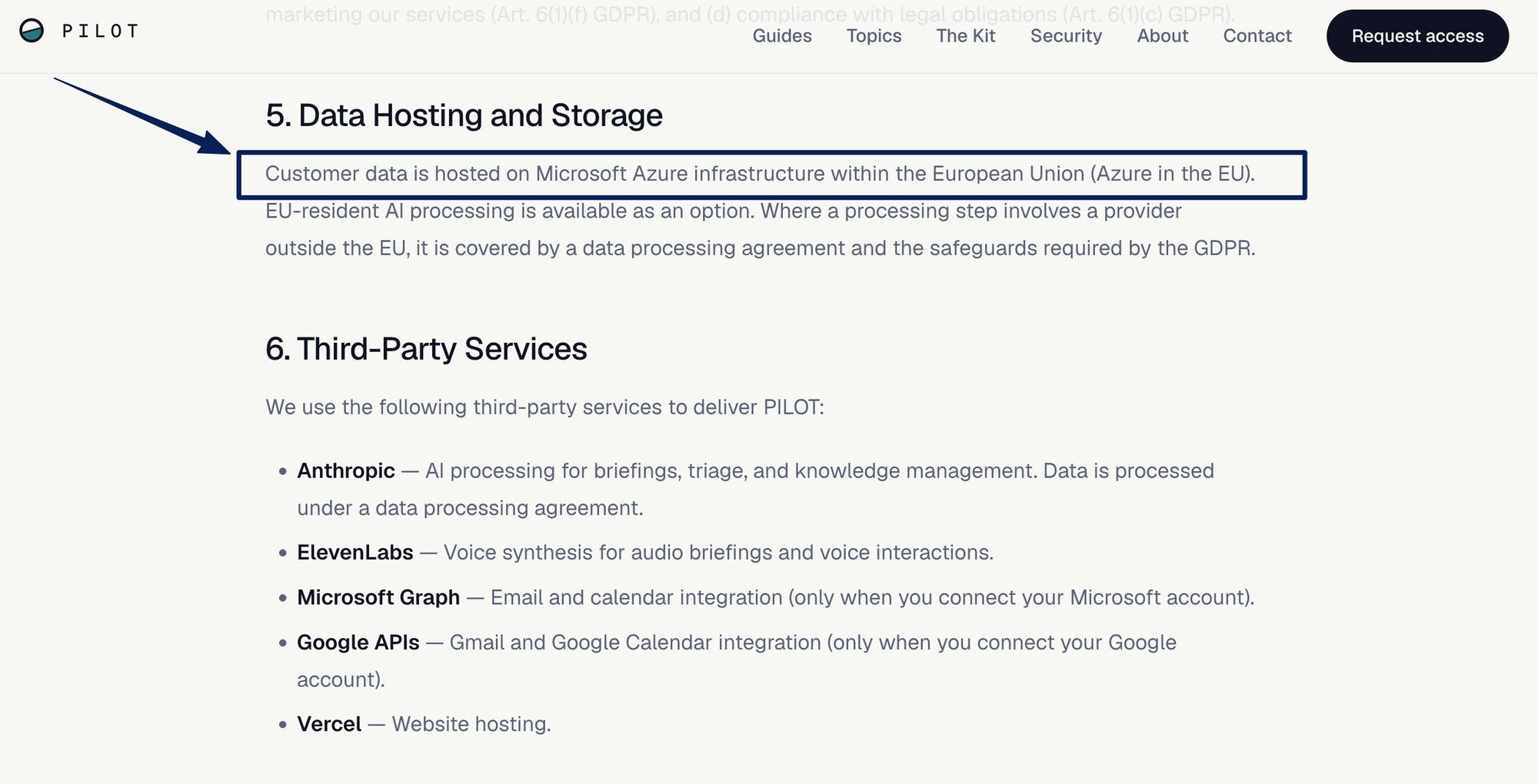
PILOT's privacy policy says customer data is hosted on Microsoft Azure infrastructure within the European Union, EU-resident AI processing is available as an option, account deletion removes personal data within 30 days except legal-retention cases, and GDPR data portability rights apply. Before connecting client material, confirm retention, export, isolation, and deletion behavior.
FAQ
Can PILOT be tested with sample data before live accounts? Ask during onboarding whether you can begin with dummy or non-sensitive data. PILOT's public product demo uses seeded data, but that does not confirm the exact testing options available to private clients. If possible, start with invented commitments or old low-risk records before connecting live business accounts.
Which business records should stay outside its context? Keep legal disputes, passwords, raw payment details, sensitive health information, tax records, and confidential client material outside until you have reviewed vendor terms and your own obligations.
Can PILOT keep client decision logs in separate workspaces? Do not assume that until onboarding confirms it. Ask whether client logs can be separated by workspace, schema, account, export, and deletion rule.
What records should be exported before switching tools? Export briefing history, decision logs, task lists, source references, account settings, and client notes needed for continuity. Keep them human-auditable.
Does PILOT support separate retention rules for client data? Confirm this before connecting client accounts. Public privacy language gives a general deletion timeline, but client-specific retention settings should be checked during onboarding.
Test the Role, Not the Fantasy
An AI chief of staff is worth testing when a solopreneur's bottleneck is deciding what matters, tracking commitments, and keeping a weekly review honest. It is not the first tool to buy when the work is already clear and only needs execution. Start with one weekly decision cadence, keep external actions human, and let the review decide how much access the role deserves.
Continue Reading
More Guide
Autonomous AI Assistant: A 2026 Reality Check

Turn a YouTube Video to Notes: course2md

How to Opt Out of Mistral AI Training

What Is M3E Canvas? Sketch UIs, Get AI Prompts

MiniMax M3 Free Ended: What to Use Instead

MarkItDown: When Your Markdown Comes Back Thin
The MoClaw editorial team writes about workflow automation, AI agents, and the tools we build. Default byline for industry overviews, listicles, and collaborative pieces.
Ready to put this into practice?
MoClaw runs browser tasks, research, and schedules automatically. Try it free.
References: U.S. Census Bureau — Small Business Week 2026 · PILOT — private AI chief of staff · PILOT — Privacy Policy