Claude Skills vs OpenClaw Skills
Claude Skills vs OpenClaw skills compared by ecosystem, portability, workflow scope, and execution layer, plus where a managed layer fits in.
Table of Contents
Claude skills and OpenClaw skills are both built on the same SKILL.md folder format: instructions an agent loads when a task matches. Claude's version runs inside Anthropic's hosted products, while OpenClaw's runs inside a self-hosted agent you operate yourself. The format overlaps heavily. The execution layer does not.
Key takeaways:
- Both systems use the same SKILL.md format. Anthropic published it as an open standard at agentskills.io in December 2025, making it cross-platform by design.
- The instruction file is portable. The execution environment is not.
- Claude skills run inside Anthropic's hosted products, with platform-enforced restrictions and low setup load.
- OpenClaw skills run on hardware you control, with more setup but full ownership of tools, models, and permissions.
- A managed layer like Zentor sits above both, for people who want a recurring task to run without authoring skill files or running a server.
I kept rebuilding the same setup. Every time I started a new monitoring task, I wrote the same instructions from scratch: what to check, how to format the output, what to ignore. I'd done it about a dozen times before I stopped and asked why I wasn't saving it as a reusable unit. That question is what sent me reading about skills, and specifically the Claude skills vs OpenClaw skills comparison, because those were the two systems people kept pointing me to. This is not a verdict on which one wins. It's what I found when I tried to figure out which one fits the way I actually work.
Hi everyone, I'm Vera. I read the official docs, set up a couple of small things on the Claude side, and stopped short of self-hosting OpenClaw. This is the practical difference a non-technical operator actually runs into, not a runtime evaluation, just a record of where the two systems diverge for someone who'd rather not own the server.
Claude Skills in the Claude Ecosystem
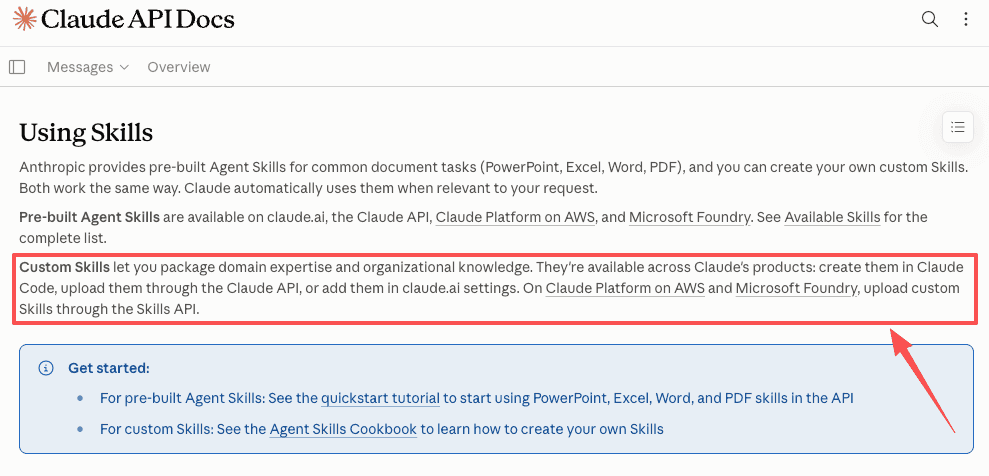
Claude agent skills are folders Claude loads on its own when your request matches the skill's description. Each skill needs a SKILL.md with two parts: short metadata, meaning a name and a description, and then the actual instructions. Optional folders hold scripts, references, and assets the model reads only when it needs them. Anthropic's Agent Skills documentation lays out where they work (verified January 2026, check the current docs, since platform support changes): claude.ai, the Claude API, Claude Code, and several partner platforms.
The part I cared about as a user: I don't load these manually. Claude scans the lightweight metadata first and pulls the full instructions only when the task calls for it. Anthropic calls this progressive disclosure, and it's the reason a stack of skills doesn't slow every request down. There are pre-built skills for documents, and you can upload your own.
I made one small skill out of that research-summary formatting I'd been retyping. The instructions were the easy part. The part I got wrong twice was the description. The first version was too vague, and the skill just didn't trigger when I expected it to. I rewrote the description to say plainly when it should fire, and that fixed it. So the lesson I'd pass on: the description field isn't filler, it's the switch.
What you give up is control over the environment. The skill runs where Anthropic runs it. For me that's a feature, not a loss. For someone who needs the task on their own hardware, it's the wrong end of the trade. And for someone who wants neither, no server, but also no skill files to maintain, there's a managed option (here's how it compares to running OpenClaw yourself) worth knowing about before you commit to either system.
OpenClaw-Style Skills in Agent Workflows
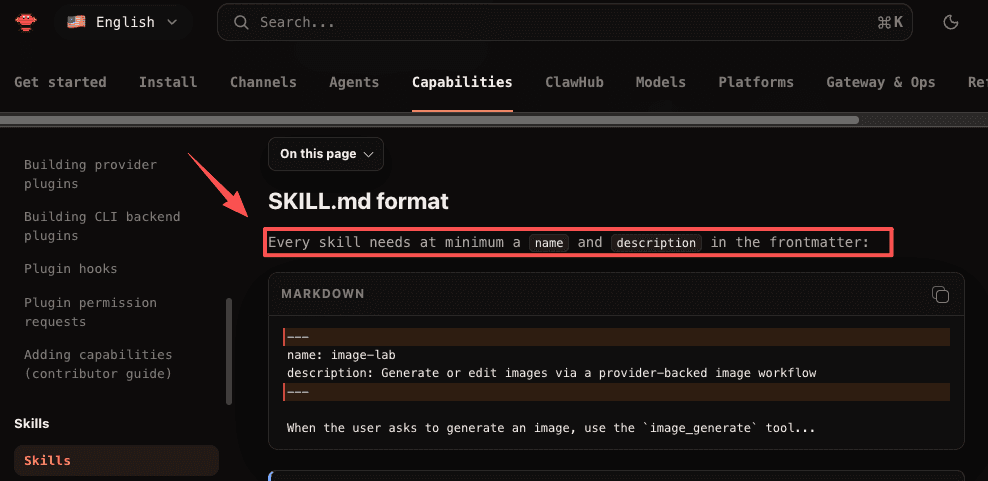
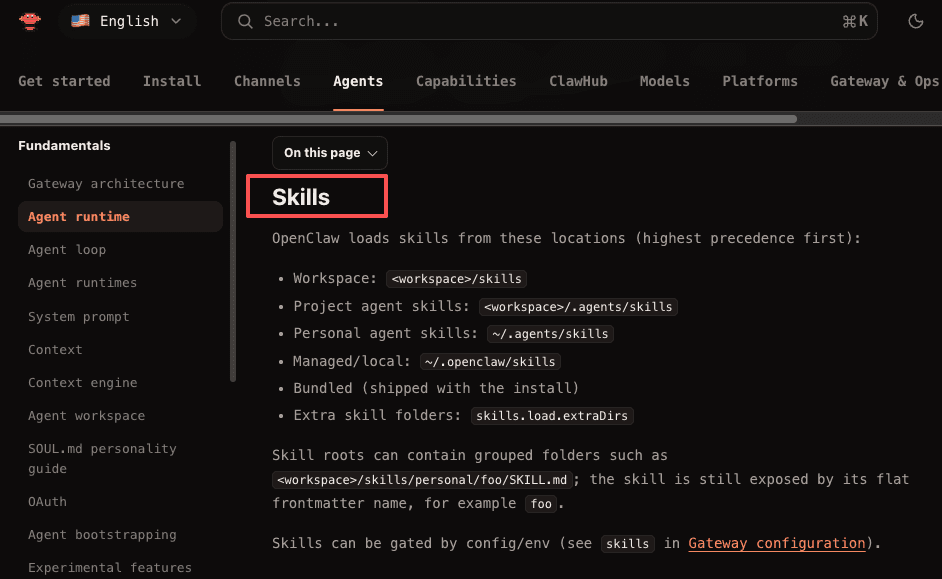
OpenClaw is an open-source agent you run yourself, locally or on a server you control. Its skills use the same SKILL.md folder format: a repeatable workflow, a checklist, a command sequence, loaded into the agent when relevant. OpenClaw's skills documentation describes the same minimum frontmatter, name and description, and the same idea of teaching the agent how to behave for a specific job.
The difference shows up around the skill. OpenClaw separates skills from plugins. Skills are instructions. Plugins carry code, credentials, and the tools. Skills load from a few places by precedence: the workspace, a shared directory, a managed root, or a plugin package. There's a public registry called ClawHub for finding and sharing them, separate from Anthropic's own repository.
This is more moving parts. It's also more reach. In an OpenClaw agent workflow you decide which model provider runs behind it, what tools get exposed, and what each skill is allowed to touch. That's real power if you want it.
I read through the setup documentation and worked through a test SKILL.md using the same folder structure as my Claude skill, and stopped before standing up the runtime. The instruction file dropped in cleanly. What I didn't get to, and won't pretend I did, is the part that matters most in OpenClaw: wiring the tools, setting the install policy, and keeping the agent patched. That's a real job, and reviewing skill sources for safety is part of it. I'm not the person who self-hosts. I'm including that not as a knock on OpenClaw, it's clearly built for people who do want the keys, but because pretending I'd run it would make the rest of this less useful to the person who actually is considering it.
Comparison Dimensions
Here's where the two land on the dimensions that mattered to me. I tried to be fair. Each side wins somewhere.
| Dimension | Claude Skills | OpenClaw Skills |
|---|---|---|
| Portability | Open format, SKILL.md instructions transfer | Same base format, instructions transfer |
| Runtime | Anthropic-hosted; zero server setup | Self-hosted; runtime setup required before first skill runs |
| Setup time (estimate) | Minutes, upload the folder, done | Hours to days, install, configure runtime, set API key, test |
| Tools | Built-in execution environment | You choose model provider and wire each tool |
| Sharing | Anthropic's skill repo and product surfaces | ClawHub public registry |
| Governance | Platform enforces restrictions | You set install policy and per-agent allowlists |
| Learning curve | Low; description field is the main variable | Medium–high; safe operation requires reviewing skill source |
On portability: because the SKILL.md format is shared, the instruction file itself is fairly portable between the two. What does not travel is the execution layer. A skill that leans on Anthropic's hosted environment won't behave the same when dropped into a self-hosted OpenClaw setup, and the reverse holds too. As Anthropic's engineering write-up on Agent Skills makes clear, a skill is designed for the environment it runs in. Move the instructions, and you still have to supply the runtime. Move the knowledge, and you still have to supply the environment.
On governance, both took it seriously, just differently. Anthropic enforces restrictions at the platform level. OpenClaw hands you the controls: OpenClaw's agent runtime lets you gate skills per agent and set install policies before anything runs. One approach is "trust the platform." The other is "you're responsible." Which one is better depends entirely on who you'd rather have holding the keys.
I keep coming back to the same split. The format is converging. The execution layer is not. That's the real fork in a Claude skills vs OpenClaw skills decision, and it's less a technical question than a question about how much you want to own.
Where Zentor Fits as a Managed Workflow Layer
Neither of those is where I actually spend my day. I don't author skill files and I don't run a server. I use Zentor, which sits a level up from both: a managed cloud AI computer that runs recurring tasks for me, with skills handled on its side rather than something I assemble.
To be clear about the relationship: Zentor is not officially affiliated with Anthropic or OpenClaw. It's a managed workflow layer, not a replacement for either skill system. If you want to author and own SKILL.md files, those two are the real conversation. If you mostly want a repeated task to just run, without you maintaining the machine under it, that's the gap Zentor fills for me. Set it once, then stop thinking about it. That's the most honest thing I can say about it.
FAQ
Can I move a SKILL.md between Claude and OpenClaw and have it work the same way?
The instruction file transfers cleanly in most cases. Both systems read the same SKILL.md format, so the written workflow, the steps, the format rules, the trigger description, all of it arrives intact. What does not transfer is the execution layer: the tools available, the model provider, and the permissions the skill can invoke. A skill written for Anthropic's hosted environment will not find that environment inside OpenClaw, and vice versa. The file moves. The wiring does not come with it.
Does ClawHub work with Claude, or only with OpenClaw?
ClawHub is OpenClaw's public skill registry, not a shared registry for all SKILL.md-compatible tools. Skills published to ClawHub are packaged and distributed for OpenClaw's install system, which handles gating, allowlists, security scanning, and version tracking on OpenClaw's side. Claude's pre-built skills live in Anthropic's own repository. The format is shared. The registries are separate. You can copy a SKILL.md out of a ClawHub skill and upload it to Claude manually, but you are not "installing from ClawHub" into Claude, you are adapting an instruction file from one environment to another. For the OpenClaw registry itself, our ClawHub security review explains skills, plugins, installation, and review checks.
Which is easier for non-technical teams?
A managed or hosted setup is lower friction, because there's no server to stand up and no runtime to maintain. Self-hosting OpenClaw gives more control but expects someone comfortable running and securing the agent. If no one on the team wants that job, the hosted route is the calmer one.
What does each approach actually cost, beyond the software?
Claude skills cost nothing extra beyond your existing Claude access. OpenClaw is free and open-source, but the real cost is your time: setup, security review, and ongoing maintenance of the machine it runs on. Neither option is truly free. One charges in subscription fees, the other in hours. The question is which currency you have more of.
Claude Skills vs OpenClaw Skills: Pick by How Much Runtime You Want to Own
So which side suits you, I can't settle that for you. The format question is mostly resolved: both speak SKILL.md, and that part keeps converging. The real fork is the execution layer, and that's a question about how much infrastructure you want in your life, not which system is better.
I can only speak to my setup. Mine is the one where I'd rather not own the runtime at all, which is why the managed layer is where I actually landed.
Author: Vera. I run a one-person practice and write up how I hand recurring work off, one decision at a time. Not a runtime benchmark, just a record of where two systems actually diverge for someone who'd rather not own the server.
Continue Reading
More Comparison
Claude Tool Use vs Agent Skills
OpenClaw Slack vs Claude Tag for Team Agents
AI Agent Skills vs Zapier: Beyond Trigger Automation

Best Open Interpreter Alternative in 2026: Six Picks
Autonomous AI Agents: Self-Host vs Managed

Cursor Projects vs Background Agents
The Zentor editorial team writes about workflow automation, AI agents, and the tools we build. Default byline for industry overviews, listicles, and collaborative pieces.
Choosing between tools? Let MoClaw run the work.
Always-on AI assistant on its own cloud computer. No switching required, no setup.
References: Agent Skills open standard (agentskills.io) · Anthropic Agent Skills documentation · Anthropic engineering: Agent Skills · OpenClaw skills documentation · OpenClaw agent runtime docs