What Is Kimi K3? Moonshot's 2.8T Model
What is Kimi K3? Moonshot's 2.8T-parameter flagship launched July 16, 2026 with a 1M context window and open weights due July 27. Specs, price, access.

Table of Contents
What is Kimi K3? Kimi K3 is Moonshot AI's flagship large language model, a roughly 2.8-trillion-parameter Mixture-of-Experts (MoE) system with a 1-million-token context window that launched on July 16, 2026. Moonshot calls it the first open-weight model in the 3-trillion-parameter class, and it is aimed squarely at frontier coding and agent work rather than at being a cheap alternative.
That framing matters because the numbers back it up. On the independent Artificial Analysis Intelligence Index v4.1, Kimi K3 scored 57.1, landing as the #4 tested configuration and effectively the #3 model family, close behind GPT-5.6 Sol Max at 58.9 and Claude Fable 5 (with an Opus 4.8 fallback) at 59.9 (Artificial Analysis). An open-weight Chinese model within roughly three points of the best closed systems is the story of this launch.
Key Takeaways:
- Kimi K3 is a ~2.8T-parameter MoE model with a 1M-token context window and native text, image, and video understanding, launched July 16, 2026.
- It ranks as the effective #3 model family on the independent Artificial Analysis index (57.1), the strongest open-weight result to date.
- Full open-source weights are promised by July 27, 2026; until then K3 is a hosted model, not a download.
- Pricing is $3 input / $15 output per million tokens, roughly a 5x jump over K2.6, which ends the era of cheap Chinese AI.
- Two variants ship at launch: K3 Max for chat and agents, and K3 Swarm Max for large-scale parallel work.
What Is Kimi K3? The 30-Second Answer
Kimi K3 is the third-generation flagship from Moonshot AI, the Beijing lab behind the Kimi assistant. If you only read one section, this is what is kimi k3 in practice: a very large, sparsely activated model built for long-context reasoning, coding, and autonomous agent workflows, released first as a hosted service with open weights to follow.
Here is the model at a glance.
| Spec | Kimi K3 |
|---|---|
| Developer | Moonshot AI |
| Launch date | July 16, 2026 |
| Parameters | ~2.8T total (MoE, 896 experts, ~16 active per token) |
| Context window | 1,048,576 tokens (1M) |
| Architecture | Kimi Delta Attention (KDA) + Attention Residuals |
| Modality | Native text, image, and video understanding |
| Variants | K3 Max (chat/agent), K3 Swarm Max (parallel processing) |
| Open weights | Promised by July 27, 2026 |
| Price (per 1M tokens) | $3.00 input / $0.30 cache hit / $15.00 output |
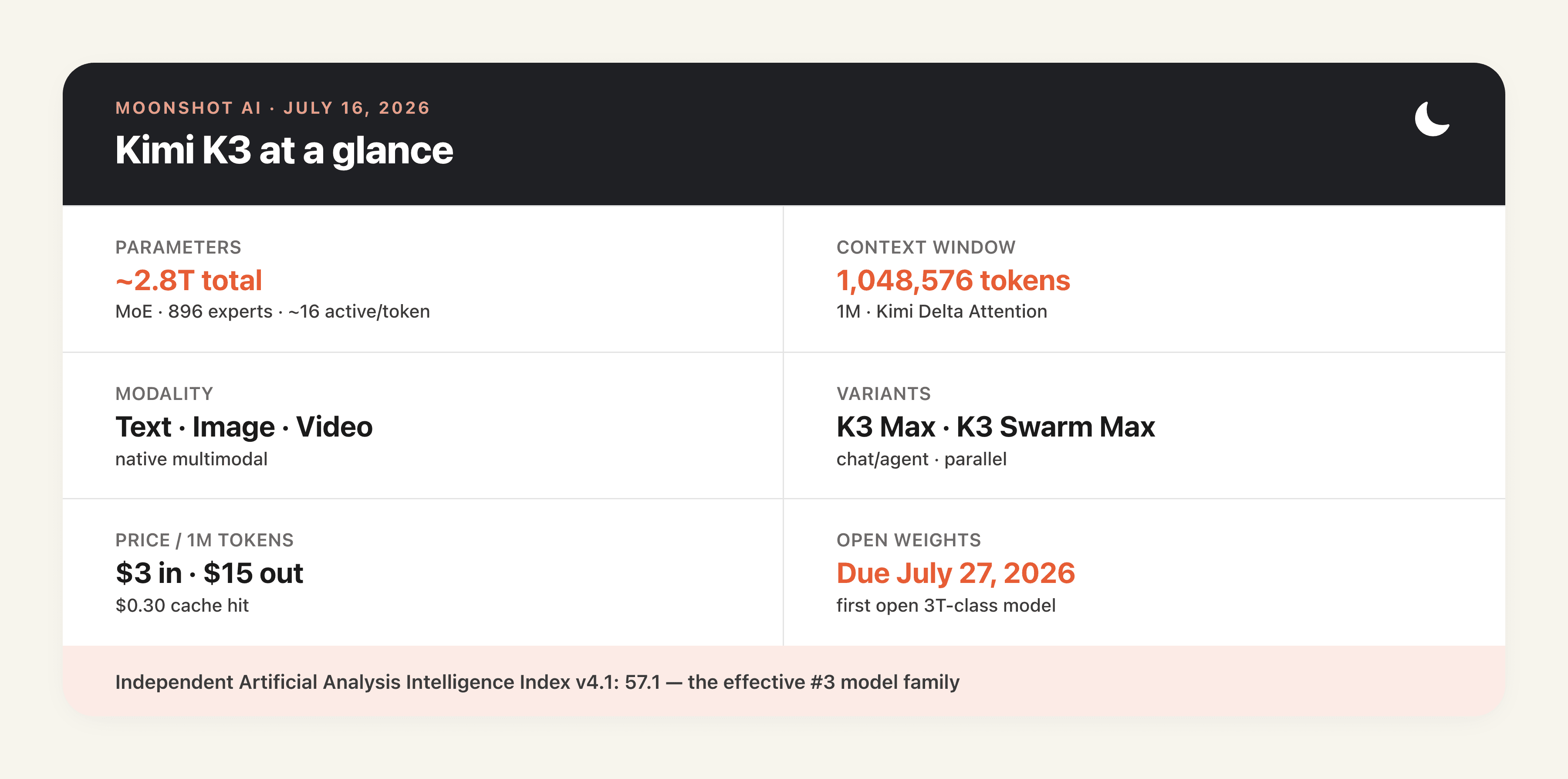
The short version: K3 is bigger, longer-context, and multimodal, and for the first time a model this size is headed for an open release. Moonshot is reportedly raising at a $31.5 billion valuation (per the Financial Times), up from $20 billion in May, so the launch also doubles as a statement about how far Chinese labs have closed the gap.
What this resolves: the one-sentence definition and the headline specs. What it leaves unsolved: whether an eye-catching parameter count translates into work you would actually trust it to do. The rest of this guide gets specific.
Kimi K3 Release Date and How It Leaked
The Kimi K3 release date is July 16, 2026, though the internet found out a day early. A promotional page for Moonshot AI K3 went live prematurely on the Kimi Open Platform, and by the time Moonshot made it official, screenshots of the spec sheet were already circulating. Independent analyst Simon Willison had a write-up out within hours (simonwillison.net), and mainstream coverage from Axios framed it as a Chinese open model reaching frontier-level results (Axios).
Consider Priya, a founding engineer at a 12-person dev-tools startup who had budgeted a full sprint to evaluate the next big open model. The leak moved her timeline up by a day: she had K3 wired into a test harness before Moonshot's own launch blog finished loading. That is the tempo this release set.
The launch shipped K3 across three surfaces at once: Kimi Code (model ID k3), the Kimi app including iOS, and the API. A recharge promotion ran July 15 to August 11, offering 10 to 30 percent bonus credits, which tells you Moonshot wanted usage volume from day one.
What this resolves: the exact Kimi K3 release date and where you can reach it. What it leaves unsolved: the open-source question, which has its own deadline covered below.
Kimi K3 Parameters, Architecture, and Context Window
The Kimi K3 parameters headline is roughly 2.8 trillion total, but that number is misleading on its own. K3 is a sparse Mixture-of-Experts model with 896 experts, of which only about 16 activate per token, so the compute cost per token is a fraction of what a 2.8T dense model would demand. This is what lets a 3T-class model run at usable speed and price (MarkTechPost).
Two architecture choices define the model. The first is Kimi Delta Attention (KDA), a hybrid linear attention scheme that keeps memory and compute manageable across very long inputs. The second is Attention Residuals, which help preserve signal deep in the network. Together they are what make the Kimi K3 context window of 1,048,576 tokens practical rather than theoretical. One million tokens is enough to hold an entire mid-size codebase, a long research corpus, or hours of transcript in a single prompt.
K3 is also natively multimodal. Unlike bolt-on vision layers, image and video understanding are part of the base model, which matters for agent tasks that read screenshots, dashboards, or recorded UI flows.
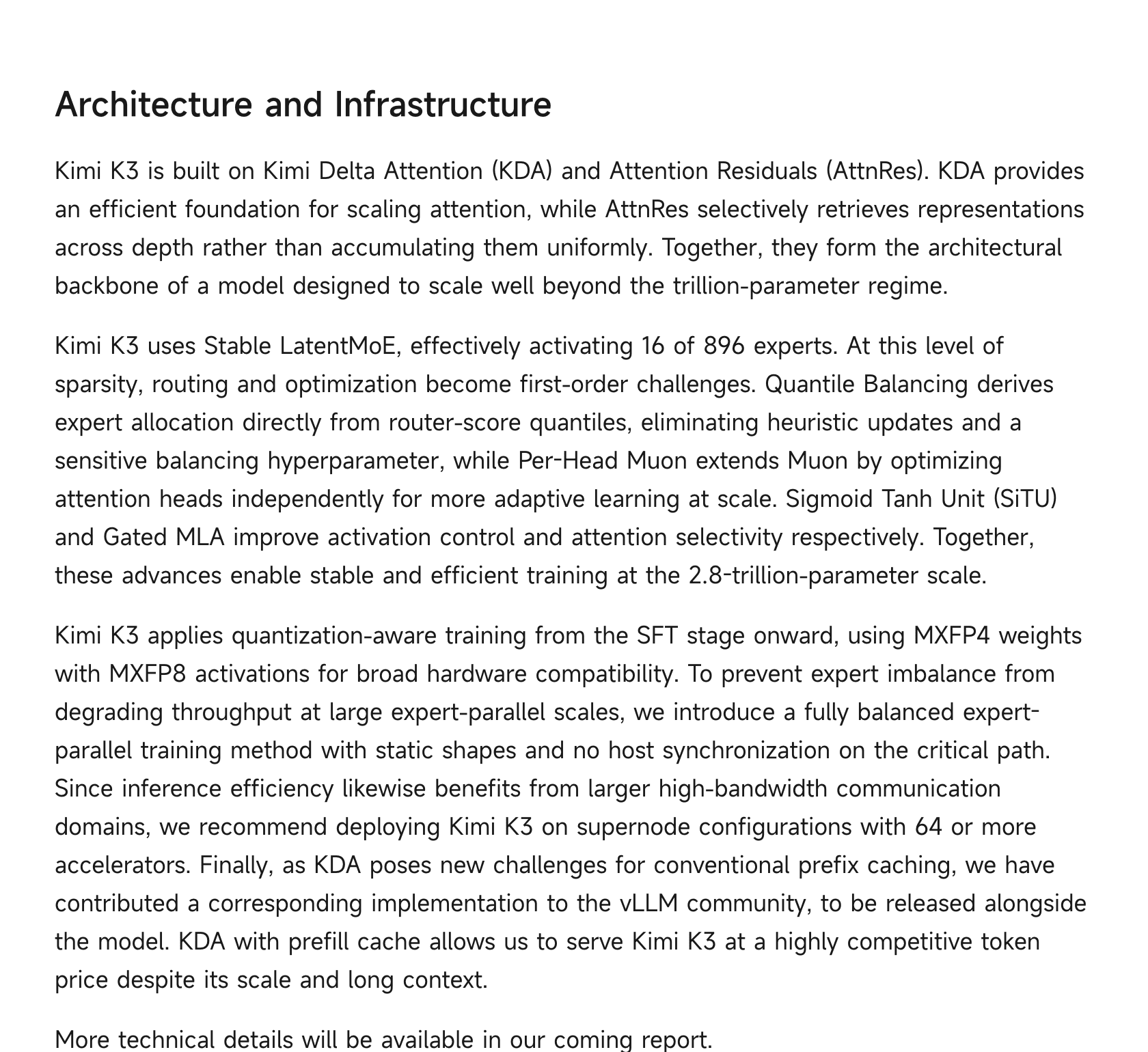
What this resolves: what the Kimi K3 parameters and context window actually buy you. What it leaves unsolved: big and long-context does not automatically mean accurate, which the benchmark section handles next.
How Good Is Kimi K3? Benchmarks and Early Tests
Kimi K3 benchmarks split into two piles, and mixing them is the fastest way to get the story wrong. Label everything.
On the independent side, Artificial Analysis puts Kimi K3 at 57.1 on its Intelligence Index v4.1, the #4 tested configuration and effectively the #3 model family, trailing GPT-5.6 Sol Max (58.9) and Claude Fable 5 with Opus 4.8 fallback (59.9), and only about half a point behind Sol xhigh (Artificial Analysis). Independent testers also placed K3 at #1 on the Frontend Code Arena, ahead of comparable Claude and GPT configurations. That is a genuinely strong result for an open-weight model.
Moonshot's self-reported numbers are higher and need a caveat. The company's table shows Terminal-Bench 2.1 at 88.3, Program Bench at 77.8, SWE Marathon at 42.0, and Kimi Code Bench 2.0 at 72.9, and claims wins over Opus 4.8 Max and GPT-5.5 high on mainstream benchmarks while conceding losses to Fable 5 and GPT-5.6 Sol. Important caveat: Moonshot's comparison table mixes harnesses (KimiCode vs Claude Code vs Codex), so those cross-model rows are not controlled head-to-heads. Read the self-reported wins as directional, not decisive.
Early community tests point the same direction, and should be read as anecdotes, not evidence. In one widely shared coding test on X, an AI researcher pitted K3 against Opus 4.8 on a Flappy Bird build and called K3 "significantly better," even "Opus 5 level" (single anecdotal test). Other developers pegged K3 at roughly Opus 4.8 level for coding while noting that Fable 5 and GPT-5.6 Sol still lead Terminal-Bench 2.1. A useful showcase sits underneath the noise: MiniTriton, where K3 built a compact Triton-like compiler from scratch, with tile-level IR over MLIR, optimization passes, and PTX codegen, that matches or beats Triton and torch.compile on supported roofline benchmarks and sustains end-to-end nanoGPT training convergence.
One honest negative: The Decoder reports that K3's hallucination rate increased versus its predecessor, citing Artificial Analysis (the-decoder.com). A smarter model that is also more confidently wrong is a real trade-off for agent workloads that act on their own output.
 Kimi.ai@Kimi_MoonshotIntroducing Kimi K3: Open Frontier Intelligence. 2.8 Trillion Parameters, 1 Million Context, Native Multimodal. Kimi Delta Attention enables up to 6.3x faster decoding in million-token contexts. Built for long-horizon agentic coding. Open Weights by July 27, 2026.32.5K likes · on X, July 2026
 Arena.ai ✓@arenaBig news: Kimi-K3 is now #1 in the Frontend Code Arena with 1679 pts, surpassing Claude Fable 5. This is a 17-place jump from Kimi-k2.6 (#18 to #1). Kimi-K3 ranked #1 in 6 of 7 domains.17.5K likes · on X, July 2026
 Artificial Analysis ✓@ArtificialAnlysKimi K3 scores 57 on the Artificial Analysis Intelligence Index. Its intelligence is comparable to Opus 4.8 and GPT-5.5 but remains behind Fable 5 and GPT-5.6 Sol. Moonshot AI plans to release the 2.8T parameter model's weights, which would make it the leading open weights model.4.7K likes · on X, July 2026
 Guillermo Rauch ✓@rauchgKimi K3 is the best performing model on our web engineering benchmark, ahead of Fable, reaching a comparable success rate in less time. This is the first time that an open model is ahead of all proprietary ones for this comprehensive benchmark.2.9K likes · on X, July 2026
 wh ✓@nrehiew_Here are a few benchmark scores of K3 that have been officially confirmed This is a Fable/Sol class model that is strictly better than Opus 4.8 across the board at Sonnet pricing. Insane2.9K likes · on X, July 2026
 Theo - t3.gg ✓@theoNormally I don’t comment on rumors, but if Kimi K3 actually beats out Opus 4.8 that’s nuts Also hearing Opus 5 might drop?4.3K likes · on X, July 2026
 Alex Finn ✓@AlexFinnI was wrong. I said we were a year away from Fable 5 on our desk. That day is today. An open model BETTER than Fable 5 in some benchmarks just dropped. Better than ChatGPT 5.6 on FrontierSWE. Better than Fable 5 on Automation Bench. This fundamentally changes the AI race.2.5K likes · on X, July 2026
 gus ✓@igus_aiThe CEO of Anthropic, watching China launch a new AI model that beats Claude Opus 4.8 at EVERYTHING, matches Fable 5 while costing 8 TIMES LESS, and on top of that is 100% open source, and being able to do nothing about it.18.8K likes · on X, July 2026 · translated from Spanish
What this resolves: where Kimi K3 actually lands, with each number labeled by who reported it. What it leaves unsolved: whether K3 is the right pick for you specifically, which comes down to price and access. See our deeper kimi k3 vs claude breakdown for the head-to-head.
Kimi K3 Price: The End of Cheap Chinese AI?
The Kimi K3 price is the part of the launch that surprised people most. K3 costs $3.00 per million input tokens, $0.30 for a cache hit, and $15.00 per million output tokens. Its predecessor, K2.6, ran $0.60 input and $2.50 output.
| Model | Input / 1M | Cache hit / 1M | Output / 1M |
|---|---|---|---|
| Kimi K3 | $3.00 | $0.30 | $15.00 |
| Kimi K2.6 | $0.60 | not published | $2.50 |
That is roughly a 5x jump on both ends. In practical terms a typical task lands near $0.94, which puts K3 at about the cost of GPT-5.6 Sol and roughly half of Claude Opus 4.8. So K3 is not expensive by frontier standards. What changed is the framing: Chinese models used to hold a rough 10x discount over Claude, and this pricing ends that. If your honest answer to what is Kimi K3 was "the cheap frontier model," this launch rewrites it. You are now choosing K3 on capability, not on it being the cheap option.
Take Marcus, an indie developer who moved to Kimi last year mostly to cut his API bill. Running the same nightly refactor agent on K3 instead of K2.6, his output-heavy workload jumped from a few dollars a week to real money. For him the upgrade math is no longer automatic, which is exactly the calculation this pricing forces. If cost per task drives your decision, our kimi k3 vs k2.6 comparison walks through when to hold.
What this resolves: the Kimi K3 price, the size of the jump, and the per-task math. What it leaves unsolved: how to actually get access, including the plan gotchas.
How to Access Kimi K3 Right Now
Kimi keeps expanding its agent surface, from browser agents like Kimi WebBridge to the model itself. You can reach Kimi K3 today through three doors: Kimi Code using model ID k3, the Kimi app (including iOS), and the API. The entry subscription starts at 199 RMB per month, and the July 15 to August 11 recharge promotion adds 10 to 30 percent bonus credits.
Two gotchas are worth knowing before you start. First, K3 access, the full 1M context, and the HighSpeed tier are all membership-gated, so calling them on the wrong plan returns a 401 rather than a helpful message. Second, start a new session after switching models, because carrying an old session across a model switch can trigger avoidable cache-miss costs.
Trying a new model is the easy part. Turning it into work that runs on a schedule, remembers context between runs, and reaches your tools and channels is the part that eats a week. That is the layer MoClaw handles: instead of wiring prompts by hand every time a new model ships, you point a hosted agent at the job and let the managed Kimi K3 agent do the work while the underlying model keeps changing underneath it.
What this resolves: every current path to Kimi K3 and the two mistakes that cost people money. What it leaves unsolved: how K3 stacks up against the specific model you use now, covered in the sibling comparisons.
FAQ: Kimi K3
Is Kimi K3 open source?
Not yet, but it is planned to be. Moonshot has promised full open weights by July 27, 2026, under a permissive license consistent with the Kimi K2 family. Until those files ship, K3 is a hosted model you access through the app and API, and Artificial Analysis still classifies it as proprietary. The kimi k3 open source milestone is a deadline, not a current fact.
When will Kimi K3 weights be released?
By July 27, 2026, per Moonshot's launch messaging. If it lands, K3 becomes the first openly downloadable model in the 3-trillion-parameter class, ahead of the previous largest open model, DeepSeek v4 Pro at 1.6T. For another open-weight challenger worth watching, see Inkling AI from Thinking Machines.
How many parameters does Kimi K3 have?
Roughly 2.8 trillion total parameters in a Mixture-of-Experts design with 896 experts, of which about 16 activate per token. The active parameter count per token is far smaller than the headline figure, which is what keeps it fast and affordable to run.
Is Kimi K3 better than Claude?
It depends on the task. On the independent Artificial Analysis index, Claude Fable 5 still leads overall, but K3 tops the Frontend Code Arena and trades wins on coding benchmarks. The honest answer needs a use-case-by-use-case read, which is why we wrote a full kimi k3 vs claude comparison.
What is K3 Swarm Max?
K3 Swarm Max is the launch variant built for large-scale parallel processing, where one model orchestrates many sub-agents at once, versus K3 Max for standard chat and agent tasks. We break down how the kimi k3 agent swarm actually coordinates hundreds of sub-agents in a dedicated guide.
Is Kimi K3 the Model to Watch in 2026?
Having now walked through what Kimi K3 is, the launch reads as a genuine inflection point rather than routine version bump. An open-weight model within a few points of the best closed systems, with a 1M-token window and native video, changes the calculus for anyone who assumed the frontier would stay locked behind US labs. The two open questions are whether the July 27 weights actually ship and whether the higher hallucination rate bites in production.
What is clear is that the cheap-Chinese-AI era is over, and models now churn at the frontier every few weeks. If you are building on top of them, the durable move is to treat the model as a swappable part and invest in the workflow around it. From here, compare K3 to what you run today: kimi k3 vs claude for the frontier head-to-head, kimi k3 vs k2.6 if you are already on Kimi, and kimi k3 agent swarm if parallel agents are your reason to care.
Continue Reading
More Guide
Inkling AI Safety and Privacy: What to Know
Inkling AI Limitations: What It Can't Do (Yet)

Inkling AI for Coding: Benchmarks, Agents, and Setup

Inkling AI: Thinking Machines' First Open-Weight Model

Claude Skills for Marketing

How to Fix AI-Sounding Content
The MoClaw editorial team writes about workflow automation, AI agents, and the tools we build. Default byline for industry overviews, listicles, and collaborative pieces.
Use Kimi K3 on MoClaw, without the setup
Run Kimi K3 as an always-on managed agent with memory, your tools, and scheduling. No API wiring, no plan gating, no self-hosting.
References: Kimi K3 on Artificial Analysis (Intelligence Index v4.1) · Moonshot AI Releases Kimi K3: 2.8T Open MoE with KDA and 1M Context (MarkTechPost) · China's open-weight Kimi K3 reaches frontier-level results (Axios) · Kimi K3, and what we can still learn from the pelican benchmark (Simon Willison) · Kimi's open model K3 nears GPT-5.6 Sol and Fable 5 (The Decoder) · China's Moonshot AI releases Kimi K3, the largest open-source model ever (VentureBeat)