Check Your AI Brand Visibility With NiubiGEO

AI brand visibility is whether models name you at all. NiubiGEO is an Apache-2.0 self-hosted auditor that shows the answers and sources behind each call.
Table of Contents
Your site ranks. Your ads convert. And when someone asks Claude or Perplexity "what should I use for this," a competitor's name comes back and yours doesn't. That gap is what AI brand visibility measures, and until recently checking it meant either pasting prompts into six chat windows by hand or paying a vendor between $100 and $500 a month for a dashboard that won't show you its working.
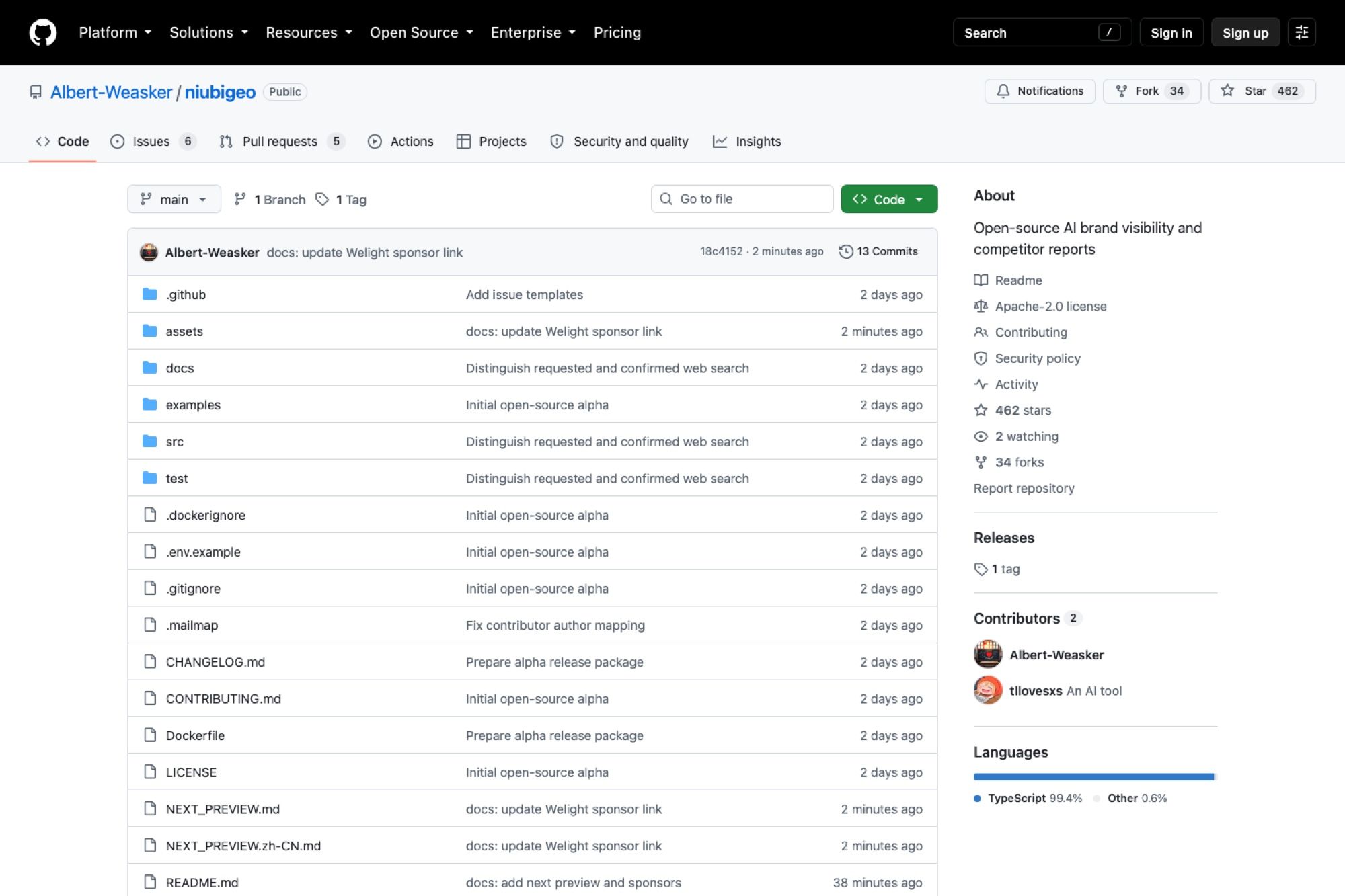
NiubiGEO is a third option: an Apache-2.0, self-hosted auditor that runs the questions against models you configure and links every conclusion back to the answer it came from. It went public on 3 September 2026 and had 462 stars by the morning of the 6th. It's also alpha, and the README says so in a badge, so treat what follows as a tool worth running rather than a tool worth standardising on.
What AI Brand Visibility Actually Measures
It isn't rank tracking with a new coat of paint. A search engine returns ten links and you can count where you landed. A model returns a paragraph, and the useful questions are different in kind.
Does the model know your product exists? If it does, does it describe your positioning correctly or does it remember the version of you from eighteen months ago? When a user asks a category question without naming any brand, whose names come back? And which pages did the model lean on to build that answer, because those pages are the actual lever you can pull.
NiubiGEO's README frames the failure modes bluntly. A model can miss your brand entirely, misunderstand your positioning, remember only part of your product, recommend competitors first, or cite third-party pages while ignoring your official site. Four of those five are invisible to any tool that only counts mentions.
MoClaw
Hand a competitor-tracking job to a hosted cloud AI computer and let it run on a schedule instead of on your laptop. Free trial: 3 days and 1,000 credits. Subscriptions start at $20/month for 1,000 credits.
What you get out of one audit
The report is organised as a set of plain business questions rather than a metric dump. Straight from the README:
Summary
├── Does AI recognize your product?
├── How does AI describe your brand?
├── Who are the confirmed competitors?
├── Which questions surface competitors more often?
├── Which important questions miss your brand?
└── Which sources support these conclusions?
Two design choices in there are worth stealing even if you never run this tool.
The first is the split between confirmed competitors and loosely related names. Anything that scrapes model output for brand names will pick up noise, and a list that mixes a real rival with a company the model mentioned once is worse than no list. NiubiGEO separates them.
The second is that full model answers stay collapsed by default and expand on demand. You get a readable conclusion, and the evidence is one click away instead of absent. Most commercial dashboards give you a score between 0 and 100 and no way to audit it, which is fine right up until you have to explain the number to someone who didn't buy the tool.
Running it takes Docker and about three minutes
Clone, copy .env.example to .env, add at least one provider key, and start it:
git clone https://github.com/Albert-Weasker/niubigeo.git
cd niubigeo
cp .env.example .env
docker compose up --build
Then open http://localhost:8787, enter a domain, confirm the brand, competitors and questions it proposes, and run the audit. There's a published image too, at ghcr.io/albert-weasker/niubigeo:v0.1.0-alpha, if you'd rather not build.
The .env.example accepts keys for OpenRouter, OpenAI, Anthropic, Gemini, Perplexity and DeepSeek. You need at least one; you get more signal with several, because the whole point is that different models have different pictures of you. One thing the README is careful about, and I'd repeat louder: the Community Edition generates its results through the provider APIs you configure, which is not the same thing as the consumer chat products your customers actually use. API answers and web-product answers can diverge on search grounding, system prompts and personalisation. Read the report as "what the model knows," not "what your customer saw."
That caveat is the reason a single audit is a starting point rather than a deliverable.
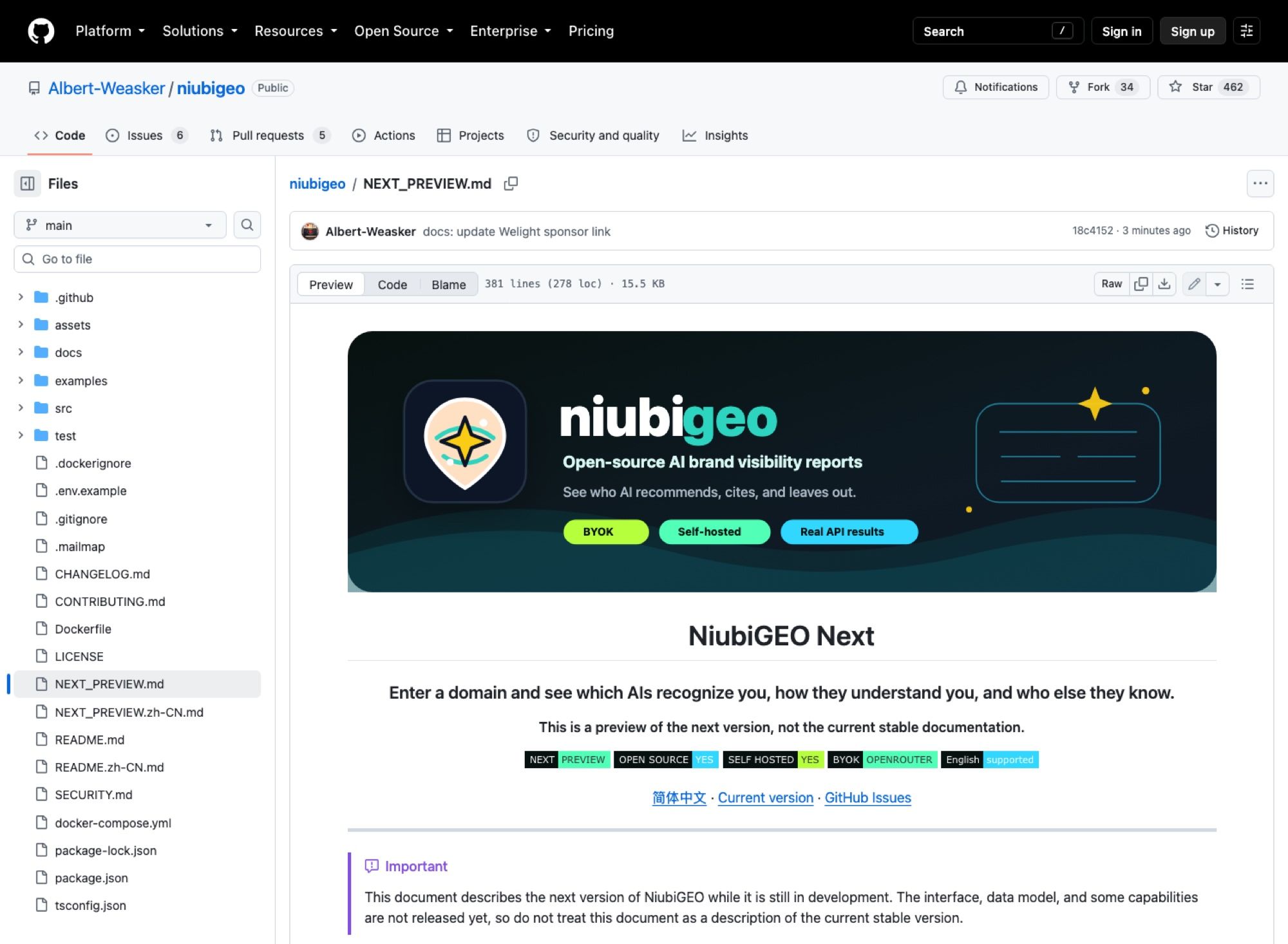
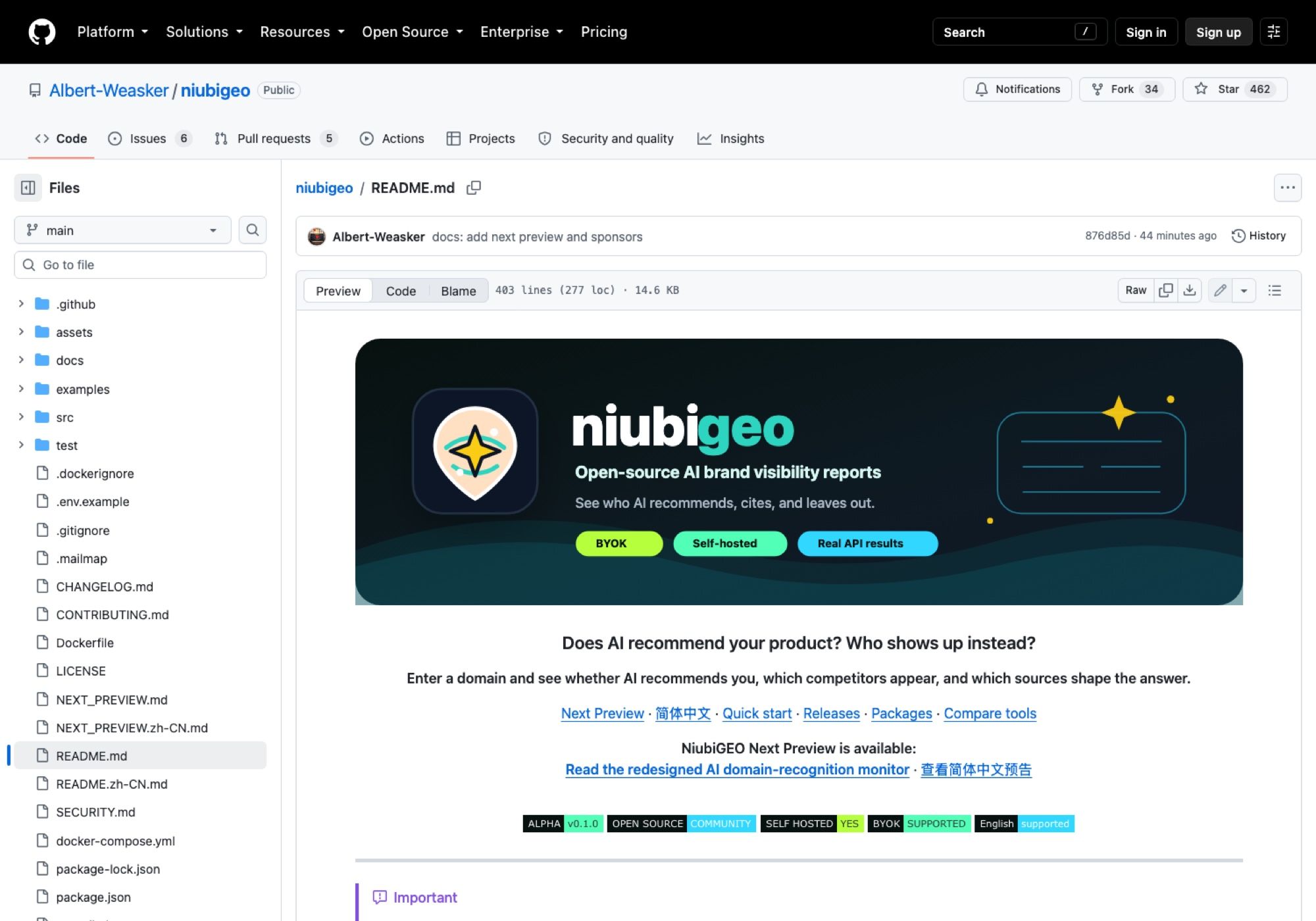
Note the file in that screenshot. NEXT_PREVIEW.md describes a redesigned monitoring product that hasn't shipped, and the repo flags it as such. If you're evaluating this, read README.md for what exists today and treat the preview as a roadmap, not a spec.
The part everyone underestimates: the question list
Before the audit runs, NiubiGEO proposes a brand, a competitor set and a list of questions, and asks you to confirm them. That confirmation step is easy to click through and it is the single biggest lever on whether the output is worth anything.
Think about what a real buyer types. Not "is NiubiGEO good," which nobody searches, but "how do I check whether ChatGPT recommends my product," or "cheapest way to track brand mentions in AI answers," or a bare category question with no vendor named at all. The last kind is where you learn the most, because an unprompted answer is the only one that tells you who the model reaches for by default.
Get this list wrong in the obvious direction, by stuffing it with questions that contain your own brand name, and every model will dutifully describe you and the report will read like a success. You will have measured recall, not recommendation. Those are different problems with different fixes, and conflating them is how teams end up celebrating a number while losing the deals.
A workable split, for a first run: two thirds category questions that never mention any vendor, one third questions naming you directly. The first bucket tells you whether you are in the consideration set. The second tells you whether the description is accurate once you are.
This is also the part that is genuinely hard to hand to someone else, since it requires knowing how your buyers talk. Once the list exists, though, re-running it is mechanical, and mechanical is exactly what you want to move off your own machine. Handing the question list and the keys to MoClaw means the weekly run happens whether or not you are at a desk, and you pick up the result from a phone instead of remembering to open a terminal.
The sources column is the one you can act on
Everything else in the report tells you where you stand. The citation list tells you what to do about it.
If a model recommends a competitor and its cited sources are two Reddit threads and a comparison post on somebody's blog, your problem isn't your homepage copy. It's that the pages models actually read when answering your category question don't mention you. That's a content and outreach problem with a known shape, and it's roughly the same work as classic digital PR pointed at a different target.
This is where the work stops being a one-time audit. Model answers move when the underlying sources move, which happens continuously and without warning. Checking once in September tells you nothing about October. We covered the general version of that problem in automated competitor monitoring, and it applies here with an extra wrinkle: you're not watching one competitor's site, you're watching six models' opinions of an entire category.
Running that on a schedule is where a laptop stops being the right computer. Six provider APIs, a couple of dozen questions each, repeated weekly, is a job that wants to execute at 3am while you're asleep and to still be there when you look. That's the gap MoClaw fills: a hosted cloud AI computer that stays up so a recurring audit has somewhere to run, alongside your existing tooling rather than instead of it.
NiubiGEO versus the commercial tools
The commercial category is crowded and better funded. Profound, Similarweb's AI Brand Visibility module, Advanced Web Ranking's brand intelligence product and a dozen startups all sell some version of this, usually with prompt libraries, historical charts, and someone to email when it breaks.
What you give up by self-hosting is the history and the support. What you get is the ability to read every question before it runs, see the raw answer behind each conclusion, and inspect how the tool decided something counted as a competitor. For a founder who wants to understand the mechanism before signing a yearly contract, that's a good trade. For a marketing team that needs a chart in a board deck next Tuesday, it probably isn't.
There's also the cost shape. Self-hosting moves your spend from a subscription to provider tokens, which is cheaper at low volume and not obviously cheaper at high volume once you're running hundreds of questions across six models every week.
What to do with the result
Run it once against your own domain and once against the competitor you lose deals to. Compare the two source lists, not the two scores. If their citations include a page type you have no equivalent of, that's your next quarter's content brief, and it'll be a more specific brief than any keyword tool would have given you.
Then decide whether you need this weekly. If yes, the tool is the easy part and the schedule is the hard part; something has to run it, store the history, and tell you when an answer changed. Our writeup on monitoring competitor website changes with AI agents covers how that loop is usually built, and the AI SEO agent piece covers what to do once the loop starts producing findings.
The version of this that works long-term isn't a person opening a terminal every Monday. It's a machine that already has the keys, already has the question list, and doesn't need your hardware awake to do the run. MoClaw was built for exactly that shape of job, which is why we treat "check my AI brand visibility" as a recurring task rather than a report you buy.
FAQ
What is GEO?
Generative engine optimisation: the practice of shaping how AI systems describe and recommend your brand, as opposed to where you rank in a list of blue links. It overlaps heavily with SEO, since models lean on indexed pages, but the measurable outcome is different. You're optimising for being named and cited in a generated answer.
Is NiubiGEO free?
The Community Edition is open source under Apache-2.0 and free to self-host, confirmed from the repository on 6 September 2026. You still pay for the model APIs it calls, since it uses provider keys you supply. It is tagged v0.1.0-alpha, with a single release and 13 commits as of that date, so expect breaking changes.
How is GEO different from SEO?
SEO optimises for a ranked list where position is the outcome. GEO optimises for a synthesised answer where the outcomes are inclusion, accurate description, and citation. A page can rank first and still be absent from the model's answer if the model built that answer from a Reddit thread and a review site instead.
Which models does NiubiGEO test against?
Whichever ones you give it keys for. The shipped .env.example covers OpenRouter, OpenAI, Anthropic, Gemini, Perplexity and DeepSeek. Because it queries provider APIs rather than the consumer chat apps, results indicate what the model knows rather than exactly what an end user sees in the web product.
Can I run an AI brand visibility check without hosting anything?
The commercial tools exist for that reason and they're the fast path. If you want the transparency of self-hosting without keeping a machine awake for it, a hosted cloud AI computer such as MoClaw can hold the keys and run the schedule, so the tradeoff isn't only "my laptop or their dashboard."
The uncomfortable part
Most teams who run this for the first time find the models know they exist and won't recommend them. That reads as a failure and usually isn't; it means the brand is indexed but absent from the third-party pages models reach for when nobody names a vendor. Fixing that is slow, unglamorous work on other people's websites, and no dashboard shortens it.
What a self-hosted audit buys you is the ability to see that clearly, in September, instead of guessing about it for another two quarters.
Continue Reading
More Guide
MiniMax M3 Free Ended: What to Use Instead

MarkItDown: When Your Markdown Comes Back Thin

Lightpanda Is Fast Because of What It Skips

OpenAI Deprecated Its Codex Skills Repo

Open Science: The AI Workbench for Researchers

How to Use GPT-6 Astra: What It Really Costs
The MoClaw editorial team writes about workflow automation, AI agents, and the tools we build. Default byline for industry overviews, listicles, and collaborative pieces.
Ready to put this into practice?
MoClaw runs browser tasks, research, and schedules automatically. Try it free.
References: https://github.com/Albert-Weasker/niubigeo · https://github.com/Albert-Weasker/niubigeo/blob/main/README.md · https://github.com/Albert-Weasker/niubigeo/blob/main/LICENSE · https://github.com/Albert-Weasker/niubigeo/blob/main/NEXT_PREVIEW.md · https://github.com/Albert-Weasker/niubigeo/releases · https://www.tryprofound.com/ · https://www.advancedwebranking.com/brand-intelligence