Antigravity Account Suspended: The Real Rules

Third-party tools can get your Antigravity account suspended. What clause 6 says, what Google changed on Sep 3, and how to appeal. (as of 2026-09-04)
Table of Contents
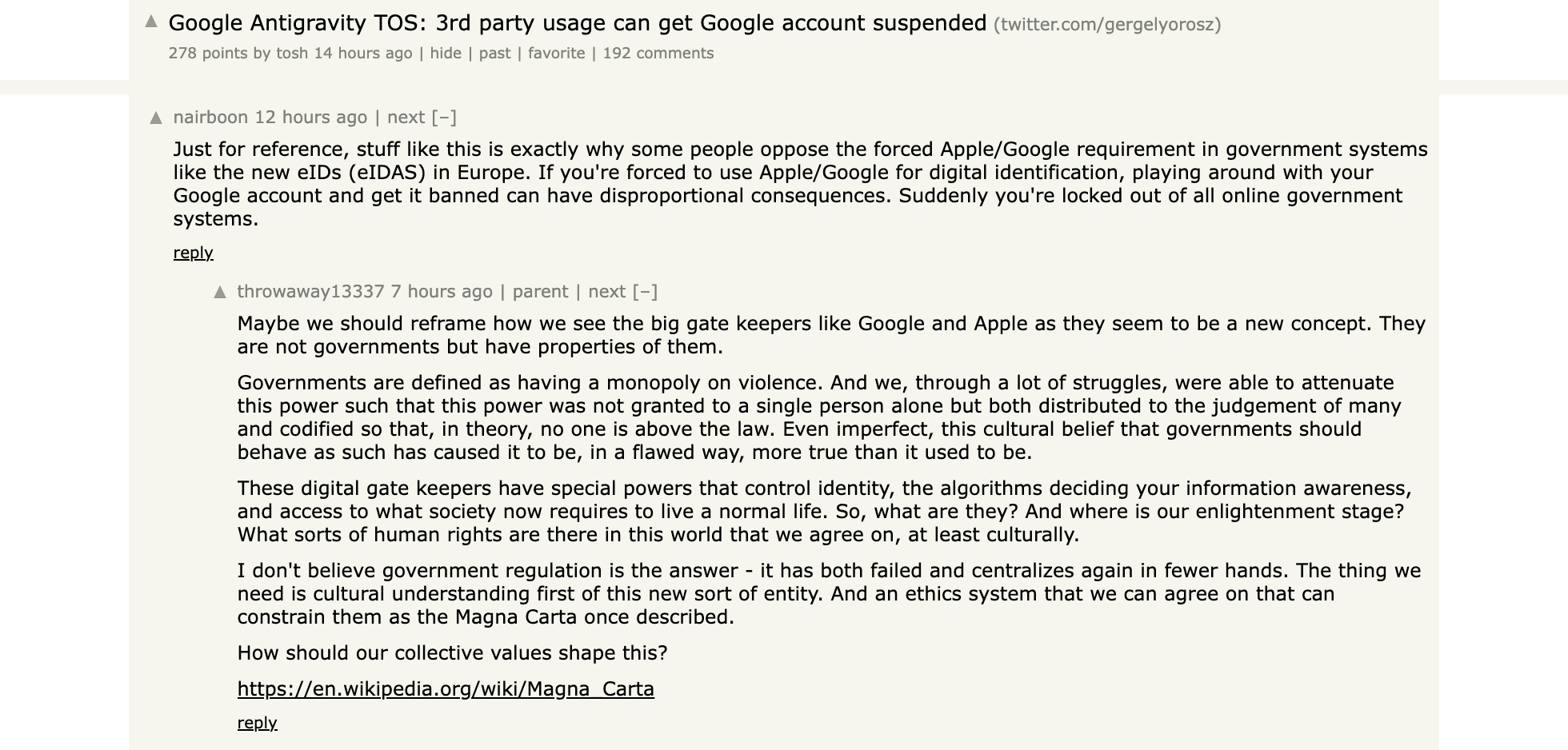
Gergely Orosz read the Google Antigravity terms on September 3 and decided the risk wasn't worth it. His post hit the Hacker News front page at 278 points with a blunt headline: third-party usage can get your Google account suspended. Within about twelve hours Google had rewritten the clause. If you're running OpenClaw, OpenCode, or any other harness against an Antigravity subscription, the question of what gets an Antigravity account suspended now has a narrower and much more specific answer than it did that morning.
Here's what the terms say today, what changed, and what the people who actually got banned reported.
Key Takeaways:
- Clause 6 of the Antigravity Additional Terms names OpenClaw directly: using third-party software to reach the service through Antigravity OAuth is a breach of the agreement.
- As of September 3, 2026, the penalty is scoped to "your Antigravity and/or Gemini CLI accounts." Earlier wording was read as putting the whole Google account at risk, which is what set off the Hacker News thread.
- The Gemini CLI blast radius is not a bug. Antigravity and Gemini CLI draw on the same quota, so a suspension on one surface takes the other with it.
- Bans have landed with no warning email. Some users got access back the same day through a support form; others waited.
- Nothing in the terms forbids third-party harnesses generally. What it forbids is reaching Google's service with them.
What Clause 6 Actually Says
The document is called the Google Antigravity Additional Terms of Service, and it's short: eight numbered items and a link to the support forum. Item 6 is the one that matters, and it's worth reading in full rather than in paraphrase, because the paraphrases circulating are what caused the confusion:
You must not abuse, harm, interfere with, or disrupt the Service. This includes, but is not limited to, using the Service in connection with products not provided by us. Using third party software, tools, or services to access the Service (e.g. using OpenClaw with Antigravity OAuth) is a breach of this Agreement. Such actions may be grounds for suspension or termination of your Antigravity and/or Gemini CLI accounts.
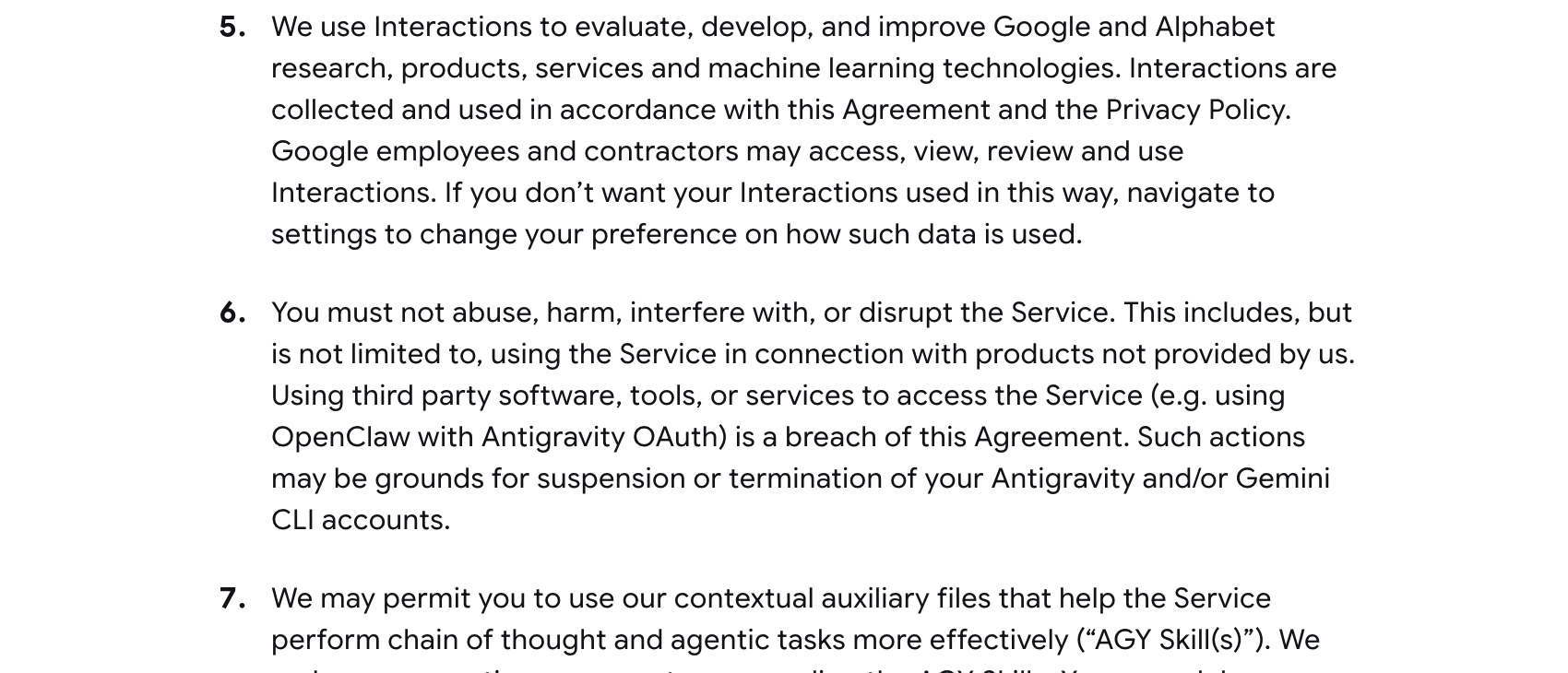
Two things stand out. Google named a specific third-party tool in its own terms of service, which is unusual and tells you how much traffic that particular integration was pulling. And the verb is "may be grounds for," not "will result in," so this is written as an enforcement option rather than an automatic trigger.
Clause 8 matters too if you swap the model out: pick a third-party or open-source model as your main agent model and you're bound by that model's terms as well, with Anthropic's commercial terms called out by name.
What Changed on September 3
The version people reacted to that morning read differently at the end. Instead of naming Antigravity and Gemini CLI, it stopped at "your account," and in a product you sign into with Google credentials, that reads like your Google account. The Hacker News submission title still carries that reading, frozen at the moment it was posted: "3rd party usage can get Google account suspended."
Antigravity's team responded on X the same day, saying they'd heard the feedback and updated the terms to make clear the scope covers Antigravity and Gemini CLI accounts only. Orosz, who started the thread, acknowledged the update and then pushed a second point that hasn't been resolved: the Antigravity terms sit under the Google Terms of Service, which the document names as the "Universal Terms" in item 1 and folds into a single thing it calls "the Agreement." Whether breaching a service-specific term can cascade upward through that structure is a question about Google's universal terms, not about clause 6, and Google hasn't addressed it publicly as of September 4, 2026.
So the honest summary: the specific scary reading was walked back, quickly and in writing. The broader legal question underneath it is still open, and anyone telling you it's settled in either direction is guessing.
What Gets an Antigravity Account Suspended in Practice
The mechanism is the OAuth token. When you sign into Antigravity, you get credentials that a third-party harness can pick up and use to spend your subscription's model quota through its own client instead of Google's. That's the pattern clause 6 describes, and it's what OpenClaw's Antigravity integration did.
Abuse detection runs on the backend, behind the API rather than inside the IDE, which is why it doesn't matter much which client you point at it. Reports from developers on X through 2026 describe accounts suspended for exactly this, with no warning email and no notice in the product before access stopped. One described getting banned for running Antigravity models through an OpenClaw bot over OAuth, cited only as a terms violation. Another said the ban hit the Antigravity account while every other Google account they held kept working, and that a support form restored access the same day.
That spread is the part worth planning around. The outcomes people reported ranged from same-day restoration to a long silence, and none of them had a documented timeline to point at beforehand.
Worth separating two things that keep getting merged in the discussion. Having an Antigravity account suspended for OAuth abuse is a documented, named breach with a clause behind it. Losing access because a shared quota got throttled, which Antigravity's team also mentioned on September 3 while resetting Gemini quotas under heavy 3.8 Flash load, is a capacity event with no ban attached. Both look identical from the client: requests stop working. Only one of them is something you did.
Why the Suspension Reaches Gemini CLI
This surprised people more than the ban itself: developers who never touched Antigravity found their Gemini CLI access gone at the same time. The terms now say this outright rather than leaving it to be discovered, and Antigravity's team gave the reason on X: the two surfaces draw on the same quota pool. Enforcement lands on the quota, so it lands on both.
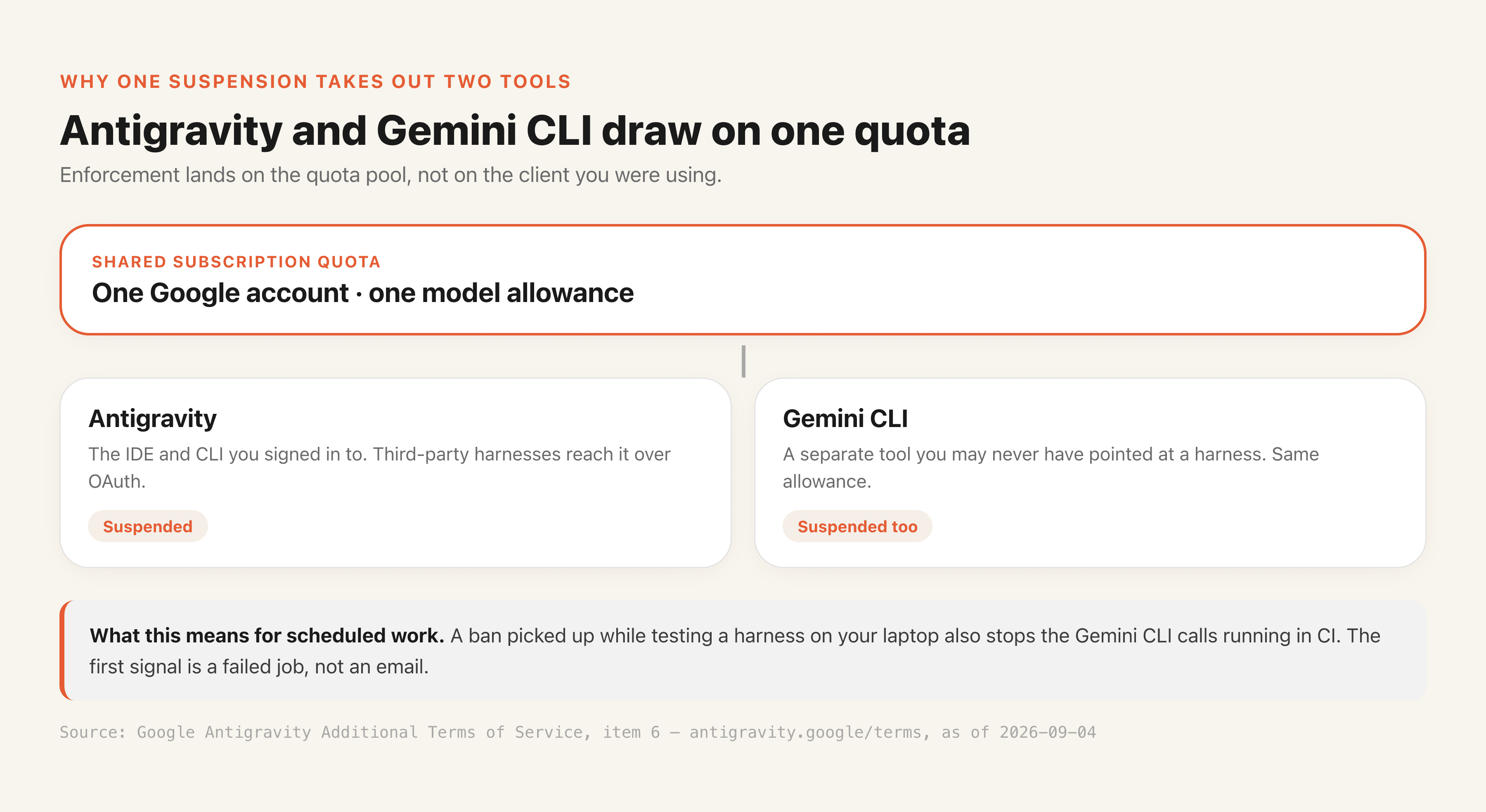
Practically, that means the blast radius of an Antigravity experiment is wider than the product you were experimenting with. If Gemini CLI is in a CI pipeline or a scheduled job somewhere, a suspension you picked up while testing a harness on your laptop takes that pipeline down too, and the first sign will be the job failing rather than an email.
This is the same shape as the OpenAI model cutoff that hit Cursor users: the vendor changes what a client is allowed to reach, and the thing that breaks is downstream of the decision, on a machine nobody touched that day. Access you didn't buy directly is access you don't control. That's the argument for keeping the agent work you depend on somewhere that isn't tied to a subscription you also use for other things, and it's the specific gap MoClaw covers, since the cloud computer your agents run on is a separate surface from the vendor accounts you're testing against.
How to Appeal a Suspension
There's no published appeals SLA, so treat anyone quoting you a turnaround time with suspicion. What does exist, from the terms themselves:
The document ends by pointing at the official Antigravity discussion forum for questions, and that's where the suspension threads have been getting attention from Google staff. Item 3 gives a support address, antigravity-support@google.com, though that one is specified for deleting your stored interaction data rather than for account recovery. The developers who reported getting access back described going through a support form and, in the cases that moved fastest, escalating publicly until someone from the team picked it up.
Before you file anything, disconnect the harness. An appeal while the OAuth integration is still running is an appeal against behaviour that's still happening.
Running Third-Party Agents Without Betting Your Subscription
Clause 6 doesn't say third-party harnesses are forbidden. It says using them to reach Google's service is a breach. OpenClaw with its own model credentials, pointed at a provider that permits it, isn't what this clause is about; the breach is the OAuth path into Antigravity's subsidised quota. If you want to keep running the harness, that's the line to stay on the right side of, and it's the same line Anthropic drew when it ended flat-rate subscription access for third-party agent frameworks in April 2026.
The pattern is now established enough to plan around rather than react to. Subsidised subscription quota is priced for the vendor's own client, and every vendor that has noticed a harness arbitraging that gap has closed it. Two have done it in five months.
Which leaves a practical question: where does the agent run, if not on a subscription that can be withdrawn while you're asleep? A scheduled agent needs a machine that stays up, and a laptop closed at midnight isn't one. That's the requirement MoClaw was built for, a hosted cloud AI computer that keeps running so scheduled work has somewhere to land, sitting alongside your existing setup instead of replacing it. Nothing about using it stops you running Antigravity in your IDE the way Google intends; the point is that the two don't share a failure mode, so a suspension on one doesn't take the other down. If you want the longer version of that trade-off, OpenClaw explained covers who self-hosting actually suits.
None of this makes Google the villain. Running a frontier model at subscription prices only works if consumption tracks a client the vendor controls, and a harness that spends the quota faster breaks that arithmetic. The reasonable complaint was never that the rule exists; it was that the rule was written vaguely enough to sound like it could cost you your email, and that one got fixed within a day.
FAQ
Can I use OpenClaw with Antigravity?
Not through Antigravity OAuth. Clause 6 of the Antigravity Additional Terms names that exact combination as a breach of the agreement, and lists suspension or termination of your Antigravity and Gemini CLI accounts as possible consequences. Running OpenClaw against a different provider, with credentials that provider allows, isn't covered by this clause.
Why was my Antigravity account suspended without warning?
Multiple developers have reported exactly this through 2026: no email, no in-product notice, just an access failure. Abuse detection runs behind the API rather than in the client, so the first signal is usually a failed request. As of September 4, 2026 Google hasn't published a notification policy for these suspensions.
Does an Antigravity ban affect my whole Google account?
The terms as written on September 4, 2026 scope it to "your Antigravity and/or Gemini CLI accounts," and Antigravity's team stated publicly on September 3 that the update was meant to make exactly that clear. Users who reported bans said their other Google accounts and services kept working. The open question Orosz raised is whether Google's universal terms, which the Antigravity document incorporates by reference, allow broader action; Google hasn't answered that.
Why did my Gemini CLI stop working?
Antigravity and Gemini CLI share a quota pool, so enforcement against one surface hits the other. This is now stated directly in the terms rather than being something you find out afterwards.
How long does an Antigravity suspension appeal take?
There's no published timeline. Reported outcomes ranged from same-day restoration through a support form to no resolution for weeks. Anyone quoting you a specific number is not citing Google.
Continue Reading
More Guide
MiniMax M3 Free Ended: What to Use Instead

MarkItDown: When Your Markdown Comes Back Thin

Lightpanda Is Fast Because of What It Skips

OpenAI Deprecated Its Codex Skills Repo

Open Science: The AI Workbench for Researchers

How to Use GPT-6 Astra: What It Really Costs
The MoClaw editorial team writes about workflow automation, AI agents, and the tools we build. Default byline for industry overviews, listicles, and collaborative pieces.
Ready to put this into practice?
MoClaw runs browser tasks, research, and schedules automatically. Try it free.
References: Google Antigravity Additional Terms of Service · Hacker News: Google Antigravity TOS discussion (278 points) · Official Google Antigravity discussion forum · google-gemini/gemini-cli (GitHub) · Anthropic Commercial Terms of Service