Free AI Agent: Where Each Free Tier Stops

Which AI agents are actually free? Genspark gives about one deep research a day, Skywork 120 credits a day, and ChatGPT puts its agent behind $20.
Table of Contents
Most free AI agents give you roughly one useful task per day, and the ones that don't publish a number are usually the ones with the smallest allowance. Genspark says about one deep research daily. Skywork hands out 120 credits for logging in. ChatGPT doesn't include its agent below $20 a month, and neither does Claude.
We went through the pricing screens of each of these on August 11, 2026, including two that hide their prices behind a login, and wrote down what was actually there. Everything below has a date on it, because half of what's published about free AI agent tiers was true nine months ago.
Key Takeaways:
- Genspark's free tier is around 1 Deep Research, 1 Data Search and 1 Fact Check per day, which is the clearest published free allowance we found.
- Skywork lists "120 credits/day, login bonus" on all three of its paid cards, not as a separate free plan.
- Manus currently shows no free plan card on its pricing page at all, while its own documentation still describes one.
- OpenAI's "Work agent for multi-step tasks" starts at ChatGPT Plus, $20/month. The $8 Go tier doesn't list it, and carries a note that it may include ads.
- Every free tier here resets daily, so none of them can be saved up for a heavy week, and none can run a job while you're asleep.
Free AI Agent Options, Measured Instead of Advertised
Here's what each vendor publishes, read directly from their own screens on August 11, 2026:
| Product | Free allowance as published | Entry paid tier | Where the agent starts |
|---|---|---|---|
| Genspark | ≈1 Deep Research, 1 Data Search, 1 Fact Check per day | $19.99/mo billed annually | Free tier includes agents |
| Skywork | 120 credits/day login bonus, listed on paid cards | $12.50/mo (list $19.99) | Cloud PC starts at Plus, $33.32 |
| Manus | No free card shown on pricing page | $20/mo, 4,000 credits | All paid tiers |
| ChatGPT | Not listed on the upgrade screen | $8/mo Go, no agent row | Work agent at Plus, $20 |
| Claude | Free plan exists, no Claude Code | $20/mo Pro | Claude Code at Pro, $20 |
Two things jump out of that table. The first is that $20 has become the price of an agent almost everywhere; OpenAI and Anthropic landed on the same number independently, and Manus sits there too. The second is that Skywork, which hands out one of the more usable free allowances here, is the only one whose prices you cannot reach without an account at all.
Genspark publishes its ladder on the upgrade screen: $19.99, $39.99 and $199.99 a month billed annually, carrying 10,000, 21,000 and 125,000 credits. Skywork publishes nothing comparable; skywork.ai drops you straight into the workspace, and the pricing route never loads a comparison. You can find out what Skywork gives away free long before you can find out what it charges.
Genspark Publishes a Number, Which Almost Nobody Else Does
Genspark's pricing page carries a table headed "Equivalent to X times of Interactions." Free gets about 1 Deep Research per day; Plus gets about 50 per month; Pro gets about 625 per month. Fact Check runs slightly lower across every column, roughly 40 and 500 against 50 and 625, which suggests fact checking pulls more tool calls than its name implies.
That framing deserves credit. Denominating a tier in tasks rather than credits is the difference between a budget and a guess, and Genspark is close to alone in doing it.
One number they don't publish, you can derive. The Credits Pack column lists 7,500 credits as roughly 38 Deep Research runs, which works out to about 197 credits per run. That's the only implied per-task rate any of these vendors exposes, and it lets you convert a credit balance into work before you've spent anything.
The gap in their disclosure is Super Agent, the flagship. Its row spans all four columns with one sentence saying consumption varies by conversation length, tool usage and model complexity. So the free tier is predictable for the three named agents and unpredictable for the one most people signed up to try.
Where Manus and Skywork Actually Put Their Daily Credits
Both of these put a daily refresh on their paid cards, which changes what "free" means.
Manus lists "300 refresh credits everyday" on all three tiers: $20 for 4,000 monthly credits, $40 for 8,000, $200 for 40,000. There's no free card on that page. The Manus documentation still describes a Free Plan with "limited monthly credits," so the company's own two surfaces disagree, and we've left that contradiction as we found it rather than picking a side.
Run the arithmetic on the daily refresh and it turns out to matter more than the headline. Three hundred credits a day is 9,000 a month, which is more than twice the entry tier's own 4,000 allowance. Most of what a $20 Manus subscriber can spend arrives in 300 credit slices, one day at a time, and can't be banked.
Skywork does the same thing with a different number. Its upgrade screen prints "120 credits/day, login bonus" on Basic, Plus and Ultra alike, with monthly allowances of 10,000, 28,000 and 150,000 credits at $12.50, $33.32 and $158.32 against list prices of $19.99, $49.99 and $249.99. The word "login" is doing quiet work there: the bonus rewards showing up, so an automation running unattended collects nothing.
ChatGPT and Claude Both Price the Agent at $20
OpenAI's upgrade screen separates agents into two named products. "Work agent for multi-step tasks" and "Codex agent for coding" both appear first on ChatGPT Plus at $20/month. The $8 Go tier lists five features, all of them quantity increases over free, with no agent row anywhere. Under the Go card sits a line reading "This plan may include ads," which neither Plus nor Pro carries.
Above Plus, Pro comes in two flavours selected by a toggle: $100 a month for 5x more usage than Plus, or $200 for 20x. The feature lists are otherwise identical, so that decision is arithmetic rather than judgement.
Anthropic landed in the same place. Claude's pricing puts Claude Code inside the $20 Pro tier and leaves it out of Free entirely.
Two companies with very different products converging on the same number isn't coincidence; it's what happens when the marginal cost of running an agent turns out to be similar for everyone. Expect $20 to hold as the floor until inference gets meaningfully cheaper.
The Wall Is the Same Wall Every Time
Google's People Also Ask box for these queries reads like a support queue. Search "manus ai free" and it returns "Why is Manus AI not giving free credits?" alongside "Is there any way to get Manus AI for free?" Search "skywork ai free" and you get "How to use skywork ai for free?" and "Does Skywork AI offer a free trial?"
Those aren't research questions. They're the questions people type after something stopped working.
The search results say the same thing from another angle. On the Manus pricing results page, two of the top ten are threads in r/ManusOfficial, one titled around the credit system being unreasonably expensive and another arguing the product is overpriced for what it delivers. Reddit threads rank on a pricing query when the vendor's own page doesn't answer the question, and the question here is always the same one: how many runs do I get.
The second organic result for "manus ai free" is Manus's own help article about daily refresh credits not refreshing. When a troubleshooting page ranks on a free-tier query, the free tier isn't really the topic. The topic is being stuck. What none of this reveals is what those people do next, since no vendor publishes how many of them upgrade and how many simply close the tab.
What Free Tiers Are Genuinely Good For
We're not going to pretend these tiers are worthless, because for one pattern they're genuinely the right answer.
If you run one research pass a week and occasionally check a fact, Genspark's free tier covers you outright and upgrading would be waste. If you want to find out whether an agent can handle your kind of work at all, 120 Skywork credits or one Genspark run per day is enough to learn that. Sampling is what these tiers are built for, and they do it well.
Where they fall apart is iteration. Getting a research prompt right usually takes four or five attempts, and on a daily cap those attempts live on separate days, which means you lose the thread between them. Anyone who has tried to tune a workflow across a week of one-shot-per-day attempts knows the feeling; by Thursday you can't remember what you changed on Tuesday.
Bursts break them too. Four vendor comparisons before a Thursday meeting is four days of free tier, so you needed to start on Monday, and nobody starts on Monday.
The One Thing No Daily Free Tier Can Do
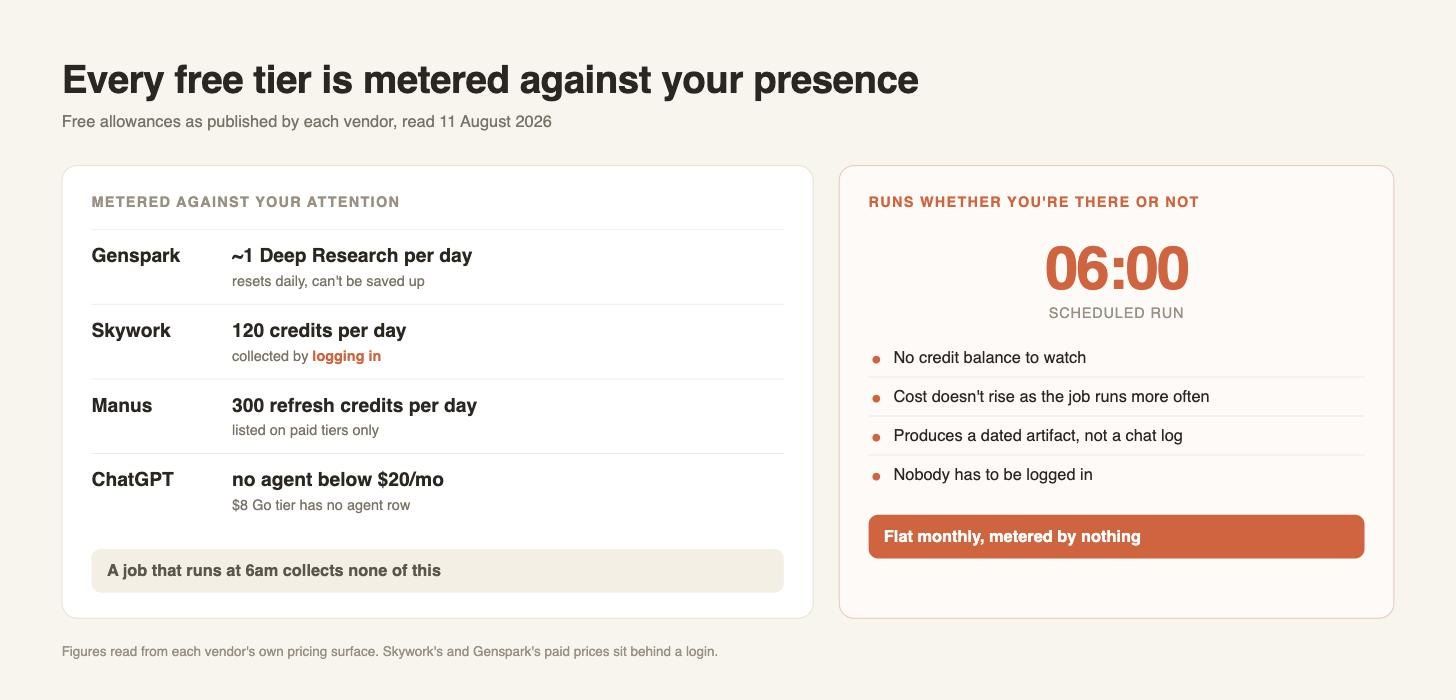
Read back through every allowance above and one property is shared by all of them. They're metered against your attention.
Skywork's 120 credits are a login bonus, so you collect them by showing up. Genspark's daily run resets whether or not you use it, so it rewards presence. Manus refreshes 300 credits each day on the same logic. Every one of these models assumes a human sitting at the screen deciding what to spend.
That assumption holds fine for work you ask for and breaks completely for work that should already be done. A competitor sweep that runs at 6am, a report assembled before you open your laptop, a monitor that stays quiet until something changes: none of those involve a person deciding to spend a credit, and a login bonus is worth precisely nothing to a job that runs while you're asleep.
This is the gap MoClaw was built for, and it's worth being exact about what it is and isn't. MoClaw is a hosted cloud AI computer that runs scheduled agents on a flat monthly subscription. It doesn't meter per task, so a job that runs every weekday doesn't cost more as you extend it, and it doesn't need you present to collect anything. It's also not free, and it's not a replacement for asking an agent a question in a chat window, which the products above do well.
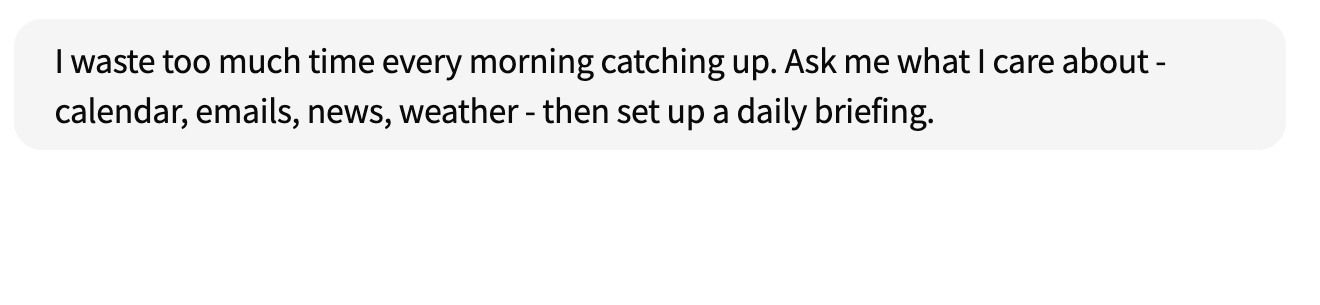
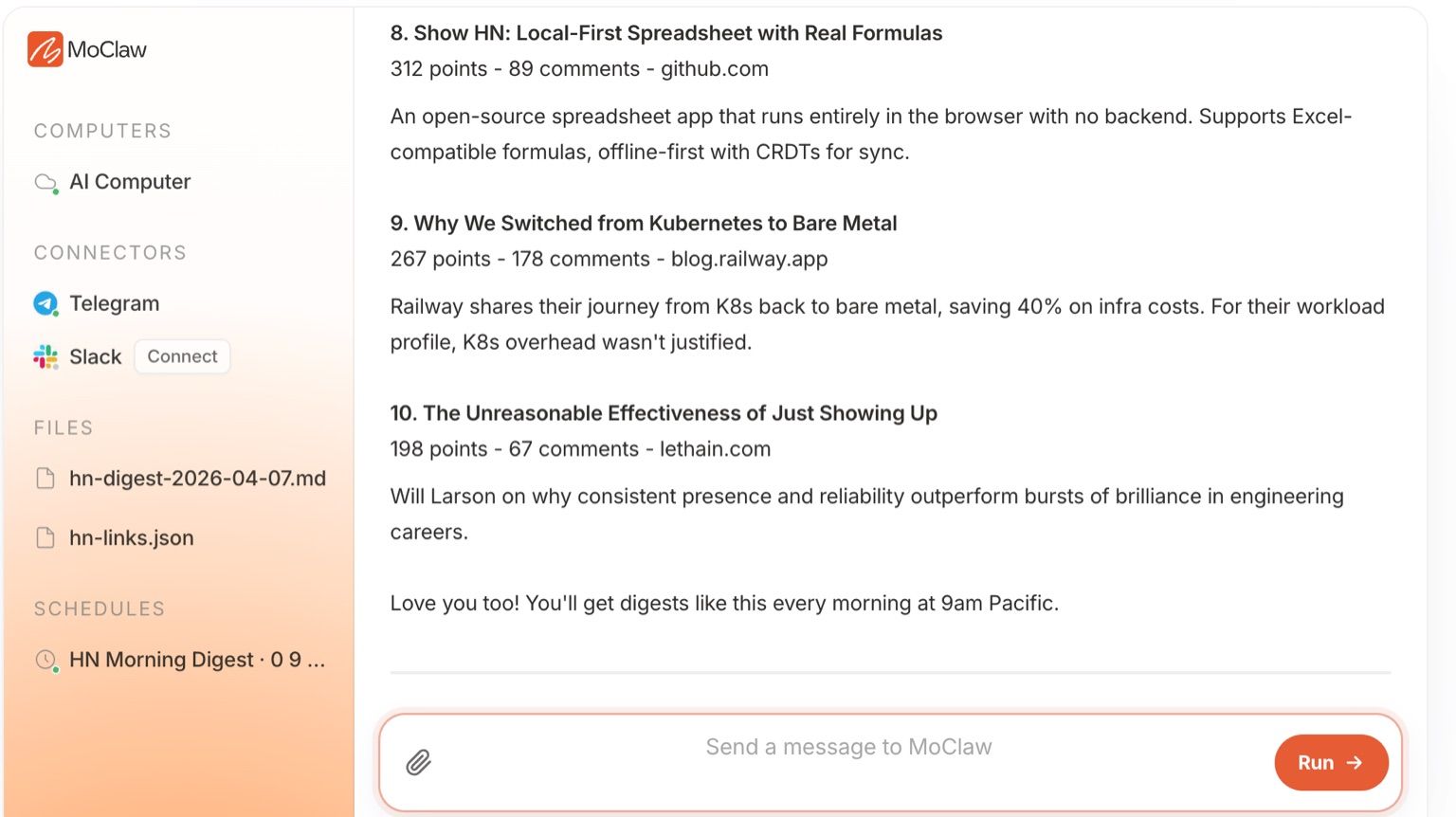
The honest framing is that these are different purchases. Free tiers price curiosity. Scheduled work is a different problem, and no daily allowance solves it at any tier, including the $200 ones.
If you're comparing on cost rather than shape, we've written the closer comparisons separately: a cheaper alternative to Manus AI and the wider Manus AI alternatives.
FAQ
What is the best free AI agent right now?
Genspark, if you want a free tier you can plan against; it publishes roughly one Deep Research, one Data Search and one Fact Check per day. Verified August 11, 2026.
Is Manus AI free?
Its pricing page currently shows three paid cards and no free card, while its documentation still describes a Free Plan with unspecified credits. We covered that contradiction in is Manus AI free.
Does ChatGPT have a free AI agent?
No. "Work agent for multi-step tasks" first appears on ChatGPT Plus at $20/month, and it isn't listed on the $8 Go tier. More detail in is ChatGPT agent free.
How many free credits does Skywork give?
120 credits per day, described as a login bonus, printed on all three paid cards. Full numbers in is Skywork AI free.
Can I run a free AI agent on a schedule?
Not meaningfully. Daily allowances reset rather than accumulate, and Skywork's is explicitly a login bonus, so unattended jobs collect nothing.
Are open-source agents a better free option?
They remove the licence cost and hand you the hosting, credentials and uptime instead. That's a genuine trade rather than a free lunch, and it only works out if your own time is cheap.
Reading a Free Tier Before You Build On It
Three questions settle almost every one of these, and none of them is "how many credits do I get."
Does the vendor publish the tier in tasks or in credits? Tasks you can plan against; credits you can't, until you've measured your own consumption. Does the allowance reset daily or accumulate monthly? A daily reset is fine for steady work and useless for bursts. And does collecting it require you to log in? If it does, no automation you write will ever benefit from it.
Run your three most typical tasks on whichever tier you're evaluating and write down the balance before and after each one. That single measurement, credits per task for your work, turns every table in this article into a decision. It's also the number none of these vendors will give you, which is why the search results for their pricing are full of Reddit threads instead of documentation.
All figures here were read from vendor pricing screens on August 11, 2026. Skywork's entire ladder sits behind a login, so treat those figures as a dated observation rather than a rate card. Manus changed its entry-tier display during the day we were reading it, from a flat $20 to a promotional $10 first month. Vendor pricing moves, and Manus in particular is mid-integration into Meta after the acquisition announced in December 2025.
Continue Reading
More Comparison
Business Travel App vs AI Travel Agent Workflow

Travel Agency App vs AI Workflow for Clients

AI Copilot vs AI Agent for Recurring Work

Grok 4.5 vs GPT-5.5 for Agent Tasks

Opus 5 vs Fable 5: Two Different Rankings

Opus 5 vs Kimi K3: A Tie, Then a Choice
The MoClaw editorial team writes about workflow automation, AI agents, and the tools we build. Default byline for industry overviews, listicles, and collaborative pieces.
Choosing between tools? Let MoClaw run the work.
Always-on AI assistant on its own cloud computer. No switching required, no setup.
References: Genspark Pricing (official) · Manus Pricing Plans (official) · Claude pricing (Claude Code tier) · r/ManusOfficial thread on the credit system cost · r/ManusOfficial thread on Manus pricing versus output · Skywork (pricing visible only after login)