How to Access Claude Mythos 5.1 (Who Gets In)

How to access Claude Mythos 5.1: the vetted programs that grant it, why it is US-only, and what Fable 5.1 gives you instead. Verified Sept 2026.
Table of Contents
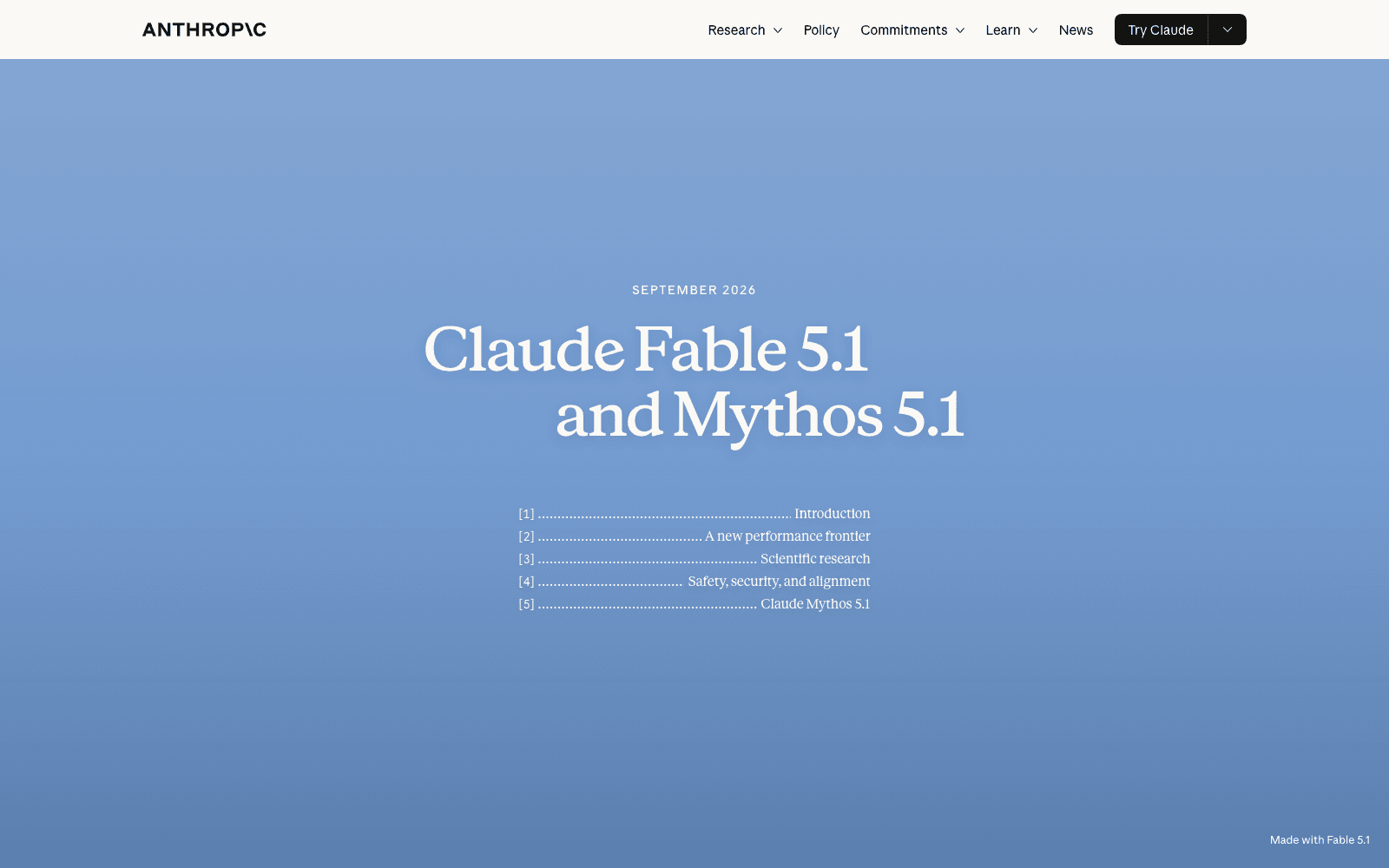
There is no signup button for Claude Mythos 5.1. If you are looking for how to access Claude Mythos, the honest answer is that Anthropic routes it through vetted access programs rather than a plan upgrade, and as of 2026-09-02 those programs are open only to US organizations. Anthropic announced Mythos 5.1 on September 1, 2026 alongside Claude Fable 5.1, and described the pair as "the same model, but with different levels of safeguards."
Key Takeaways:
- Mythos 5.1 and Fable 5.1 are the same underlying model. The gate is safeguard configuration, not capability.
- The API model ID is
claude-mythos-5-1, and per Anthropic's docs it "offers the same capabilities to Project Glasswing participants only." - Access runs through Project Glasswing, the Life Sciences Verification Program, and the Cyber Verification Program. The cyber program does not include Mythos yet.
- Anthropic states it can currently make Mythos available only to "a set of US organizations."
- Pricing starts at $10 per million input tokens and $50 per million output tokens, identical to Fable 5.1's headline rate.
What Claude Mythos 5.1 Is, and Why It Is Gated
Anthropic markets Mythos as "our most capable model for cybersecurity and biology research." That framing explains the lock. A model tuned to find exploitable flaws in real software is useful to defenders and equally useful to everyone else, so Anthropic ships two builds of the same weights: Fable 5.1 for general release, Mythos 5.1 for organizations it has checked.
The Claude docs put it bluntly: Mythos 5.1 "offers the same capabilities to Project Glasswing participants only." Anthropic's Mythos product page words the same restriction more broadly, saying the model "is available to vetted cyberdefenders and life scientists through our trusted access programs." Those two sentences do not describe identical gates, and if you are writing a procurement doc, the product page is the one that reflects the current program set.
What you do not get is a tier you can buy. No Claude Max plan, no enterprise contract, and no amount of API spend converts into Mythos access on its own.
How to Access Claude Mythos: The Programs That Grant It
Three programs currently sit between you and the model, and they screen for different things.
Project Glasswing is the big one. Anthropic launched it on April 7, 2026 to point frontier capability at securing critical software, with launch partners including AWS, Apple, Broadcom, Cisco, CrowdStrike, Google, JPMorganChase, the Linux Foundation, Microsoft, NVIDIA, and Palo Alto Networks. Anthropic says the program is expanding to roughly 150 new organizations across more than fifteen countries. If you maintain a browser, a widely deployed open source component, or internet infrastructure, this is your door, and Anthropic points open source maintainers at its Claude for Open Source program to apply.
The Life Sciences Verification Program is invite-only and still in beta. It grants reduced biology safeguards to advanced life scientists, which matters if your work keeps tripping refusals on ordinary wet-lab or clinical questions.
The Cyber Verification Program reduces cyber safeguards for defensive security work. Read the wording carefully before you plan around it: Anthropic says the program "will include access to Mythos models in the near future," so applying today buys you a place in line rather than a model ID. You apply through the Mythos access interest form.
Notice what none of these check. Not your token spend, not your company size, not whether you already run Claude in production. They check whether your work is defensive and whether Anthropic can verify who you are.
The US-Only Limit That Kills Most Applications
Buried in Anthropic's own copy is the line that ends the conversation for most readers: "Currently, we're only able to make it available to a set of US organizations, though we're working to expand access."
That is a jurisdiction test, not a capability test, and it is not something a stronger application overcomes. A European security vendor doing genuinely defensive work, with the exact profile Glasswing was built for, is out on geography alone. If you are outside the US, the practical move is to register interest so you are in the queue when the boundary moves, then build on Fable 5.1 in the meantime.
Mythos Access Has Already Been Revoked Once
The most useful thing on Anthropic's Mythos page is not the marketing copy, it is the announcement log. It records a model whose availability has moved twice this year.
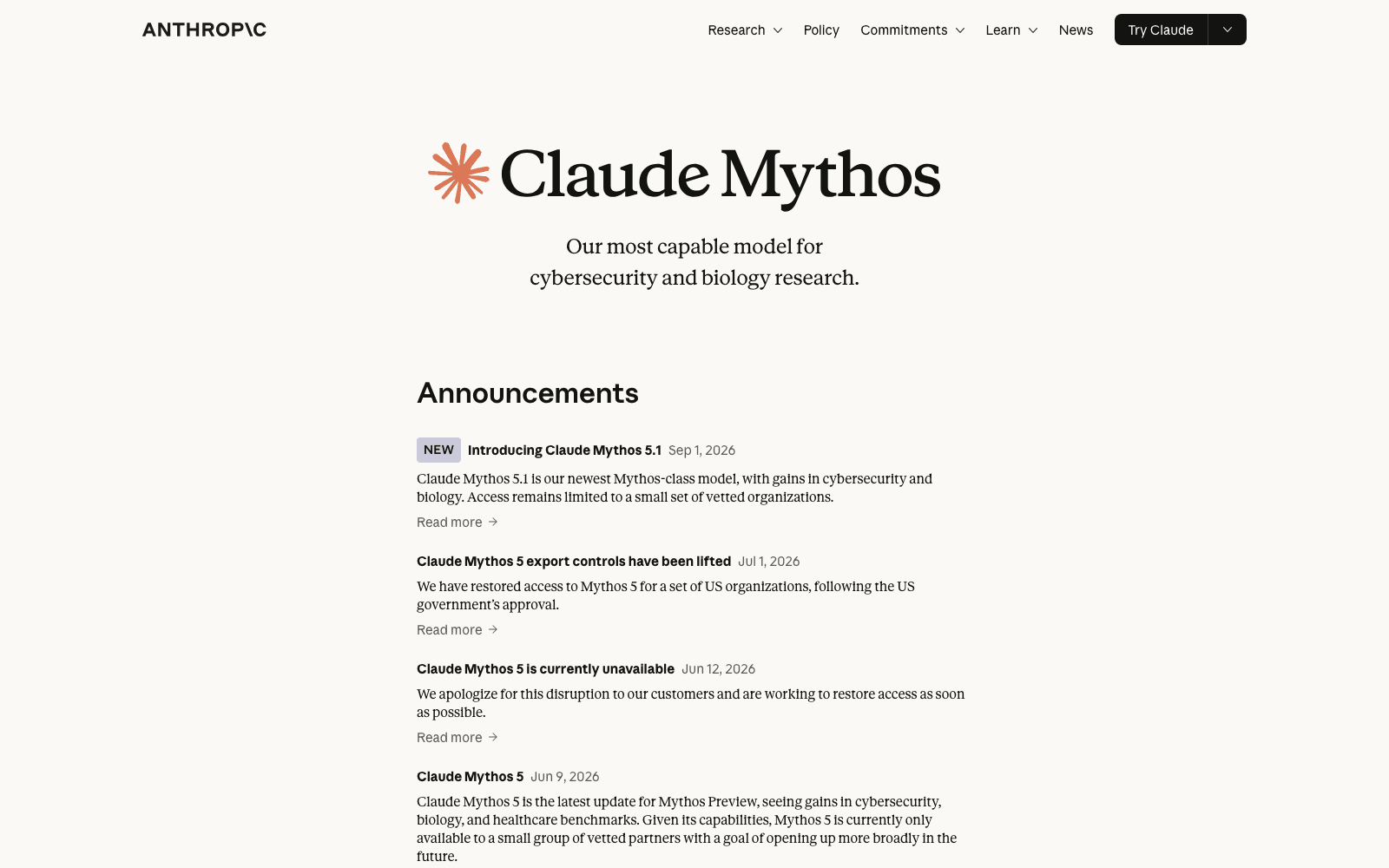
On June 9, 2026 Anthropic shipped Mythos 5 to "a small group of vetted partners." Three days later, on June 12, the page carried a flat notice that the model was "currently unavailable," with an apology for the disruption. Access came back on July 1 under the heading "Claude Mythos 5 export controls have been lifted," where Anthropic wrote that it had "restored access to Mythos 5 for a set of US organizations, following the US government's approval."
Then the September 1 entry for Mythos 5.1 repeats the same qualifier: "Access remains limited to a small set of vetted organizations."
Nineteen days of disruption inside a single quarter, driven by export control rather than engineering, is the part worth planning around. If a pipeline depends on a model whose availability answers to a government approval process, the failure mode is not a slow response, it is a model ID that stops resolving.
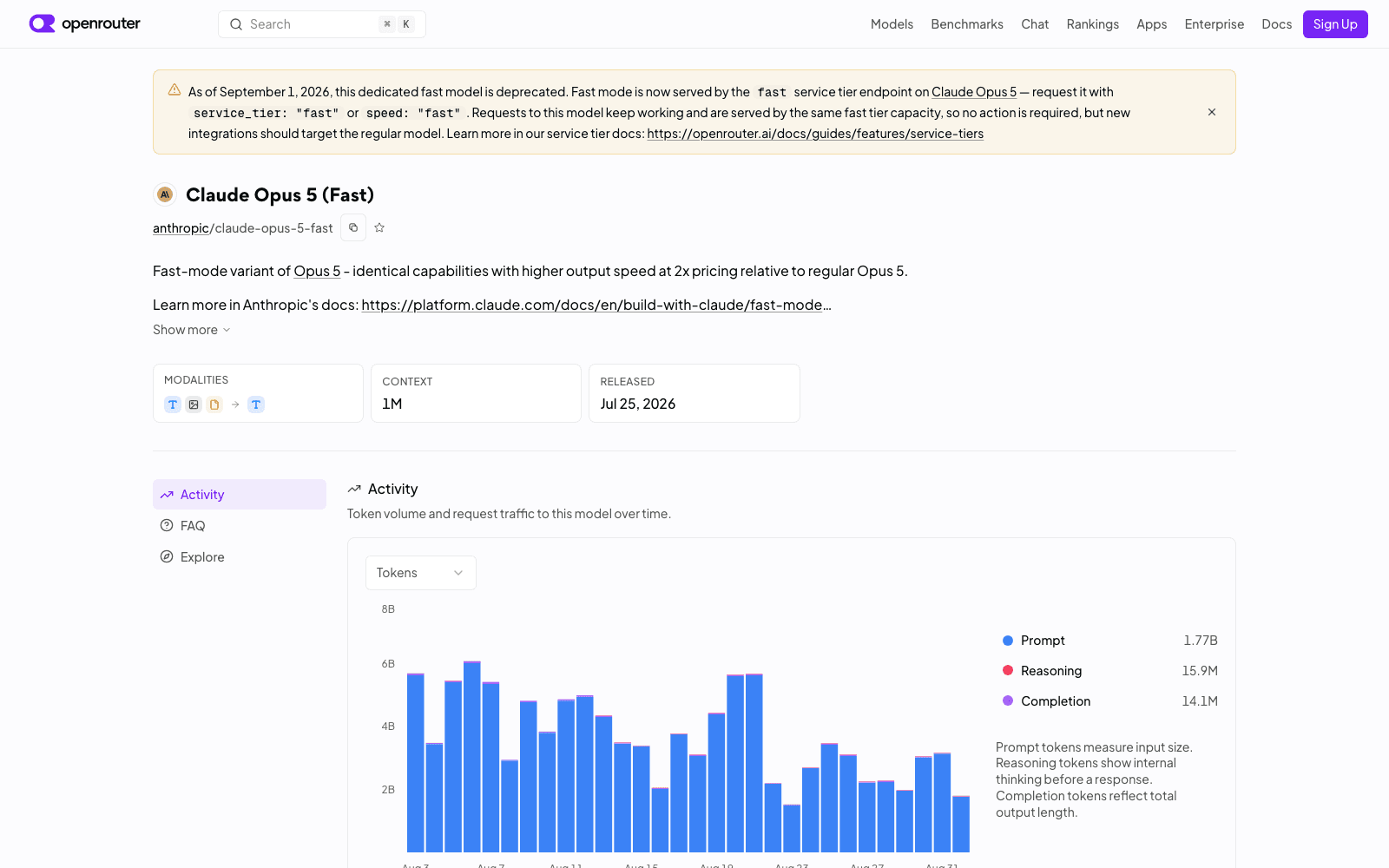
Model identifiers shift under you even when nobody breaks anything. On September 1, 2026 OpenRouter retired the dedicated anthropic/claude-opus-5-fast slug along with the 4.8 and 4.7 fast variants, folding fast mode into a fast service tier on the regular model; existing calls keep working on the same capacity, but the ids dropped off the model list and now report zero endpoints, so every new integration has to be written differently. That is the polite version of the problem. The Mythos version is a model that stops answering because an export approval lapsed. Either way, the thing your workflow points at is less permanent than it looks, which is the argument for putting a managed layer like MoClaw between your work and a specific vendor string.
Fable 5.1 Is the Same Model, and You Can Run It Today
Here is the part most "how to get Mythos" write-ups skip. Anthropic says the two models are the same thing with different safeguard settings, so for the overwhelming majority of work, Fable 5.1 is not a downgrade. It is the identical model with the guardrails left on.
Fable 5.1 also narrowed the gap that made people want Mythos in the first place. Anthropic reports that Fable 5.1's cybersecurity safeguards fire around 60% fewer interventions per session than Fable 5, and that biology safeguards trigger 85% less often on benign elementary biology and medical questions. If your reason for chasing Mythos was that Claude kept refusing routine security or clinical work, that reason got substantially weaker on September 1. We covered the older version of this failure in why Claude switched models mid-task, where over-broad safeguards pushed sessions onto a fallback model.
The specifics, from Anthropic's model comparison table as of 2026-09-02:
| Claude Fable 5.1 | Claude Mythos 5.1 | |
|---|---|---|
| API model ID | claude-fable-5-1 |
claude-mythos-5-1 |
| Availability | General release | Vetted access programs, US only |
| Input / output per MTok | $10 / $50 | From $10 / $50 |
| Cache reads | $0.25 per MTok | $0.25 per MTok |
| Context window | 1M tokens | Same capabilities |
| Max output | 128K tokens | Same capabilities |
| Retirement no sooner than | September 1, 2027 | Not published |
Cache reads are the number that moved. On Fable 5.1 they cost 2.5% of the base input rate instead of the usual 10%, which takes a cached million-token read from $1.00 down to $0.25. For an agent that re-reads the same repository or corpus on every turn, that is the line item that decides whether the run is affordable.
Where Long-Running Agent Work Actually Breaks
Fable 5.1 is built for jobs measured in hours rather than seconds. Anthropic positions it for "agent sessions that run for hours, multistep deep research, analysis carried through to a finished document, spreadsheet, or deck," with adaptive thinking always on and effort defaulting to high.
An hours-long agent session has a requirement that has nothing to do with the model: something has to stay awake for the duration. A laptop that sleeps when you close the lid is not that thing, and neither is a terminal session that dies with your SSH connection. That gap is what MoClaw fills, running Fable 5.1 as a hosted cloud AI computer with persistent memory and scheduling already wired, alongside whatever you already have rather than in place of it. You keep your Claude subscription and your own API keys pointed wherever they point; the hosted layer is just where the long jobs go to survive the night.
Access is the easy half of this problem, which is also the lesson of our guide to every Claude Opus 5 access path. Getting the model is a form. Keeping a multi-hour job alive on it is infrastructure.
What Mythos 5.1 Costs Once You Are Approved
Anthropic lists Mythos 5.1 pricing as starting at $10 per million input tokens and $50 per million output tokens, matching Fable 5.1's headline rate, with cache reads at the same 2.5% of base input. All figures as of 2026-09-02.
The word doing the work is "starts." Earlier Mythos preview material carried a materially higher $25 / $125 per million rate for the post-preview period, so treat $10 / $50 as a floor tied to a specific program tier rather than a quote. If the number matters to a budget, get it in writing from whichever program admits you.
There is no free tier, no trial, and no consumer plan that includes it. Cost is genuinely not the barrier here; eligibility is. Teams that clear the vetting are rarely the teams worried about the per-token rate. That asymmetry is worth naming: if you are on the wrong side of the gate and simply want the capability in hand this week, MoClaw opens with a 3-day free trial and 1,000 credits, which answers "can I get access" on a timescale a vetting queue cannot.
FAQ
Can individuals get Claude Mythos 5.1?
No. Every current path admits organizations, not people. Individual open source maintainers are the closest exception, and they apply through the Claude for Open Source program rather than as individuals buying access.
What is the Claude Mythos 5.1 model ID?
claude-mythos-5-1. Having the string does nothing without program approval on your account, since the gate is entitlement rather than a hidden endpoint.
Is Mythos 5.1 smarter than Fable 5.1?
Not in capability. Anthropic describes them as the same model with different safeguard levels, so the difference you would notice is fewer refusals on cybersecurity and biology work, not better reasoning.
How long does Mythos access take to approve?
Anthropic publishes no timeline. The Cyber Verification Program has not started including Mythos yet, and Project Glasswing has run on invitation and partnership since April 2026, so plan in quarters.
Is Claude Mythos available outside the US?
Not currently. Anthropic states it can only make Mythos available to a set of US organizations while it works to expand access.
Apply for Mythos, Build on Fable 5.1
Every workable answer to how to access Claude Mythos runs through a vetting queue, so treat it as a procurement track with a long, uncertain timeline and get the interest form submitted if your organization plausibly qualifies as a US cyberdefender or life sciences lab. Then ignore it and ship. Anthropic has said the capability is identical, cut the false refusals that made the restricted build attractive, and priced cached reads low enough that long agentic runs stopped being a budget question. Waiting on a program that has revoked access once already, for a model that would not change what your agent can do, is the expensive choice. For a sense of where Fable sits against the rest of the lineup, our Opus 5 versus Fable 5 comparison breaks down which one to reach for by workload.
Continue Reading
More Guide
MiniMax M3 Free Ended: What to Use Instead

MarkItDown: When Your Markdown Comes Back Thin

Lightpanda Is Fast Because of What It Skips

OpenAI Deprecated Its Codex Skills Repo

Open Science: The AI Workbench for Researchers

How to Use GPT-6 Astra: What It Really Costs
The MoClaw editorial team writes about workflow automation, AI agents, and the tools we build. Default byline for industry overviews, listicles, and collaborative pieces.
Ready to put this into practice?
MoClaw runs browser tasks, research, and schedules automatically. Try it free.
References: https://www.anthropic.com/claude-fable-and-mythos-5-1 · https://www.anthropic.com/claude/mythos · https://platform.claude.com/docs/en/about-claude/models/choosing-a-model · https://platform.claude.com/docs/en/models/overview · https://anthropic.com/glasswing · https://claude.com/form/mythos-access-interest · https://openrouter.ai/docs/guides/features/service-tiers